AQA · A-Level · History
Course version: 7042 · Version from Sept 2017
Germany, 1918–1945 – The impact of War, 1939–1945 (A-level only): Policies…
Full specification wording
2O Democracy and Nazism: Germany, 1918–1945 – The impact of War, 1939–1945 (A-level only): Policies towards the Jews and the ‘untermenschen’ during wartime; the Wannsee Conference and the 'Final Solution'
Wartime radicalised Nazi racial policies, escalating persecution into systematic extermination.
Checked against the AQA 7042 specification (opens in a new tab) on .
- Point 3 of 4
- 3 key terms
Study notes
From the checked teaching notes for this specification point.
The idea
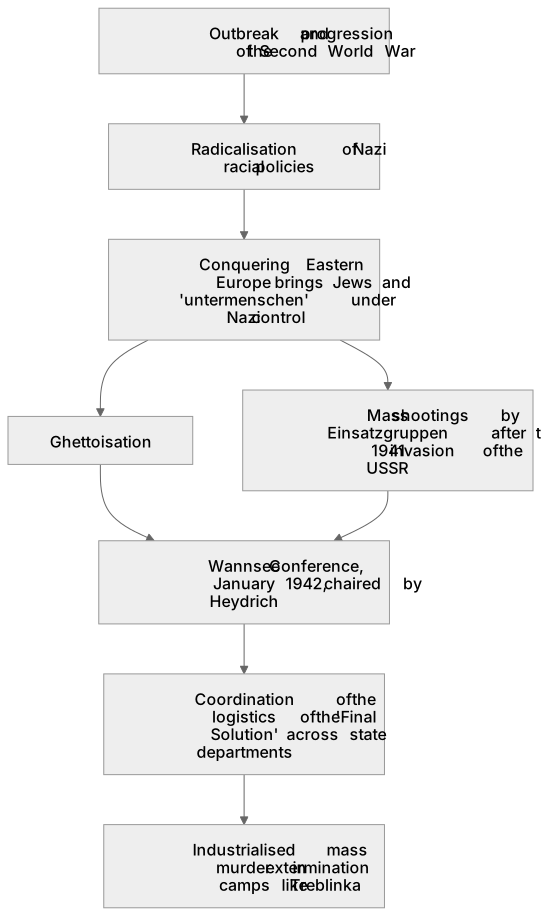
Wartime radicalised Nazi racial policies, escalating persecution into systematic extermination. Conquering Eastern Europe brought millions of Jews and 'untermenschen' (subhumans), including Roma and Soviet prisoners, under Nazi control. Initial wartime policies featured ghettoisation and mass shootings by Einsatzgruppen after the 1941 invasion of the USSR. The January 1942 Wannsee Conference, chaired by Heydrich, did not initiate the Holocaust but coordinated the logistical implementation of the 'Final Solution' across state departments. This facilitated the industrialised mass murder of Jews in extermination camps like Treblinka, representing the horrific culmination of Nazi racial ideology amidst the chaos of global conflict.
What earns the marks
- Explain the radicalisation of racial policies due to the outbreak and progression of the Second World War.
- Detail the treatment of 'untermenschen', including the starvation and execution of Soviet POWs and the persecution of the Roma.
- Analyse the role of the Einsatzgruppen in the transition to mass killings in the East.
- Evaluate the significance of the Wannsee Conference in coordinating the logistics of the 'Final Solution'.
- Assess the structuralist versus intentionalist historical debates regarding the decision-making process for the 'Final Solution'.
Common mistakes and how to put them right
Claiming the Wannsee Conference was where the decision to exterminate the Jews was made.
Put it right by explaining it was a meeting to coordinate the logistics of an already ongoing extermination process.
Focusing solely on the Jewish experience.
Put it right by ensuring the treatment of other 'untermenschen', such as Soviet POWs and Roma, is also addressed.
Treating the 'Final Solution' as a pre-planned blueprint from 1933.
Put it right by discussing the cumulative radicalisation and the impact of the war on escalating policies.
Exam tips
- Use specific examples of policies, such as the Madagascar Plan or the General Government ghettos, to demonstrate the evolution of Nazi plans before the 'Final Solution'.
- When discussing the Wannsee Conference, explicitly mention the coordination between the SS and various civil service departments.
- Engage with historical interpretations (e.g., intentionalist vs structuralist) to evaluate how and why the 'Final Solution' emerged during the war.
Try the lesson
The start of the 2O Democracy and Nazism: Germany, 1918–1945 – The impact of War, 1939–1945 (A-level only): Policies towards the Jews and the ‘untermenschen’ during wartime; the Wannsee Conference and the 'Final Solution' lesson, made from checked teaching notes for this specification point.
Have a go first
What was the primary purpose of the Wannsee Conference held in January 1942?
Listen
Wartime radicalised Nazi racial policies, escalating persecution into systematic extermination. Conquering Eastern Europe brought millions of Jews and 'untermenschen' (subhumans), including Roma and Soviet prisoners, under Nazi control. Initial wartime policies featured ghettoisation and mass shootings by Einsatzgruppen after the 1941 invasion of the USSR. The January 1942 Wannsee Conference, chaired by Heydrich, did not initiate the Holocaust but coordinated the logistical implementation of the 'Final Solution' across state departments. This facilitated the industrialised mass murder of Jews in extermination camps like Treblinka, representing the horrific culmination of Nazi racial ideology amidst the chaos of global conflict. A strong answer earns marks for these points. Explain the radicalisation of racial policies due to the outbreak and progression of the Second World War. Detail the treatment of 'untermenschen', including the starvation and execution of Soviet POWs and the persecution of the Roma. Analyse the role of the Einsatzgruppen in the transition to mass killings in the East. Evaluate the significance of the Wannsee Conference in coordinating the logistics of the 'Final Solution'. A common slip: Claiming the Wannsee Conference was where the decision to exterminate the Jews was made. Instead, explaining it was a meeting to coordinate the logistics of an already ongoing extermination process. Exam tip: Use specific examples of policies, such as the Madagascar Plan or the General Government ghettos, to demonstrate the evolution of Nazi plans before the 'Final Solution'.
See it
Key words
Say what each word means before you turn the card.
Radicalisation and escalation
Try answering aloud or in your head before turning the card.
State bureaucracy and coordination
Try answering aloud or in your head before turning the card.
Historical controversy and interpretation
Try answering aloud or in your head before turning the card.
See every definition
- Radicalisation and escalation
- Wartime radicalised Nazi racial policies, escalating persecution into systematic extermination.
- State bureaucracy and coordination
- The January 1942 Wannsee Conference, chaired by Heydrich, did not initiate the Holocaust but coordinated the logistical implementation of the 'Final Solution' across state departments.
- Historical controversy and interpretation
- Structuralist versus intentionalist historical debates concern the decision-making process for the 'Final Solution'.
Label the diagram
Some boxes have lost their names. Pick the right name for each number.
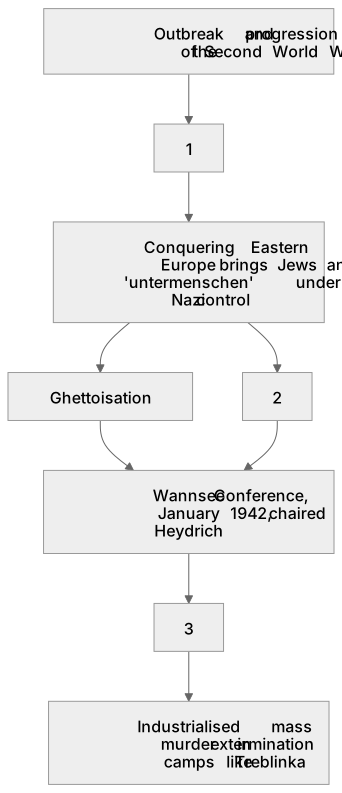
1Box 1
2Box 2
3Box 3
There is more to this lesson
The full lesson goes on to check your understanding and help you earn the marks. Create a free account to carry on, with your progress saved.
A week of Premium from your first lesson · Then the free plan continues · No card, no charge
Test your understanding of 2O Democracy and Nazism: Germany, 1918–1945 – The impact of War, 1939–1945 (A-level only): Policies towards the Jews and the ‘untermenschen’ during wartime; the Wannsee Conference and the 'Final Solution'
Active recall beats re-reading. Take an instant quiz now to test what you’ve learned and lock it into long-term memory.
A week of Premium from your first lesson · Then the free plan continues · No card, no charge