AQA · A-Level · History
Course version: 7042 · Version from Sept 2017
Germany, 1918–1945 – The impact of War, 1939–1945 (A-level only): The…
Full specification wording
2O Democracy and Nazism: Germany, 1918–1945 – The impact of War, 1939–1945 (A-level only): The wartime economy and the work of Speer; the impact of bombing; the mobilisation of the labour force and prisoners of war
Germany's wartime economy initially struggled with inefficiency.
Checked against the AQA 7042 specification (opens in a new tab) on .
- Point 2 of 4
- 4 key terms
Study notes
From the checked teaching notes for this specification point.
The idea
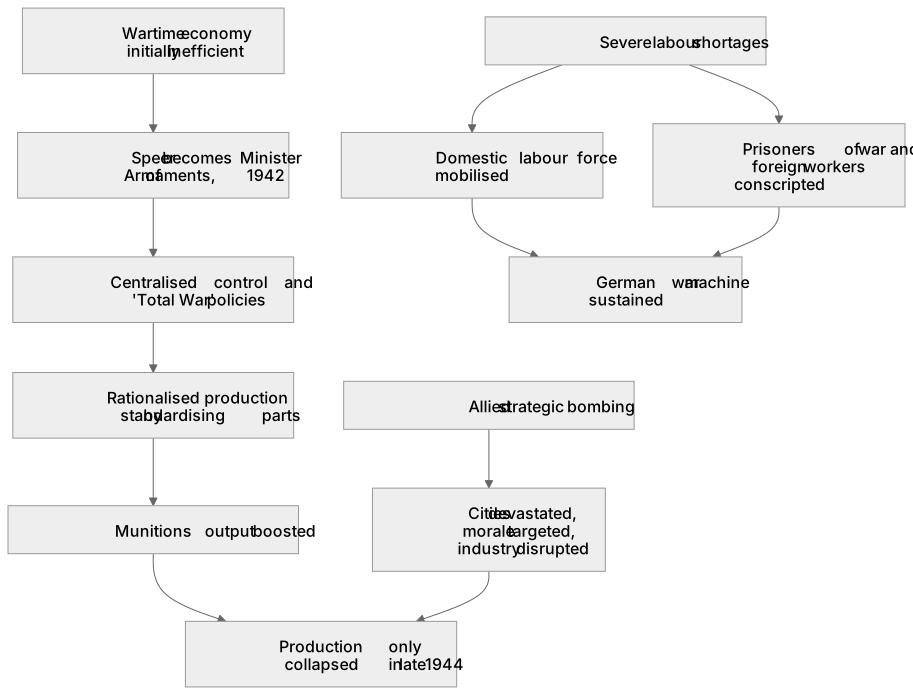
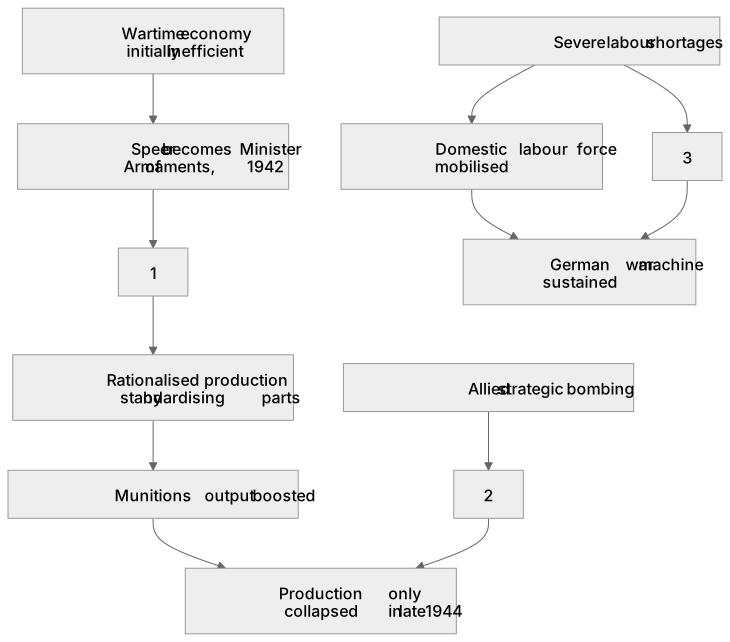
Germany's wartime economy initially struggled with inefficiency. In 1942, Albert Speer became Minister of Armaments, centralising control and implementing 'Total War' policies. Speer rationalised production by standardising parts, which dramatically boosted munitions output despite Allied strategic bombing. This bombing devastated cities like Hamburg, aiming to break morale and disrupt industry, though production only collapsed in late 1944. To meet severe labour shortages, the regime mobilised the domestic labour force, but relied heavily on forced labour. Millions of prisoners of war and foreign workers were conscripted into brutal conditions in factories and agriculture, becoming essential to sustaining the German war machine.
What earns the marks
- Evaluate the effectiveness of Albert Speer's rationalisation policies in increasing armaments production between 1942 and 1944.
- Analyse the economic and psychological impact of Allied strategic bombing on German cities and industrial output.
- Assess the extent to which the German wartime economy depended on the exploitation of prisoners of war and foreign forced labour.
- Examine the limitations of the domestic mobilisation of the labour force, including the delayed conscription of women into industry.
- Compare the chaotic economic management of the early war years (1939-1941) with the centralised control under Speer.
Common mistakes and how to put them right
Claiming that Speer was in charge of the economy from the start of the war.
Put it right: Speer only took over as Minister of Armaments in February 1942.
Stating that Allied bombing immediately halted German war production.
Put it right: Armaments production actually peaked in mid-1944 despite the bombing.
Confusing the domestic labour force with forced labour.
Put it right: Ensure a clear distinction is made between mobilised German civilians and enslaved prisoners of war.
Exam tips
- Use statistics to demonstrate the success of Speer's rationalisation, such as the tripling of ammunition production between 1942 and 1944.
- When evaluating the impact of bombing, distinguish between its effect on civilian morale and its actual disruption of industrial production.
- Highlight the ideological contradictions in the wartime economy, such as the reliance on 'subhuman' prisoners of war to sustain the Aryan war effort.
Try the lesson
The start of the 2O Democracy and Nazism: Germany, 1918–1945 – The impact of War, 1939–1945 (A-level only): The wartime economy and the work of Speer; the impact of bombing; the mobilisation of the labour force and prisoners of war lesson, made from checked teaching notes for this specification point.
Have a go first
What was Albert Speer's primary objective when he was appointed Minister of Armaments and War Production in 1942?
Listen
Germany's wartime economy initially struggled with inefficiency. In 1942, Albert Speer became Minister of Armaments, centralising control and implementing 'Total War' policies. Speer rationalised production by standardising parts, which dramatically boosted munitions output despite Allied strategic bombing. This bombing devastated cities like Hamburg, aiming to break morale and disrupt industry, though production only collapsed in late 1944. To meet severe labour shortages, the regime mobilised the domestic labour force, but relied heavily on forced labour. Millions of prisoners of war and foreign workers were conscripted into brutal conditions in factories and agriculture, becoming essential to sustaining the German war machine. A strong answer earns marks for these points. Evaluate the effectiveness of Albert Speer's rationalisation policies in increasing armaments production between 1942 and 1944. Analyse the economic and psychological impact of Allied strategic bombing on German cities and industrial output. Assess the extent to which the German wartime economy depended on the exploitation of prisoners of war and foreign forced labour. Examine the limitations of the domestic mobilisation of the labour force, including the delayed conscription of women into industry. Exam tip: Use statistics to demonstrate the success of Speer's rationalisation, such as the tripling of ammunition production between 1942 and 1944.
See it
Key words
Say what each word means before you turn the card.
Economic Rationalisation
Try answering aloud or in your head before turning the card.
Total War
Try answering aloud or in your head before turning the card.
Forced Labour
Try answering aloud or in your head before turning the card.
Strategic Bombing
Try answering aloud or in your head before turning the card.
See every definition
- Economic Rationalisation
- Speer rationalised production by standardising parts, which dramatically boosted munitions output despite Allied strategic bombing.
- Total War
- In 1942, Albert Speer became Minister of Armaments, centralising control and implementing 'Total War' policies.
- Forced Labour
- The regime relied heavily on forced labour, with millions of prisoners of war and foreign workers conscripted into brutal conditions in factories and agriculture.
- Strategic Bombing
- Allied bombing devastated cities like Hamburg, aiming to break morale and disrupt industry, though production only collapsed in late 1944.
Label the diagram
Some boxes have lost their names. Pick the right name for each number.
1Box 1
2Box 2
3Box 3
There is more to this lesson
The full lesson goes on to check your understanding and help you earn the marks. Create a free account to carry on, with your progress saved.
A week of Premium from your first lesson · Then the free plan continues · No card, no charge
Test your understanding of 2O Democracy and Nazism: Germany, 1918–1945 – The impact of War, 1939–1945 (A-level only): The wartime economy and the work of Speer; the impact of bombing; the mobilisation of the labour force and prisoners of war
Active recall beats re-reading. Take an instant quiz now to test what you’ve learned and lock it into long-term memory.
A week of Premium from your first lesson · Then the free plan continues · No card, no charge