AQA · A-Level · History
Course version: 7042 · Version from Sept 2017
Germany, 1918–1945 – The Nazi Dictatorship, 1933–1939 (A-level only):…
Full specification wording
2O Democracy and Nazism: Germany, 1918–1945 – The Nazi Dictatorship, 1933–1939 (A-level only): Hitler’s consolidation of power, March 1933–1934: governmental and administrative change and the establishment of the one-party state; the Night of the Long Knives and the impact of the death of President Hindenburg
Between March 1933 and August 1934, Hitler transformed Germany into a dictatorship.
Checked against the AQA 7042 specification (opens in a new tab) on .
- Point 1 of 4
- 4 key terms
Study notes
From the checked teaching notes for this specification point.
The idea
Between March 1933 and August 1934, Hitler transformed Germany into a dictatorship. Governmental and administrative changes began with the March 1933 Enabling Act, bypassing the Reichstag, and the April 1933 Civil Service Law, purging opponents. The establishment of a one-party state culminated in the July 1933 Law Against the Founding of New Parties, outlawing all opposition. To secure army support and eliminate rivals, Hitler orchestrated the Night of the Long Knives in June 1934, purging SA leadership including Röhm. Finally, the death of President Hindenburg in August 1934 allowed Hitler to merge the offices of Chancellor and President, becoming Führer and extracting a personal oath of loyalty from the army, completing his consolidation.
What earns the marks
- Explain how the Enabling Act (March 1933) provided the legal foundation for governmental change by allowing the cabinet to enact laws without Reichstag approval.
- Detail the process of Gleichschaltung (coordination) in administrative changes, such as the abolition of state assemblies and the purging of the civil service.
- Analyse the steps taken to establish a one-party state, including the banning of the KPD and SPD, and the voluntary dissolution of right-wing and centre parties before the July 1933 decree.
- Evaluate the Night of the Long Knives (June 1934) as a turning point that neutralised the SA threat, secured the allegiance of the regular army (Reichswehr), and established murder as a legitimate tool of state.
- Assess the impact of Hindenburg's death (August 1934), specifically how it removed the final constitutional check on Hitler's power and led to the army's personal oath to the Führer.
Common mistakes and how to put them right
Claiming Hitler became a dictator immediately upon being appointed Chancellor in January 1933.
Put it right: Emphasise that his power was initially limited by Hindenburg and a coalition cabinet; the consolidation took 18 months, culminating in August 1934.
Confusing the SA (Sturmabteilung) with the SS (Schutzstaffel) during the Night of the Long Knives.
Put it right: Specify that the SS, led by Himmler, carried out the purge against the SA leadership, led by Röhm.
Stating that the Enabling Act legally abolished the Reichstag.
Put it right: Note that the Reichstag continued to exist but was rendered powerless, serving merely as an audience for Hitler's speeches.
Exam tips
- When evaluating Hitler's consolidation of power, weigh the importance of legal measures (like the Enabling Act) against the use of violence and terror (like the Night of the Long Knives).
- Use the concept of 'pseudo-legality' to explain how the Nazis used existing constitutional mechanisms to dismantle the Weimar Republic from within.
- Connect Hindenburg's death directly to the army oath; this demonstrates an understanding of how the military became personally bound to Hitler rather than the state.
Try the lesson
The start of the 2O Democracy and Nazism: Germany, 1918–1945 – The Nazi Dictatorship, 1933–1939 (A-level only): Hitler’s consolidation of power, March 1933–1934: governmental and administrative change and the establishment of the one-party state; the Night of the Long Knives and the impact of the death of President Hindenburg lesson, made from checked teaching notes for this specification point.
Have a go first
What was the primary political consequence of the death of President Hindenburg in August 1934?
Listen
Between March 1933 and August 1934, Hitler transformed Germany into a dictatorship. Governmental and administrative changes began with the March 1933 Enabling Act, bypassing the Reichstag, and the April 1933 Civil Service Law, purging opponents. The establishment of a one-party state culminated in the July 1933 Law Against the Founding of New Parties, outlawing all opposition. To secure army support and eliminate rivals, Hitler orchestrated the Night of the Long Knives in June 1934, purging SA leadership including Röhm. Finally, the death of President Hindenburg in August 1934 allowed Hitler to merge the offices of Chancellor and President, becoming Führer and extracting a personal oath of loyalty from the army, completing his consolidation. A strong answer earns marks for these points. Explain how the Enabling Act (March 1933) provided the legal foundation for governmental change by allowing the cabinet to enact laws without Reichstag approval. Detail the process of Gleichschaltung (coordination) in administrative changes, such as the abolition of state assemblies and the purging of the civil service. Analyse the steps taken to establish a one-party state, including the banning of the KPD and SPD, and the voluntary dissolution of right-wing and centre parties before the July 1933 decree. Evaluate the Night of the Long Knives (June 1934) as a turning point that neutralised the SA threat, secured the allegiance of the regular army (Reichswehr), and established murder as a legitimate tool of state. A common slip: Claiming Hitler became a dictator immediately upon being appointed Chancellor in January 1933. Instead, Emphasise that his power was initially limited by Hindenburg and a coalition cabinet; the consolidation took 18 months, culminating in August 1934. Exam tip: When evaluating Hitler's consolidation of power, weigh the importance of legal measures (like the Enabling Act) against the use of violence and terror (like the Night of the Long Knives).
See it
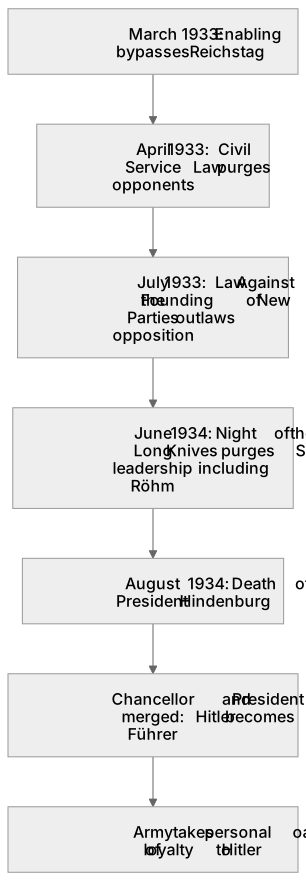
Put it in order
Put these steps in the order they happen.
- 1. Army takes personal oath of loyalty to Hitler
- 2. Chancellor and President merged: Hitler becomes Führer
- 3. July 1933: Law Against the Founding of New Parties outlaws opposition
- 4. August 1934: Death of President Hindenburg
- 5. March 1933: Enabling Act bypasses Reichstag
- 6. April 1933: Civil Service Law purges opponents
- 7. June 1934: Night of the Long Knives purges SA leadership including Röhm
Key words
Say what each word means before you turn the card.
Legal revolution and pseudo-legality
Try answering aloud or in your head before turning the card.
The role of violence and terror in politics
Try answering aloud or in your head before turning the card.
Gleichschaltung (coordination of state and society)
Try answering aloud or in your head before turning the card.
The transition from democracy to dictatorship
Try answering aloud or in your head before turning the card.
See every definition
- Legal revolution and pseudo-legality
- The use of existing constitutional mechanisms to dismantle the Weimar Republic from within, as with the Enabling Act bypassing the Reichstag.
- The role of violence and terror in politics
- The use of violence and terror, such as the Night of the Long Knives, weighed against legal measures in Hitler's consolidation of power.
- Gleichschaltung (coordination of state and society)
- Coordination seen in administrative changes such as the abolition of state assemblies and the purging of the civil service.
- The transition from democracy to dictatorship
- The transformation of Germany into a dictatorship between March 1933 and August 1934 through governmental and administrative change and the establishment of the one-party state.
Label the diagram
Some boxes have lost their names. Pick the right name for each number.
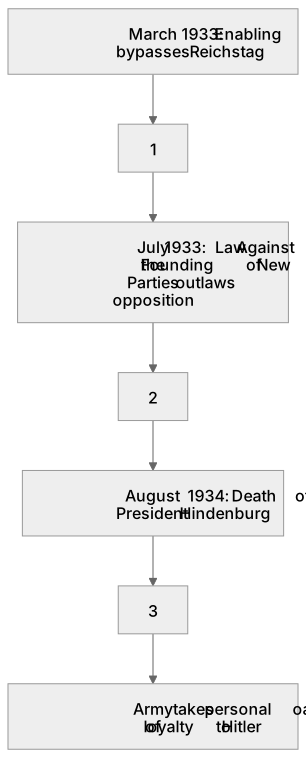
1Box 1
2Box 2
3Box 3
There is more to this lesson
The full lesson goes on to check your understanding and help you earn the marks. Create a free account to carry on, with your progress saved.
A week of Premium from your first lesson · Then the free plan continues · No card, no charge
Test your understanding of 2O Democracy and Nazism: Germany, 1918–1945 – The Nazi Dictatorship, 1933–1939 (A-level only): Hitler’s consolidation of power, March 1933–1934: governmental and administrative change and the establishment of the one-party state; the Night of the Long Knives and the impact of the death of President Hindenburg
Active recall beats re-reading. Take an instant quiz now to test what you’ve learned and lock it into long-term memory.
A week of Premium from your first lesson · Then the free plan continues · No card, no charge