AQA · A-Level · History
Course version: 7042 · Version from Sept 2017
Germany, 1918–1945 – The Nazi Dictatorship, 1933–1939 (A-level only): The…
Full specification wording
2O Democracy and Nazism: Germany, 1918–1945 – The Nazi Dictatorship, 1933–1939 (A-level only): The 'Terror State': the police, including the SS and Gestapo; the courts; extent, effectiveness and limitations of opposition and non-conformity; propaganda: aims, methods and impact; extent of totalitarianism
The Nazi regime maintained control through terror and propaganda, aiming for total societal coordination.
Checked against the AQA 7042 specification (opens in a new tab) on .
- Point 2 of 4
- 3 key terms
Study notes
From the checked teaching notes for this specification point.
The idea
The Nazi regime maintained control through terror and propaganda, aiming for total societal coordination. The 'Terror State' relied on the SS and the Gestapo, who operated above the law to root out dissent, supported by a compromised court system, notably the People's Court, which delivered predetermined verdicts. Despite this, opposition and non-conformity existed, ranging from private grumbling to youth group defiance, though its extent and effectiveness were severely limited by fear. Simultaneously, Goebbels directed propaganda aiming to indoctrinate the masses, using methods like cheap radios, rallies, and censored press. The impact of these forces raises debate over the extent of totalitarianism: while the regime aspired to total control, administrative chaos and pockets of non-conformity suggest it was never absolute.
What earns the marks
- Analyse the structure and function of the 'Terror State', specifically the overlapping roles of the SS, the Gestapo, and the SD in monitoring and eliminating perceived enemies.
- Evaluate the Nazification of the justice system, including the creation of the People's Court (Volksgerichtshof) and the removal of judicial independence to serve Nazi ideology.
- Examine the aims, methods, and impact of Nazi propaganda under Goebbels, focusing on the use of radio, film, the press, and public spectacles to manufacture consent and the Hitler Myth.
- Debate the extent of totalitarianism in Nazi Germany, contrasting the regime's aspirations for total control with the realities of polycratic inefficiency and the persistence of minor non-conformity.
Common mistakes and how to put them right
Assuming the Gestapo was a massive, omnipresent force with agents on every corner.
Put it right: Explain that the Gestapo was actually relatively small and relied heavily on voluntary denunciations from ordinary citizens to function effectively.
Conflating 'non-conformity' with 'opposition' or 'resistance'.
Put it right: Distinguish between non-conformity (behaviour that deviated from Nazi norms, like Swing Youth) and active political opposition aiming to overthrow the regime.
Stating that propaganda successfully brainwashed the entire German population.
Put it right: Note that the impact of propaganda was uneven; it was highly successful in reinforcing existing prejudices but less effective in changing deeply held religious or class loyalties.
Exam tips
- When discussing the 'Terror State', highlight the synergy between the Gestapo and the general public; the reliance on civilian denunciations is a sophisticated point for evaluation.
- Use the 'Hitler Myth' as a specific example of the impact of propaganda, showing how it helped maintain regime popularity even when specific Nazi policies were unpopular.
- In essays on totalitarianism, contrast the theoretical model of a totalitarian state (total control) with the structuralist view of Nazi Germany as a chaotic, polycratic system.
Try the lesson
The start of the 2O Democracy and Nazism: Germany, 1918–1945 – The Nazi Dictatorship, 1933–1939 (A-level only): The 'Terror State': the police, including the SS and Gestapo; the courts; extent, effectiveness and limitations of opposition and non-conformity; propaganda: aims, methods and impact; extent of totalitarianism lesson, made from checked teaching notes for this specification point.
Have a go first
Which organisation was given primary responsibility for the administration and guarding of the Nazi concentration camp system from 1934 onwards?
Listen
The Nazi regime maintained control through terror and propaganda, aiming for total societal coordination. The 'Terror State' relied on the SS and the Gestapo, who operated above the law to root out dissent, supported by a compromised court system, notably the People's Court, which delivered predetermined verdicts. Despite this, opposition and non-conformity existed, ranging from private grumbling to youth group defiance, though its extent and effectiveness were severely limited by fear. Simultaneously, Goebbels directed propaganda aiming to indoctrinate the masses, using methods like cheap radios, rallies, and censored press. The impact of these forces raises debate over the extent of totalitarianism: while the regime aspired to total control, administrative chaos and pockets of non-conformity suggest it was never absolute. A strong answer earns marks for these points. Analyse the structure and function of the 'Terror State', specifically the overlapping roles of the SS, the Gestapo, and the SD in monitoring and eliminating perceived enemies. Evaluate the Nazification of the justice system, including the creation of the People's Court (Volksgerichtshof) and the removal of judicial independence to serve Nazi ideology. Assess the extent, effectiveness, and limitations of opposition, distinguishing between active resistance (e.g., underground political networks) and non-conformity (e.g., listening to foreign broadcasts or youth swing groups). Examine the aims, methods, and impact of Nazi propaganda under Goebbels, focusing on the use of radio, film, the press, and public spectacles to manufacture consent and the Hitler Myth. A common slip: Assuming the Gestapo was a massive, omnipresent force with agents on every corner. Instead, Explain that the Gestapo was actually relatively small and relied heavily on voluntary denunciations from ordinary citizens to function effectively. Exam tip: When discussing the 'Terror State', highlight the synergy between the Gestapo and the general public; the reliance on civilian denunciations is a sophisticated point for evaluation.
See it
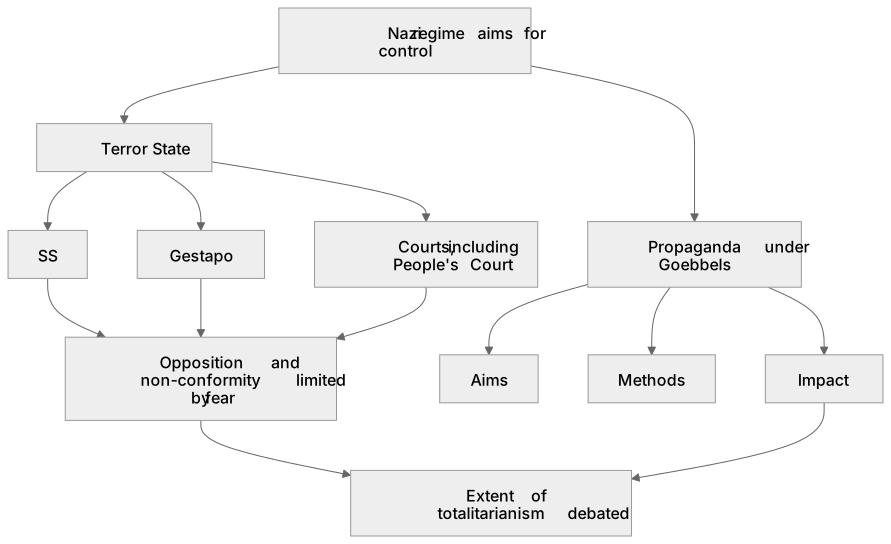
Key words
Say what each word means before you turn the card.
Coercion versus consent
Try answering aloud or in your head before turning the card.
The spectrum of resistance and non-conformity
Try answering aloud or in your head before turning the card.
The role of mass media and indoctrination in a dictatorship
Try answering aloud or in your head before turning the card.
See every definition
- Coercion versus consent
- The regime maintained control through terror and propaganda, aiming for total societal coordination.
- The spectrum of resistance and non-conformity
- Opposition and non-conformity existed, ranging from private grumbling to youth group defiance, though its extent and effectiveness were severely limited by fear.
- The role of mass media and indoctrination in a dictatorship
- Goebbels directed propaganda aiming to indoctrinate the masses, using methods like cheap radios, rallies, and censored press.
Label the diagram
Some boxes have lost their names. Pick the right name for each number.
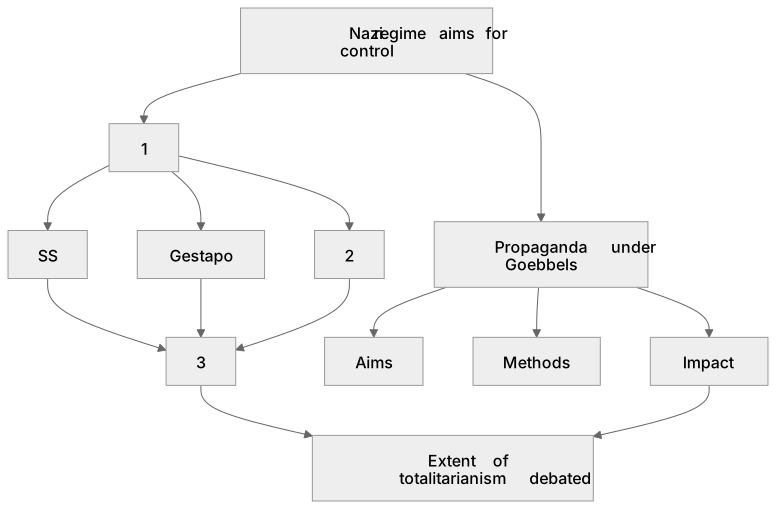
1Box 1
2Box 2
3Box 3
There is more to this lesson
The full lesson goes on to check your understanding and help you earn the marks. Create a free account to carry on, with your progress saved.
A week of Premium from your first lesson · Then the free plan continues · No card, no charge
Test your understanding of 2O Democracy and Nazism: Germany, 1918–1945 – The Nazi Dictatorship, 1933–1939 (A-level only): The 'Terror State': the police, including the SS and Gestapo; the courts; extent, effectiveness and limitations of opposition and non-conformity; propaganda: aims, methods and impact; extent of totalitarianism
Active recall beats re-reading. Take an instant quiz now to test what you’ve learned and lock it into long-term memory.
A week of Premium from your first lesson · Then the free plan continues · No card, no charge