AQA · A-Level · History
Course version: 7042 · Version from Sept 2017
Germany, 1918–1945 – The Racial State, 1933–1941 (A-level only): The…
Full specification wording
2O Democracy and Nazism: Germany, 1918–1945 – The Racial State, 1933–1941 (A-level only): The radicalisation of the state: Nazi racial ideology; policies towards the mentally ill, asocials, homosexuals, members of religious sects, the Roma and Sinti
Nazi racial ideology was rooted in Social Darwinism and the desire to purify the Volksgemeinschaft (national community) by eliminating those deemed biological or social threats.
Checked against the AQA 7042 specification (opens in a new tab) on .
- Point 1 of 4
Study notes
From the checked teaching notes for this specification point.
The idea
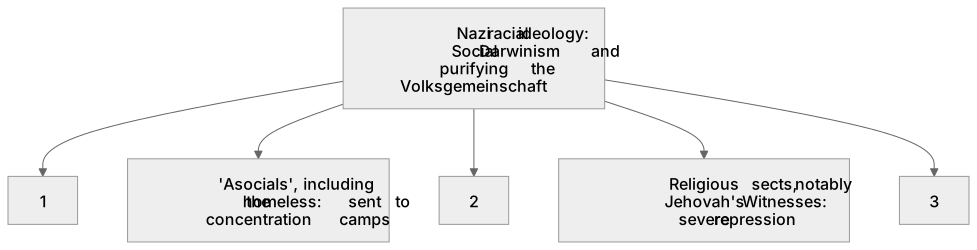
Nazi racial ideology was rooted in Social Darwinism and the desire to purify the Volksgemeinschaft (national community) by eliminating those deemed biological or social threats. The state rapidly radicalised its persecution of minorities. The mentally ill faced forced sterilisation under the 1933 Law for the Prevention of Hereditarily Diseased Offspring, escalating to the secret Aktion T4 euthanasia programme. 'Asocials', including the homeless, were sent to concentration camps. Homosexual men were aggressively prosecuted under an amended Paragraph 175 and interned. Members of religious sects, notably Jehovah's Witnesses who refused the Hitler oath, faced severe repression. The Roma and Sinti were subjected to racial profiling, losing their citizenship and facing mass deportation.
What earns the marks
- Explain the core tenets of Nazi racial ideology, including Social Darwinism, Aryan supremacy, and the concept of Lebensunwertes Leben (life unworthy of life).
- Detail the escalation of policies against the mentally ill, from the 1933 Sterilisation Law to the Aktion T4 euthanasia programme initiated in 1939.
- Analyse the categorisation and persecution of 'asocials' and homosexuals, noting the use of concentration camps and the tightening of Paragraph 175.
- Describe the treatment of religious sects, specifically how Jehovah's Witnesses were targeted for their pacifism and refusal to swear allegiance to Hitler.
- Evaluate the systematic marginalisation of the Roma and Sinti, including their subjection to the Nuremberg Laws and subsequent deportations.
Common mistakes and how to put them right
Confusing the treatment of different minority groups as identical.
Put it right: Differentiate between biological persecution (Roma, Sinti, mentally ill) and ideological or behavioural persecution (homosexuals, religious sects).
Assuming the Aktion T4 programme was public knowledge and widely accepted.
Put it right: Note that T4 was a secret programme that faced significant public and religious backlash, notably from Bishop Galen, leading to its official halt.
Stating that all religious sects were persecuted equally.
Put it right: Specify that Jehovah's Witnesses faced the most severe persecution among small sects due to their absolute refusal to compromise with the state or join the military.
Exam tips
- Use specific terminology such as Volksgemeinschaft, Lebensunwertes Leben, and Social Darwinism to demonstrate a precise understanding of Nazi ideology.
- When discussing the radicalisation of the state, trace the chronological escalation from legal discrimination and sterilisation to physical extermination.
- Compare the motivations behind the persecution of different groups to build a nuanced argument about the nature of the Nazi racial state.
Try the lesson
The start of the 2O Democracy and Nazism: Germany, 1918–1945 – The Racial State, 1933–1941 (A-level only): The radicalisation of the state: Nazi racial ideology; policies towards the mentally ill, asocials, homosexuals, members of religious sects, the Roma and Sinti lesson, made from checked teaching notes for this specification point.
Have a go first
Which of the following best describes the core ideological principle behind the Nazi regime's policies towards the mentally ill and disabled from 1933?
Listen
Nazi racial ideology was rooted in Social Darwinism and the desire to purify the Volksgemeinschaft (national community) by eliminating those deemed biological or social threats. The state rapidly radicalised its persecution of minorities. The mentally ill faced forced sterilisation under the 1933 Law for the Prevention of Hereditarily Diseased Offspring, escalating to the secret Aktion T4 euthanasia programme. Asocials', including the homeless, were sent to concentration camps. Homosexual men were aggressively prosecuted under an amended Paragraph 175 and interned. Members of religious sects, notably Jehovah's Witnesses who refused the Hitler oath, faced severe repression. The Roma and Sinti were subjected to racial profiling, losing their citizenship and facing mass deportation. A strong answer earns marks for these points. Explain the core tenets of Nazi racial ideology, including Social Darwinism, Aryan supremacy, and the concept of Lebensunwertes Leben (life unworthy of life). Detail the escalation of policies against the mentally ill, from the 1933 Sterilisation Law to the Aktion T4 euthanasia programme initiated in 1939. Analyse the categorisation and persecution of 'asocials' and homosexuals, noting the use of concentration camps and the tightening of Paragraph 175. Describe the treatment of religious sects, specifically how Jehovah's Witnesses were targeted for their pacifism and refusal to swear allegiance to Hitler. A common slip: Confusing the treatment of different minority groups as identical. Instead, Differentiate between biological persecution (Roma, Sinti, mentally ill) and ideological or behavioural persecution (homosexuals, religious sects). Exam tip: Use specific terminology such as Volksgemeinschaft, Lebensunwertes Leben, and Social Darwinism to demonstrate a precise understanding of Nazi ideology.
See it

Label the diagram
Some boxes have lost their names. Pick the right name for each number.
1Box 1
2Box 2
3Box 3
There is more to this lesson
The full lesson goes on to check your understanding and help you earn the marks. Create a free account to carry on, with your progress saved.
A week of Premium from your first lesson · Then the free plan continues · No card, no charge
Test your understanding of 2O Democracy and Nazism: Germany, 1918–1945 – The Racial State, 1933–1941 (A-level only): The radicalisation of the state: Nazi racial ideology; policies towards the mentally ill, asocials, homosexuals, members of religious sects, the Roma and Sinti
Active recall beats re-reading. Take an instant quiz now to test what you’ve learned and lock it into long-term memory.
A week of Premium from your first lesson · Then the free plan continues · No card, no charge