AQA · A-Level · History
Course version: 7042 · Version from Sept 2017
Germany, 1918–1945 – The Racial State, 1933–1941 (A-level only):…
Full specification wording
2O Democracy and Nazism: Germany, 1918–1945 – The Racial State, 1933–1941 (A-level only): Anti-Semitism: policies and actions towards the Jews, including the boycott of Jewish shops and the Nuremberg Laws
Nazi anti-Semitism evolved from ideological rhetoric into systematic state persecution, demonstrating a clear trajectory of radicalisation.
Checked against the AQA 7042 specification (opens in a new tab) on .
- Point 2 of 4
- 4 key terms
Study notes
From the checked teaching notes for this specification point.
The idea
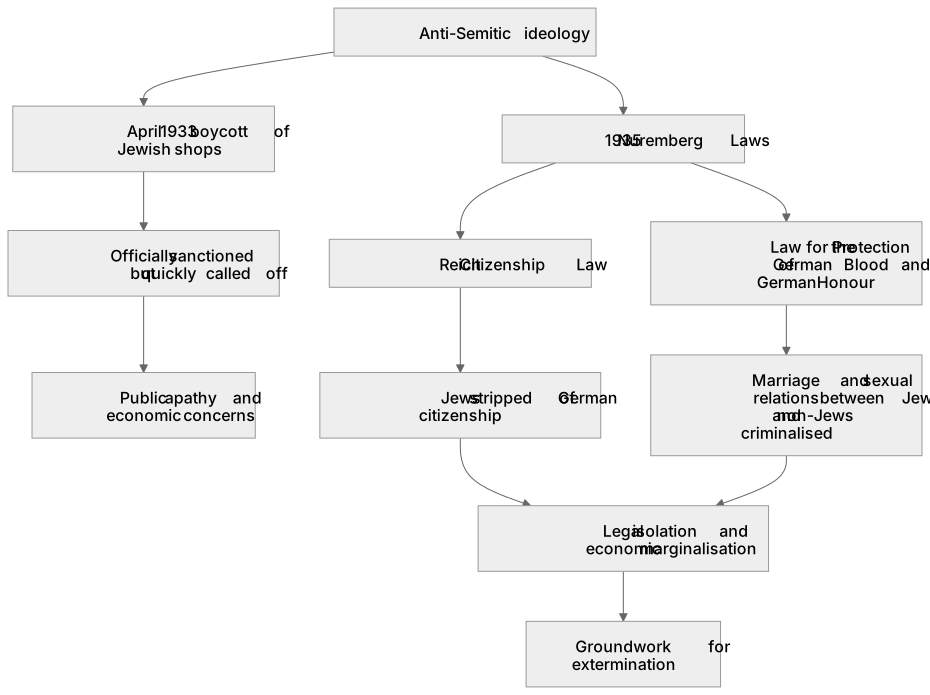
Nazi anti-Semitism evolved from ideological rhetoric into systematic state persecution, demonstrating a clear trajectory of radicalisation. Initial actions were largely uncoordinated, such as the SA-led boycott of Jewish shops in April 1933, which was officially sanctioned but quickly called off due to public apathy and economic concerns. The state subsequently institutionalised discrimination through the 1935 Nuremberg Laws. The Reich Citizenship Law stripped Jews of their German citizenship, while the Law for the Protection of German Blood and German Honour criminalised marriage and sexual relations between Jews and non-Jews. These policies legally isolated the Jewish population, economically marginalised them through forced Aryanisation, and laid the groundwork for extermination.
What earns the marks
- Trace the chronological development of anti-Semitic policies from early intimidation to comprehensive legal disenfranchisement.
- Analyse the April 1933 boycott of Jewish shops, evaluating its limited success and what it revealed about early Nazi economic caution and public attitudes.
- Explain the specific provisions of the 1935 Nuremberg Laws, including the Reich Citizenship Law and the Law for the Protection of German Blood and German Honour.
- Assess the impact of the 'Aryanisation' of Jewish businesses and the systematic removal of Jews from the civil service and professions.
- Evaluate the role of grassroots pressure from the SA versus top-down state legislation in driving the radicalisation of anti-Semitic policies.
Common mistakes and how to put them right
Claiming the 1933 boycott of Jewish shops was a massive success that destroyed the Jewish economy.
Put it right: Recognise that the boycott lasted only one day, faced public apathy, and was halted to prevent broader economic disruption.
Treating the Nuremberg Laws as a single piece of legislation.
Put it right: Distinguish between the two main laws: the Reich Citizenship Law and the Law for the Protection of German Blood and German Honour.
Assuming the Final Solution was fully planned and implemented immediately in 1933.
Put it right: Emphasise the gradual radicalisation of policies, starting with legal and economic marginalisation before escalating to physical extermination later.
Exam tips
- Memorise the exact names and dates of key legislation, particularly the two distinct components of the 1935 Nuremberg Laws.
- Discuss the interplay between radical elements of the Nazi party pushing for immediate action and the state's initial preference for legalistic discrimination.
- Use the concept of 'cumulative radicalisation' to explain how anti-Semitic policies became progressively more extreme over time.
Try the lesson
The start of the 2O Democracy and Nazism: Germany, 1918–1945 – The Racial State, 1933–1941 (A-level only): Anti-Semitism: policies and actions towards the Jews, including the boycott of Jewish shops and the Nuremberg Laws lesson, made from checked teaching notes for this specification point.
Have a go first
What was the primary purpose of the national boycott of Jewish shops and businesses organised by the Nazi regime in April 1933?
Listen
Nazi anti-Semitism evolved from ideological rhetoric into systematic state persecution, demonstrating a clear trajectory of radicalisation. Initial actions were largely uncoordinated, such as the SA-led boycott of Jewish shops in April 1933, which was officially sanctioned but quickly called off due to public apathy and economic concerns. The state subsequently institutionalised discrimination through the 1935 Nuremberg Laws. The Reich Citizenship Law stripped Jews of their German citizenship, while the Law for the Protection of German Blood and German Honour criminalised marriage and sexual relations between Jews and non-Jews. These policies legally isolated the Jewish population, economically marginalised them through forced Aryanisation, and laid the groundwork for extermination. A strong answer earns marks for these points. Trace the chronological development of anti-Semitic policies from early intimidation to comprehensive legal disenfranchisement. Analyse the April 1933 boycott of Jewish shops, evaluating its limited success and what it revealed about early Nazi economic caution and public attitudes. Explain the specific provisions of the 1935 Nuremberg Laws, including the Reich Citizenship Law and the Law for the Protection of German Blood and German Honour. Assess the impact of the 'Aryanisation' of Jewish businesses and the systematic removal of Jews from the civil service and professions. A common slip: Claiming the 1933 boycott of Jewish shops was a massive success that destroyed the Jewish economy. Instead, Recognise that the boycott lasted only one day, faced public apathy, and was halted to prevent broader economic disruption. Exam tip: Memorise the exact names and dates of key legislation, particularly the two distinct components of the 1935 Nuremberg Laws.
See it
Key words
Say what each word means before you turn the card.
Anti-Semitism
Try answering aloud or in your head before turning the card.
Legal Discrimination and Disenfranchisement
Try answering aloud or in your head before turning the card.
Economic Marginalisation (Aryanisation)
Try answering aloud or in your head before turning the card.
Cumulative Radicalisation
Try answering aloud or in your head before turning the card.
See every definition
- Anti-Semitism
- Policies and actions towards the Jews, including the boycott of Jewish shops and the Nuremberg Laws.
- Legal Discrimination and Disenfranchisement
- The state institutionalised discrimination through the 1935 Nuremberg Laws, which legally isolated the Jewish population.
- Economic Marginalisation (Aryanisation)
- The forced Aryanisation of Jewish businesses, alongside removal from the civil service and professions, economically marginalised the Jewish population.
- Cumulative Radicalisation
- Anti-Semitic policies became progressively more extreme over time, a trajectory from ideological rhetoric into systematic state persecution.
Label the diagram
Some boxes have lost their names. Pick the right name for each number.
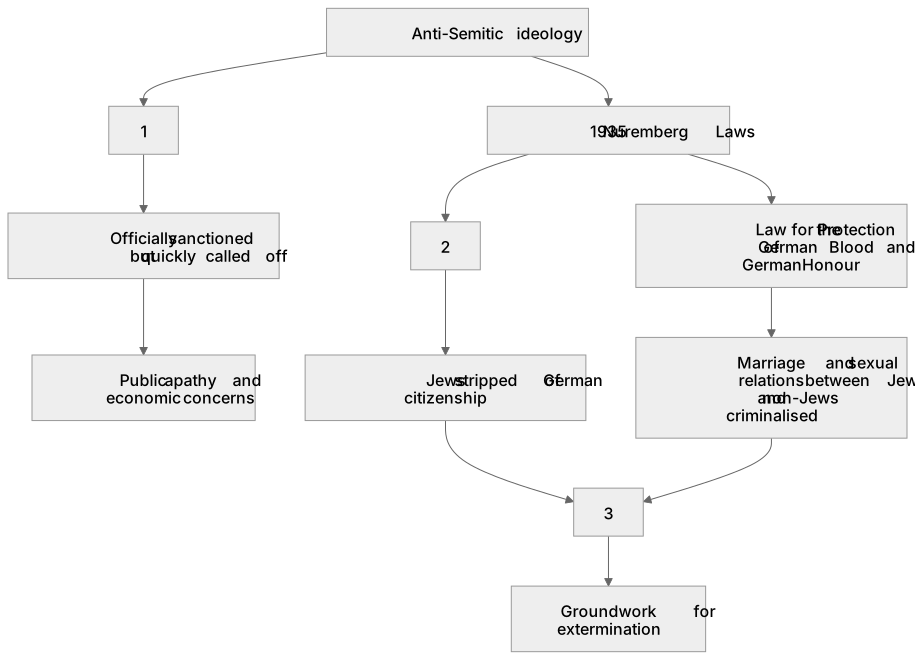
1Box 1
2Box 2
3Box 3
There is more to this lesson
The full lesson goes on to check your understanding and help you earn the marks. Create a free account to carry on, with your progress saved.
A week of Premium from your first lesson · Then the free plan continues · No card, no charge
Test your understanding of 2O Democracy and Nazism: Germany, 1918–1945 – The Racial State, 1933–1941 (A-level only): Anti-Semitism: policies and actions towards the Jews, including the boycott of Jewish shops and the Nuremberg Laws
Active recall beats re-reading. Take an instant quiz now to test what you’ve learned and lock it into long-term memory.
A week of Premium from your first lesson · Then the free plan continues · No card, no charge