AQA · A-Level · History
Course version: 7042 · Version from Sept 2017
Germany, 1918–1945 – The Racial State, 1933–1941 (A-level only): The…
Full specification wording
2O Democracy and Nazism: Germany, 1918–1945 – The Racial State, 1933–1941 (A-level only): The treatment of Jews in the early years of war: the Einsatzgruppen; ghettos and deportations
The outbreak of war in 1939 drastically escalated the persecution of Jews, transitioning from forced emigration to systematic deportation and containment.
Checked against the AQA 7042 specification (opens in a new tab) on .
- Point 4 of 4
Study notes
From the checked teaching notes for this specification point.
The idea
The outbreak of war in 1939 drastically escalated the persecution of Jews, transitioning from forced emigration to systematic deportation and containment. Following the invasion of Poland, Jews were deported to the General Government and confined in severely overcrowded ghettos like Warsaw and Łódź. These ghettos were designed to decimate the population through starvation, disease, and forced labour. The invasion of the Soviet Union in June 1941 marked another fatal turning point with the deployment of the Einsatzgruppen. These mobile killing squads followed the advancing German army, conducting mass shootings of Jewish men, women, and children. This period illustrates the lethal evolution of Nazi policy towards the Final Solution.
What earns the marks
- Analyse the purpose and conditions of the ghettos, highlighting them as tools of indirect extermination through attrition, starvation, and disease.
- Explain the logistical and ideological drivers behind the deportations of Jews to the General Government in occupied Poland.
- Evaluate the role of the Einsatzgruppen in the radicalisation of Nazi policy following the invasion of the Soviet Union in 1941.
- Assess the transition from territorial solutions (like the Madagascar Plan or Lublin reservation) to systematic mass murder during the early war years.
Common mistakes and how to put them right
Stating that ghettos were built with the immediate intention of being holding pens for extermination camps.
Put it right: Explain that ghettos were initially intended as a temporary containment solution before the policy of systematic extermination was fully formulated.
Confusing the Einsatzgruppen with regular army units (Wehrmacht).
Put it right: Specify that the Einsatzgruppen were SS paramilitary death squads, although they often received logistical support from the Wehrmacht.
Assuming the 'Final Solution' was a fully formed plan at the outbreak of war in 1939.
Put it right: Demonstrate how policy evolved chaotically from deportation and ghettoisation to the mass shootings by the Einsatzgruppen in 1941.
Exam tips
- Use specific examples of ghettos, such as Warsaw or Łódź, to illustrate the horrific living conditions and the deliberate policy of starvation.
- Link the deployment of the Einsatzgruppen directly to the ideological nature of the war against 'Judeo-Bolshevism' in the Soviet Union.
- Trace the chronological shift in policy: from deportation to the General Government, to ghettoisation, and finally to the mass shootings of 1941.
Try the lesson
The start of the 2O Democracy and Nazism: Germany, 1918–1945 – The Racial State, 1933–1941 (A-level only): The treatment of Jews in the early years of war: the Einsatzgruppen; ghettos and deportations lesson, made from checked teaching notes for this specification point.
Have a go first
What was the primary role of the Einsatzgruppen during the early years of the Second World War?
Listen
The outbreak of war in 1939 drastically escalated the persecution of Jews, transitioning from forced emigration to systematic deportation and containment. Following the invasion of Poland, Jews were deported to the General Government and confined in severely overcrowded ghettos like Warsaw and Łódź. These ghettos were designed to decimate the population through starvation, disease, and forced labour. The invasion of the Soviet Union in June 1941 marked another fatal turning point with the deployment of the Einsatzgruppen. These mobile killing squads followed the advancing German army, conducting mass shootings of Jewish men, women, and children. This period illustrates the lethal evolution of Nazi policy towards the Final Solution. A strong answer earns marks for these points. Analyse the purpose and conditions of the ghettos, highlighting them as tools of indirect extermination through attrition, starvation, and disease. Explain the logistical and ideological drivers behind the deportations of Jews to the General Government in occupied Poland. Evaluate the role of the Einsatzgruppen in the radicalisation of Nazi policy following the invasion of the Soviet Union in 1941. Assess the transition from territorial solutions (like the Madagascar Plan or Lublin reservation) to systematic mass murder during the early war years. A common slip: Stating that ghettos were built with the immediate intention of being holding pens for extermination camps. Instead, Explain that ghettos were initially intended as a temporary containment solution before the policy of systematic extermination was fully formulated. Exam tip: Use specific examples of ghettos, such as Warsaw or Łódź, to illustrate the horrific living conditions and the deliberate policy of starvation.
See it
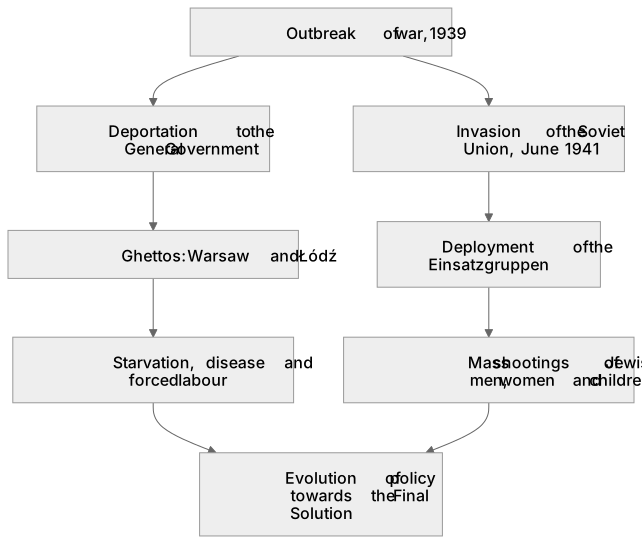
Label the diagram
Some boxes have lost their names. Pick the right name for each number.
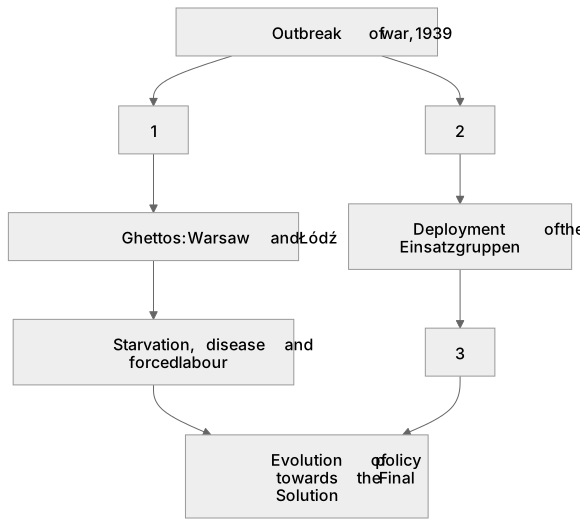
1Box 1
2Box 2
3Box 3
There is more to this lesson
The full lesson goes on to check your understanding and help you earn the marks. Create a free account to carry on, with your progress saved.
A week of Premium from your first lesson · Then the free plan continues · No card, no charge
Test your understanding of 2O Democracy and Nazism: Germany, 1918–1945 – The Racial State, 1933–1941 (A-level only): The treatment of Jews in the early years of war: the Einsatzgruppen; ghettos and deportations
Active recall beats re-reading. Take an instant quiz now to test what you’ve learned and lock it into long-term memory.
A week of Premium from your first lesson · Then the free plan continues · No card, no charge