AQA · A-Level · History
Course version: 7042 · Version from Sept 2017
Germany, 1918–1945 – The Racial State, 1933–1941 (A-level only): The…
Full specification wording
2O Democracy and Nazism: Germany, 1918–1945 – The Racial State, 1933–1941 (A-level only): The development of anti-Semitic policies and actions; the effect of the Anschluss; Reichkristallnacht; emigration; the impact of the war against Poland
The development of anti-Semitic policies and actions radicalised sharply from 1938.
Checked against the AQA 7042 specification (opens in a new tab) on .
- Point 3 of 4
- 4 key terms
Study notes
From the checked teaching notes for this specification point.
The idea
The development of anti-Semitic policies and actions radicalised sharply from 1938. The effect of the Anschluss with Austria emboldened the regime, prompting violent persecution and establishing a blueprint for forced emigration. This escalation culminated in Reichkristallnacht (November 1938), a state-sponsored pogrom causing mass arrests and the destruction of Jewish property. Concurrently, the regime intensified pressure on Jews to emigrate, stripping their assets via Aryanisation. Finally, the impact of the war against Poland in 1939 brought approximately two million more Jews under Nazi control in the German-occupied zone, forcing a shift from emigration to deportation and ghettoisation.
What earns the marks
- Explain the effect of the Anschluss in accelerating anti-Semitic violence and testing forced emigration models.
- Analyse Reichkristallnacht as a turning point from legislative discrimination to state-directed physical violence and economic expropriation.
- Evaluate the methods and limitations of Nazi emigration policies, including the financial exploitation of fleeing Jews.
- Assess how the impact of the war against Poland changed the demographic reality for the Nazis, leading to the abandonment of emigration in favour of deportation.
Common mistakes and how to put them right
Claiming Reichkristallnacht was a spontaneous public uprising.
Put it right: Emphasise that it was orchestrated by the Nazi leadership, specifically Goebbels and the SA, despite being presented as spontaneous.
Confusing the timeline of emigration and extermination.
Put it right: Clarify that until 1941, the primary Nazi goal was forced emigration and territorial resettlement, not systematic extermination.
Stating the 1939 invasion of Poland brought three million Jews under Nazi control.
Put it right: Specify that approximately two million Jews were in the German-occupied zone, while over one million remained in Soviet-occupied eastern Poland until 1941.
Exam tips
- Use the effect of the Anschluss as a key turning point to demonstrate how foreign policy successes radicalised domestic anti-Semitic policies and actions.
- When discussing Reichkristallnacht, explicitly link the violence to the subsequent economic 'Aryanisation' and the fine levied on the Jewish community.
- Contrast the policy of emigration before September 1939 with the logistical challenges of deportation and resettlement following the impact of the war against Poland.
Try the lesson
The start of the 2O Democracy and Nazism: Germany, 1918–1945 – The Racial State, 1933–1941 (A-level only): The development of anti-Semitic policies and actions; the effect of the Anschluss; Reichkristallnacht; emigration; the impact of the war against Poland lesson, made from checked teaching notes for this specification point.
Have a go first
What was the immediate catalyst for the events of Reichkristallnacht in November 1938?
Listen
The development of anti-Semitic policies and actions radicalised sharply from 1938. The effect of the Anschluss with Austria emboldened the regime, prompting violent persecution and establishing a blueprint for forced emigration. This escalation culminated in Reichkristallnacht (November 1938), a state-sponsored pogrom causing mass arrests and the destruction of Jewish property. Concurrently, the regime intensified pressure on Jews to emigrate, stripping their assets via Aryanisation. Finally, the impact of the war against Poland in 1939 brought approximately two million more Jews under Nazi control in the German-occupied zone, forcing a shift from emigration to deportation and ghettoisation. A strong answer earns marks for these points. Explain the effect of the Anschluss in accelerating anti-Semitic violence and testing forced emigration models. Analyse Reichkristallnacht as a turning point from legislative discrimination to state-directed physical violence and economic expropriation. Evaluate the methods and limitations of Nazi emigration policies, including the financial exploitation of fleeing Jews. Assess how the impact of the war against Poland changed the demographic reality for the Nazis, leading to the abandonment of emigration in favour of deportation. A common slip: Claiming Reichkristallnacht was a spontaneous public uprising. Instead, emphasise that it was orchestrated by the Nazi leadership, specifically Goebbels and the SA, despite being presented as spontaneous. Exam tip: Use the effect of the Anschluss as a key turning point to demonstrate how foreign policy successes radicalised domestic anti-Semitic policies and actions.
See it
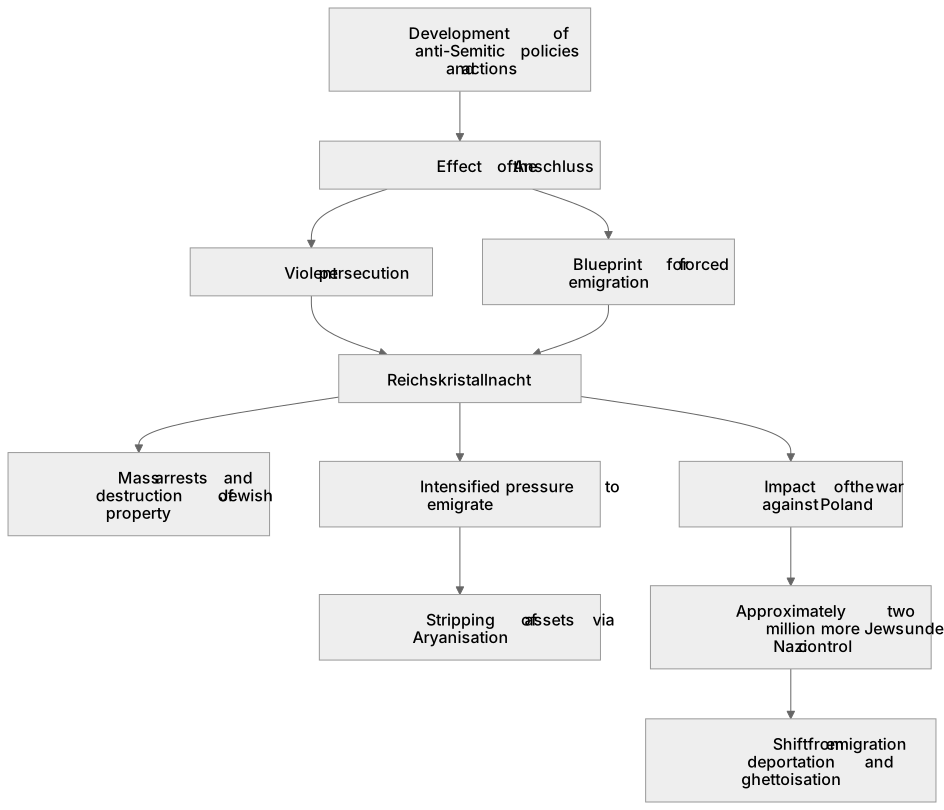
Key words
Say what each word means before you turn the card.
Radicalisation of anti-Semitic policies
Try answering aloud or in your head before turning the card.
Emigration vs Deportation
Try answering aloud or in your head before turning the card.
State-sponsored violence
Try answering aloud or in your head before turning the card.
Demographic impact of war
Try answering aloud or in your head before turning the card.
See every definition
- Radicalisation of anti-Semitic policies
- The sharp escalation from 1938 of anti-Semitic policies and actions, culminating in state-sponsored violence and economic expropriation.
- Emigration vs Deportation
- A shift from pressuring Jews to emigrate, with assets stripped via Aryanisation, to deportation and ghettoisation after the war against Poland.
- State-sponsored violence
- Reichkristallnacht, a state-sponsored pogrom in November 1938 causing mass arrests and the destruction of Jewish property.
- Demographic impact of war
- The war against Poland in 1939 brought approximately two million more Jews under Nazi control in the German-occupied zone.
Label the diagram
Some boxes have lost their names. Pick the right name for each number.
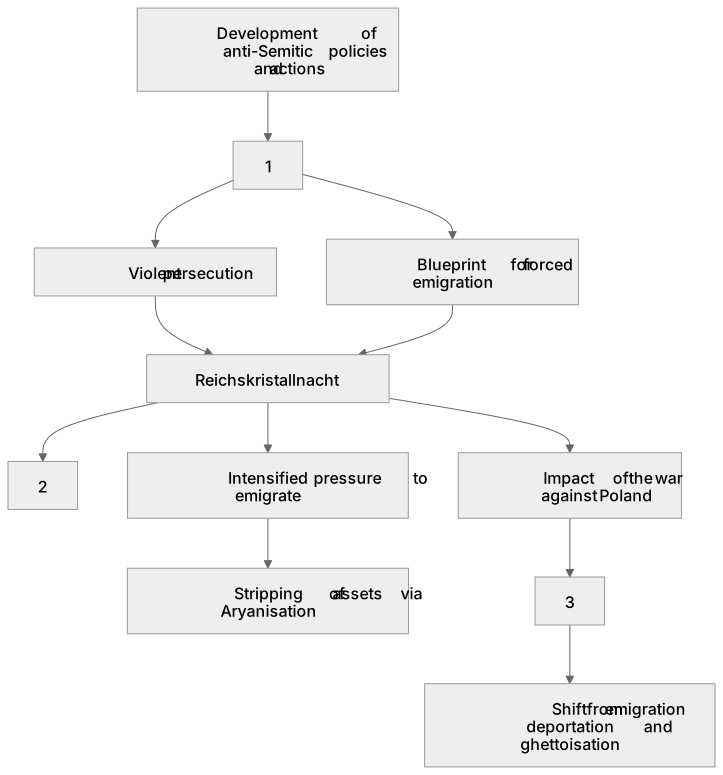
1Box 1
2Box 2
3Box 3
There is more to this lesson
The full lesson goes on to check your understanding and help you earn the marks. Create a free account to carry on, with your progress saved.
A week of Premium from your first lesson · Then the free plan continues · No card, no charge
Test your understanding of 2O Democracy and Nazism: Germany, 1918–1945 – The Racial State, 1933–1941 (A-level only): The development of anti-Semitic policies and actions; the effect of the Anschluss; Reichkristallnacht; emigration; the impact of the war against Poland
Active recall beats re-reading. Take an instant quiz now to test what you’ve learned and lock it into long-term memory.
A week of Premium from your first lesson · Then the free plan continues · No card, no charge