AQA · A-Level · History
Course version: 7042 · Version from Sept 2017
The Chinese Communist Party: background; Mao's leadership; ideology and…
Full specification wording
2P The Transformation of China, 1936–1997 – 1962 The Origins of the Civil War, 1936–1946: The Chinese Communist Party: background; Mao's leadership; ideology and policies; hostility to the Guomindang
The Chinese Communist Party (CCP) initially followed orthodox Marxism focused on urban workers.
Checked against the AQA 7042 specification (opens in a new tab) on .
- Point 2 of 4
Study notes
From the checked teaching notes for this specification point.
The idea
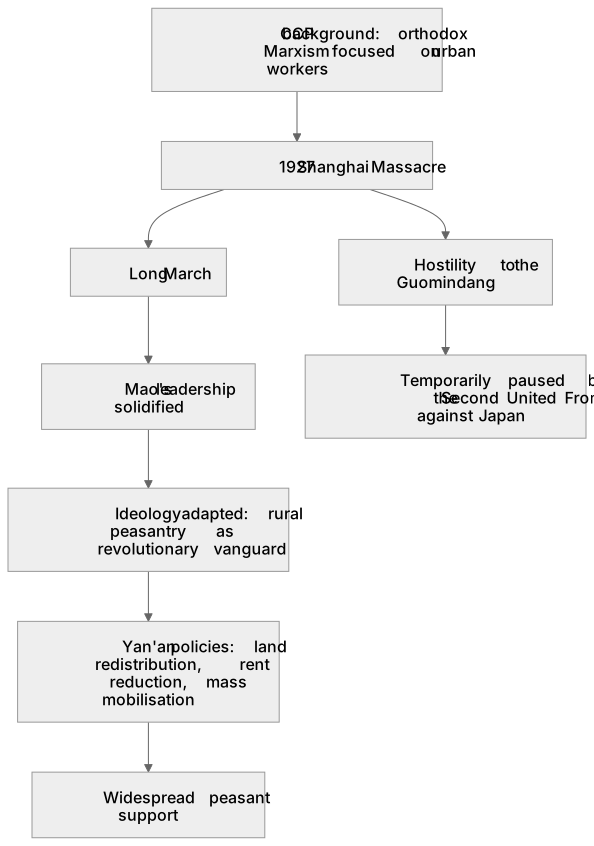
The Chinese Communist Party (CCP) initially followed orthodox Marxism focused on urban workers. Following the 1927 Shanghai Massacre and the Long March, the CCP's background shifted to rural survival. Mao Zedong's leadership solidified during this retreat. His ideology adapted Marxism to China by identifying the rural peasantry, rather than the urban proletariat, as the revolutionary vanguard. Mao's policies in the Yan'an Soviet focused on land redistribution, rent reduction, and mass mobilisation, winning widespread peasant support. Hostility to the Guomindang (GMD) was foundational, driven by the GMD's repeated extermination campaigns, though this hostility was temporarily paused by the Second United Front against Japan.
What earns the marks
- Trace the background of the CCP from its urban origins to its rural relocation following GMD persecution.
- Evaluate the consolidation of Mao's leadership, particularly his strategic successes during the Long March and the Yan'an period.
- Analyse the core tenets of Maoist ideology, specifically the adaptation of Marxism-Leninism to rely on a peasant-led revolution.
- Assess the effectiveness of CCP policies in Yan'an, such as land reform and the mass line, in securing popular support.
- Explain the deep-rooted hostility between the CCP and GMD, stemming from the White Terror and the Encirclement Campaigns.
Common mistakes and how to put them right
Stating that the CCP was always a peasant-based movement.
Put it right: Clarify that the CCP's background was initially rooted in orthodox Marxist-Leninist theory focusing on the urban proletariat, only shifting to the peasantry after 1927.
Assuming Mao was the undisputed leader of the CCP from its inception.
Put it right: Note that Mao only consolidated his leadership during the Long March and the subsequent Yan'an Rectification Movement.
Claiming the CCP and GMD fought continuously without pause.
Put it right: Acknowledge the temporary, albeit fragile, cessation of hostilities during the Second United Front to resist Japanese expansion.
Exam tips
- Contrast Mao's rural policies with Jiang Jieshi's urban focus to explain the shifting balance of popular support.
- Use the concept of the 'Mass Line' to demonstrate how Mao's ideology translated into practical policies that engaged the peasantry.
- When discussing CCP-GMD hostility, reference specific events like the 1927 Shanghai Massacre to explain the depth of communist distrust.
Try the lesson
The start of the 2P The Transformation of China, 1936–1997 – 1962 The Origins of the Civil War, 1936–1946: The Chinese Communist Party: background; Mao's leadership; ideology and policies; hostility to the Guomindang lesson, made from checked teaching notes for this specification point.
Have a go first
Which event in the mid-1930s was crucial in establishing Mao Zedong's undisputed leadership over the Chinese Communist Party?
Listen
The Chinese Communist Party (CCP) initially followed orthodox Marxism focused on urban workers. Following the 1927 Shanghai Massacre and the Long March, the CCP's background shifted to rural survival. Mao Zedong's leadership solidified during this retreat. His ideology adapted Marxism to China by identifying the rural peasantry, rather than the urban proletariat, as the revolutionary vanguard. Mao's policies in the Yan'an Soviet focused on land redistribution, rent reduction, and mass mobilisation, winning widespread peasant support. Hostility to the Guomindang (GMD) was foundational, driven by the GMD's repeated extermination campaigns, though this hostility was temporarily paused by the Second United Front against Japan. A strong answer earns marks for these points. Trace the background of the CCP from its urban origins to its rural relocation following GMD persecution. Evaluate the consolidation of Mao's leadership, particularly his strategic successes during the Long March and the Yan'an period. Analyse the core tenets of Maoist ideology, specifically the adaptation of Marxism-Leninism to rely on a peasant-led revolution. Assess the effectiveness of CCP policies in Yan'an, such as land reform and the mass line, in securing popular support. A common slip: Stating that the CCP was always a peasant-based movement. Instead, Clarify that the CCP's background was initially rooted in orthodox Marxist-Leninist theory focusing on the urban proletariat, only shifting to the peasantry after 1927. Exam tip: Contrast Mao's rural policies with Jiang Jieshi's urban focus to explain the shifting balance of popular support.
See it
Label the diagram
Some boxes have lost their names. Pick the right name for each number.
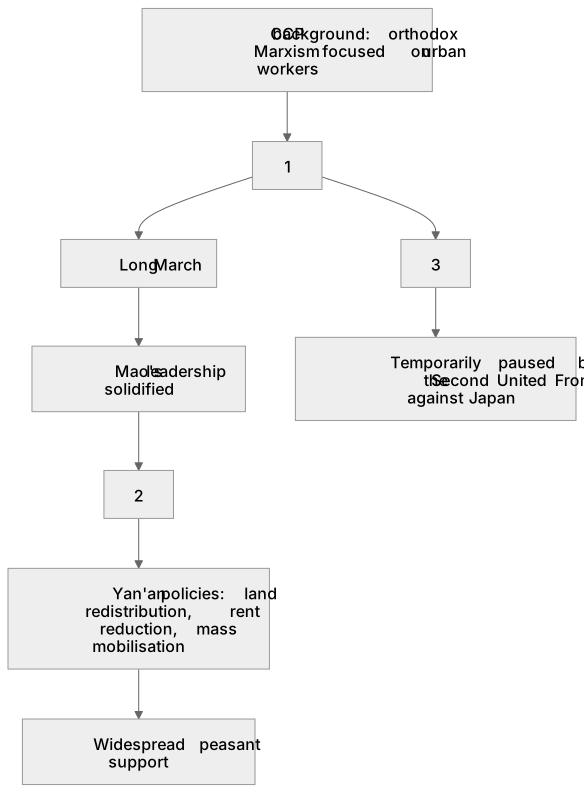
1Box 1
2Box 2
3Box 3
There is more to this lesson
The full lesson goes on to check your understanding and help you earn the marks. Create a free account to carry on, with your progress saved.
A week of Premium from your first lesson · Then the free plan continues · No card, no charge
Test your understanding of 2P The Transformation of China, 1936–1997 – 1962 The Origins of the Civil War, 1936–1946: The Chinese Communist Party: background; Mao's leadership; ideology and policies; hostility to the Guomindang
Active recall beats re-reading. Take an instant quiz now to test what you’ve learned and lock it into long-term memory.
A week of Premium from your first lesson · Then the free plan continues · No card, no charge