AQA · A-Level · History
Course version: 7042 · Version from Sept 2017
The condition of China in 1936: Japanese expansion in China; Jiang Jieshi…
Full specification wording
2P The Transformation of China, 1936–1997 – 1962 The Origins of the Civil War, 1936–1946: The condition of China in 1936: Japanese expansion in China; Jiang Jieshi and the Guomindang; leadership, ideology and policies
In 1936, China was fragmented and threatened by Japanese expansion, which began with the 1931 invasion of Manchuria.
Checked against the AQA 7042 specification (opens in a new tab) on .
- Point 1 of 4
Study notes
From the checked teaching notes for this specification point.
The idea
In 1936, China was fragmented and threatened by Japanese expansion, which began with the 1931 invasion of Manchuria. Jiang Jieshi led the Guomindang (GMD) as an authoritarian regime in Nanjing. His leadership relied heavily on military force and wealthy elites. The GMD's ideology ostensibly followed Sun Yat-sen's Three Principles, but Jiang prioritised anti-communism over democratic reform. His policies focused on urban modernisation while neglecting the rural peasantry. Crucially, Jiang's policy of 'internal pacification before external resistance' prioritised destroying the Communists over fighting the Japanese. This deeply unpopular stance culminated in the 1936 Xi'an Incident, forcing him to confront Japan.
What earns the marks
- Assess the impact of Japanese territorial encroachment, particularly the occupation of Manchuria, on Chinese domestic politics.
- Evaluate Jiang Jieshi's leadership style, noting his reliance on the military, factionalism, and the Blue Shirts to maintain control.
- Analyse the GMD's ideological foundation, contrasting the theoretical commitment to Sun Yat-sen's Three Principles with the reality of a one-party dictatorship.
- Examine GMD policies, highlighting the disparity between urban industrial development and the lack of agrarian reform for the peasantry.
- Explain the significance of the policy of 'internal pacification before external resistance' and how it undermined GMD popularity.
Common mistakes and how to put them right
Claiming the GMD controlled the entirety of China in 1936.
Put it right: Note that GMD control was largely limited to the lower Yangzi region and major cities, with warlords and Communists holding other areas.
Confusing Jiang Jieshi's ideology with pure fascism.
Put it right: Describe his ideology as a blend of traditional Confucianism, nationalism, and authoritarianism, rather than European-style fascism, despite some shared traits.
Assuming the GMD actively fought Japan throughout the early 1930s.
Put it right: Emphasise Jiang's strategy of appeasing Japan to focus on eradicating the Chinese Communist Party until the Xi'an Incident of December 1936.
Exam tips
- Use the Xi'an Incident of 1936 as a pivotal turning point to evaluate the failure of Jiang's policy of appeasing Japan.
- When discussing GMD ideology, explicitly reference Sun Yat-sen's Three Principles of the People and evaluate how far Jiang implemented them.
- Contrast the GMD's urban support base with the rural peasantry to explain the regime's structural weaknesses.
Try the lesson
The start of the 2P The Transformation of China, 1936–1997 – 1962 The Origins of the Civil War, 1936–1946: The condition of China in 1936: Japanese expansion in China; Jiang Jieshi and the Guomindang; leadership, ideology and policies lesson, made from checked teaching notes for this specification point.
Have a go first
What was the primary focus of Jiang Jieshi's 'New Life Movement' launched in the 1930s?
Listen
In 1936, China was fragmented and threatened by Japanese expansion, which began with the 1931 invasion of Manchuria. Jiang Jieshi led the Guomindang (GMD) as an authoritarian regime in Nanjing. His leadership relied heavily on military force and wealthy elites. The GMD's ideology ostensibly followed Sun Yat-sen's Three Principles, but Jiang prioritised anti-communism over democratic reform. His policies focused on urban modernisation while neglecting the rural peasantry. Crucially, Jiang's policy of 'internal pacification before external resistance' prioritised destroying the Communists over fighting the Japanese. This deeply unpopular stance culminated in the 1936 Xi'an Incident, forcing him to confront Japan. A strong answer earns marks for these points. Assess the impact of Japanese territorial encroachment, particularly the occupation of Manchuria, on Chinese domestic politics. Evaluate Jiang Jieshi's leadership style, noting his reliance on the military, factionalism, and the Blue Shirts to maintain control. Analyse the GMD's ideological foundation, contrasting the theoretical commitment to Sun Yat-sen's Three Principles with the reality of a one-party dictatorship. Examine GMD policies, highlighting the disparity between urban industrial development and the lack of agrarian reform for the peasantry. A common slip: Claiming the GMD controlled the entirety of China in 1936. Instead, Note that GMD control was largely limited to the lower Yangzi region and major cities, with warlords and Communists holding other areas. Exam tip: Use the Xi'an Incident of 1936 as a pivotal turning point to evaluate the failure of Jiang's policy of appeasing Japan.
See it
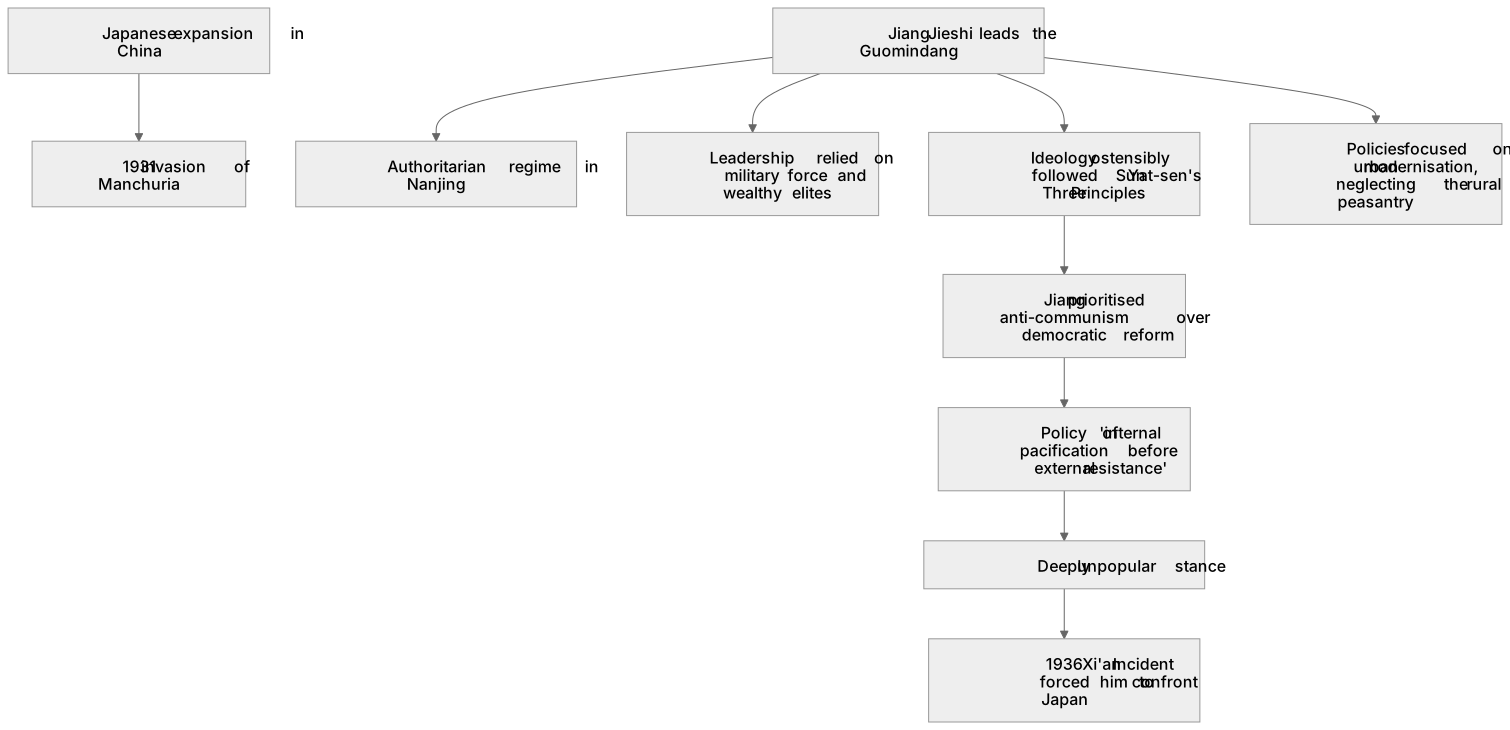
Label the diagram
Some boxes have lost their names. Pick the right name for each number.
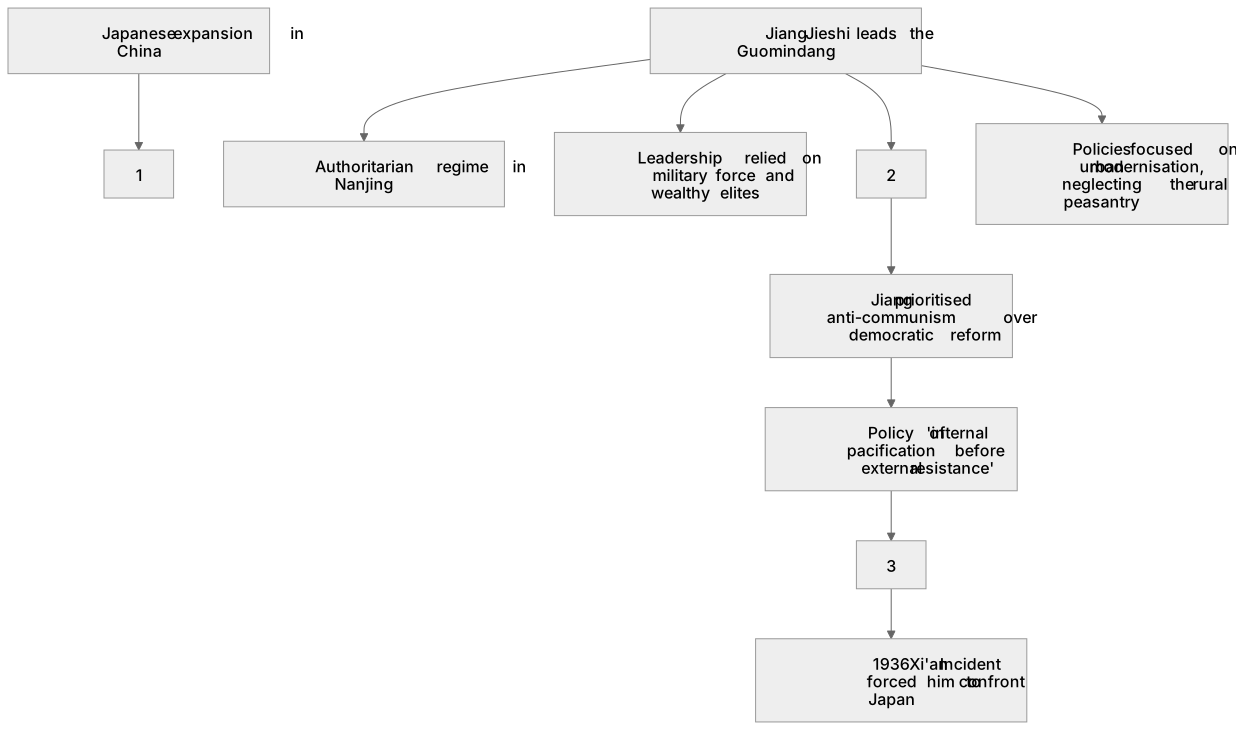
1Box 1
2Box 2
3Box 3
There is more to this lesson
The full lesson goes on to check your understanding and help you earn the marks. Create a free account to carry on, with your progress saved.
A week of Premium from your first lesson · Then the free plan continues · No card, no charge
Test your understanding of 2P The Transformation of China, 1936–1997 – 1962 The Origins of the Civil War, 1936–1946: The condition of China in 1936: Japanese expansion in China; Jiang Jieshi and the Guomindang; leadership, ideology and policies
Active recall beats re-reading. Take an instant quiz now to test what you’ve learned and lock it into long-term memory.
A week of Premium from your first lesson · Then the free plan continues · No card, no charge