AQA · A-Level · History
Course version: 7042 · Version from Sept 2017
PRC's international position and dealings with neighbours: Korea, Tibet,…
Full specification wording
2P The Transformation of China, 1936–1997 – Communist victory and the consolidation of Mao's rule, 1946–1952: PRC's international position and dealings with neighbours: Korea, Tibet, Taiwan and the USSR
The PRC's early international position was defined by its quest for security and ideological alignment.
Checked against the AQA 7042 specification (opens in a new tab) on .
- Point 4 of 4
Study notes
From the checked teaching notes for this specification point.
The idea
The PRC's early international position was defined by its quest for security and ideological alignment. Dealings with the USSR were formalised through the 1950 Sino-Soviet Treaty, providing crucial aid, though Mao resented Stalin's unequal terms. In Korea, the PRC intervened in the 1950 war to secure its border against US forces, boosting its prestige as a communist power. Regionally, the PRC asserted territorial claims by invading Tibet in 1950 and enforcing the 17-Point Agreement. Meanwhile, Taiwan remained a major flashpoint; the PRC sought to capture the island where Chiang Kai-shek's Nationalists had fled, but US naval protection prevented an invasion, cementing a long-term geopolitical standoff with its neighbours.
What earns the marks
- Evaluate the significance of the 1950 Sino-Soviet Treaty in securing economic aid and military protection, while noting the underlying tensions between Mao and Stalin.
- Analyse the impact of the Korean War on the PRC's international standing and its domestic consolidation of power.
- Assess the methods and consequences of the PRC's invasion and subsequent subjugation of Tibet in 1950.
- Explain the geopolitical factors that prevented the PRC from capturing Taiwan, specifically the intervention of the US Seventh Fleet.
Common mistakes and how to put them right
Treating the Sino-Soviet relationship as an alliance of equals without friction.
Put it right: Highlight Mao's frustration with Stalin's patronising attitude and the high interest rates on Soviet loans.
Stating that the PRC successfully conquered Taiwan in this period.
Put it right: Clarify that Taiwan remained under Nationalist control, protected by the United States, leading to ongoing cross-strait tensions.
Viewing the Korean War solely as a military conflict without domestic implications.
Put it right: Connect the Korean War to the PRC's internal mass mobilisation campaigns, such as 'Resist America and Aid Korea'.
Exam tips
- Contrast the PRC's successful assertion of control in Tibet with its failure to capture Taiwan to demonstrate the limits of its early military power.
- Use the Korean War as a key example of how external conflicts were leveraged by Mao to justify internal repression and consolidate power.
- When discussing the USSR, explicitly mention the 1950 Sino-Soviet Treaty of Friendship, Alliance and Mutual Assistance to show precise historical knowledge.
Try the lesson
The start of the 2P The Transformation of China, 1936–1997 – Communist victory and the consolidation of Mao's rule, 1946–1952: PRC's international position and dealings with neighbours: Korea, Tibet, Taiwan and the USSR lesson, made from checked teaching notes for this specification point.
Have a go first
What action did the People's Republic of China take regarding Tibet in 1950 to secure its borders and assert its territorial claims?
Listen
The PRC's early international position was defined by its quest for security and ideological alignment. Dealings with the USSR were formalised through the 1950 Sino-Soviet Treaty, providing crucial aid, though Mao resented Stalin's unequal terms. In Korea, the PRC intervened in the 1950 war to secure its border against US forces, boosting its prestige as a communist power. Regionally, the PRC asserted territorial claims by invading Tibet in 1950 and enforcing the 17-Point Agreement. Meanwhile, Taiwan remained a major flashpoint; the PRC sought to capture the island where Chiang Kai-shek's Nationalists had fled, but US naval protection prevented an invasion, cementing a long-term geopolitical standoff with its neighbours. A strong answer earns marks for these points. Evaluate the significance of the 1950 Sino-Soviet Treaty in securing economic aid and military protection, while noting the underlying tensions between Mao and Stalin. Analyse the impact of the Korean War on the PRC's international standing and its domestic consolidation of power. Assess the methods and consequences of the PRC's invasion and subsequent subjugation of Tibet in 1950. Explain the geopolitical factors that prevented the PRC from capturing Taiwan, specifically the intervention of the US Seventh Fleet. A common slip: Treating the Sino-Soviet relationship as an alliance of equals without friction. Instead, Highlight Mao's frustration with Stalin's patronising attitude and the high interest rates on Soviet loans. Exam tip: Contrast the PRC's successful assertion of control in Tibet with its failure to capture Taiwan to demonstrate the limits of its early military power.
See it
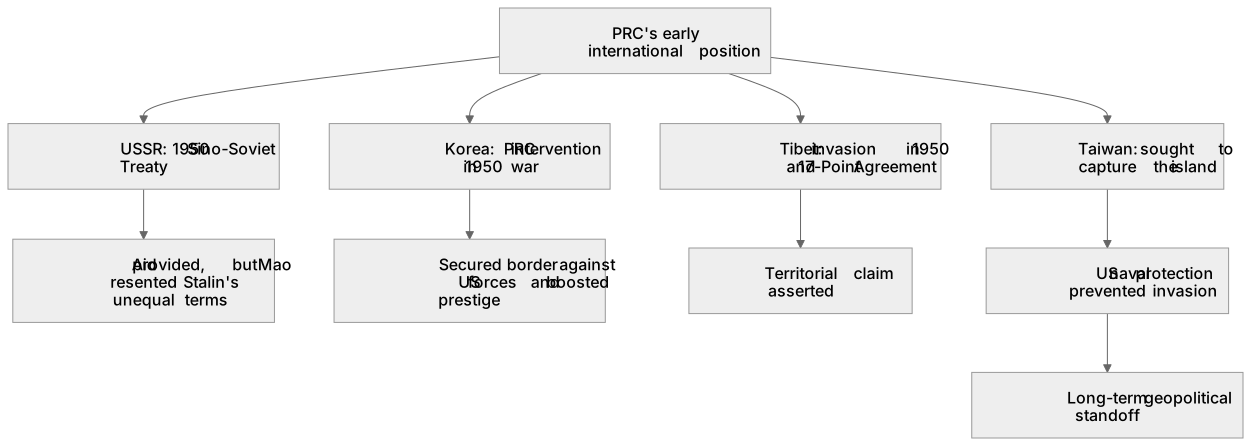
Label the diagram
Some boxes have lost their names. Pick the right name for each number.
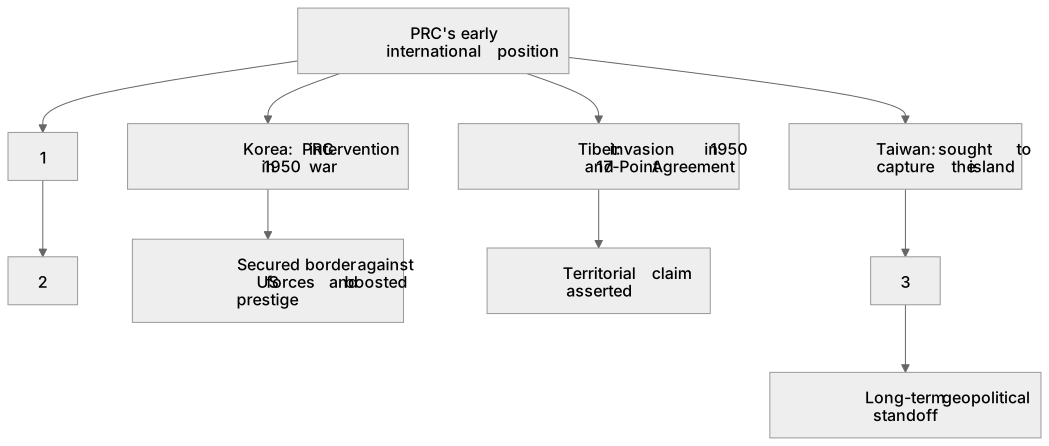
1Box 1
2Box 2
3Box 3
There is more to this lesson
The full lesson goes on to check your understanding and help you earn the marks. Create a free account to carry on, with your progress saved.
A week of Premium from your first lesson · Then the free plan continues · No card, no charge
Test your understanding of 2P The Transformation of China, 1936–1997 – Communist victory and the consolidation of Mao's rule, 1946–1952: PRC's international position and dealings with neighbours: Korea, Tibet, Taiwan and the USSR
Active recall beats re-reading. Take an instant quiz now to test what you’ve learned and lock it into long-term memory.
A week of Premium from your first lesson · Then the free plan continues · No card, no charge