AQA · A-Level · History
Course version: 7042 · Version from Sept 2017
The consolidation of power: mass mobilisation campaigns and purges; the…
Full specification wording
2P The Transformation of China, 1936–1997 – Communist victory and the consolidation of Mao's rule, 1946–1952: The consolidation of power: mass mobilisation campaigns and purges; the role of the PLA; the use of terror and propaganda; land reform; attacks on landlords and land redistribution
Mao consolidated power after 1949 through coercion, ideological control, and socio-economic restructuring.
Checked against the AQA 7042 specification (opens in a new tab) on .
- Point 3 of 4
- 4 key terms
Study notes
From the checked teaching notes for this specification point.
The idea
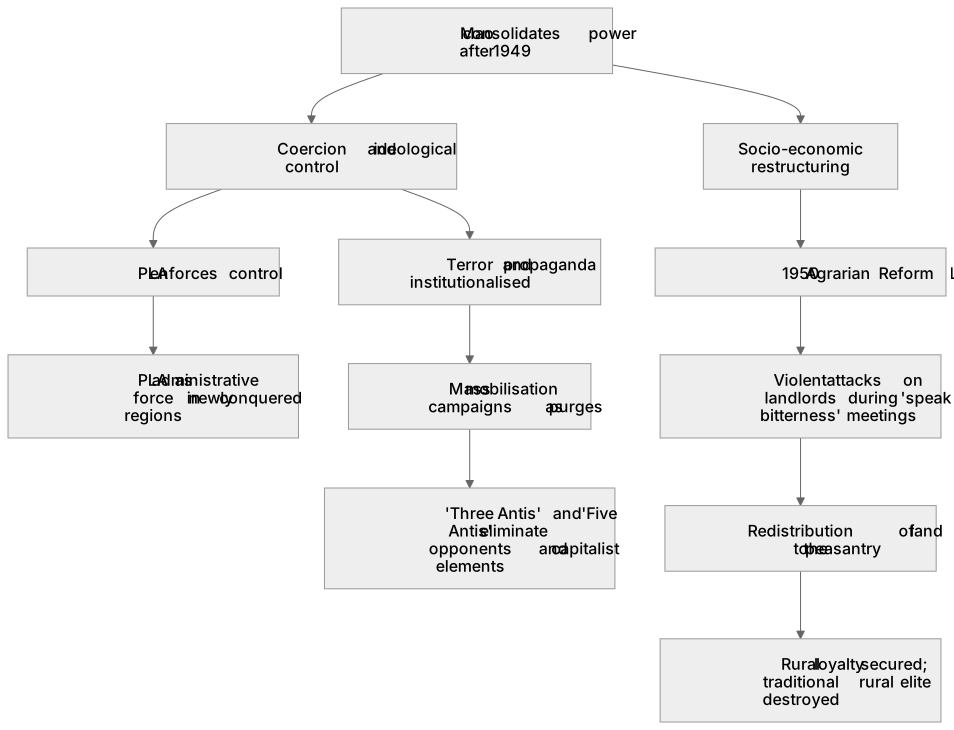
Mao consolidated power after 1949 through coercion, ideological control, and socio-economic restructuring. The People's Liberation Army (PLA) enforced control, acting as an administrative force in newly conquered regions. Terror and propaganda were institutionalised; mass mobilisation campaigns, like the 'Three Antis' and 'Five Antis', functioned as purges to eliminate political opponents and capitalist elements. Simultaneously, the 1950 Agrarian Reform Law initiated radical land reform. This involved violent attacks on landlords during 'speak bitterness' meetings, leading to their execution, followed by the systematic redistribution of land to the peasantry. This secured rural loyalty and destroyed the traditional rural elite.
What earns the marks
- Evaluate the PLA's dual function as a military enforcer and a political tool for regional administration and infrastructure rebuilding.
- Analyse how mass mobilisation campaigns (e.g., Three Antis, Five Antis) were used to purge political rivals, corrupt officials, and the national bourgeoisie.
- Assess the integration of terror and propaganda, noting how public executions and 'speak bitterness' meetings were broadcast to instil fear and conformity.
- Explain the mechanics and political impact of the 1950 Agrarian Reform Law, specifically the violent eradication of the landlord class and the redistribution of land to peasants.
Common mistakes and how to put them right
Confusing the 'Three Antis' and 'Five Antis' campaigns with the later Cultural Revolution.
Put it right: Place these early mass mobilisation campaigns strictly in the 1950-1952 consolidation period.
Assuming land reform was a purely economic policy to increase agricultural yield.
Put it right: Emphasise that land reform was primarily a political tool to destroy the landlord class and bind the peasantry to the Communist regime.
Underestimating the role of the PLA in civilian life.
Put it right: Acknowledge that the PLA was heavily involved in local government, economic production, and ideological enforcement, not just military defence.
Exam tips
- Link the use of terror directly to the consolidation of power by explaining how it eliminated specific opposition groups like the bourgeoisie and landlords.
- Use specific examples of mass mobilisation, such as the 'Resist America and Aid Korea' campaign, to demonstrate how external threats were used to justify internal purges.
- When discussing land reform, explicitly mention the 1950 Agrarian Reform Law and the psychological impact of 'speak bitterness' meetings on the peasantry.
Try the lesson
The start of the 2P The Transformation of China, 1936–1997 – Communist victory and the consolidation of Mao's rule, 1946–1952: The consolidation of power: mass mobilisation campaigns and purges; the role of the PLA; the use of terror and propaganda; land reform; attacks on landlords and land redistribution lesson, made from checked teaching notes for this specification point.
Have a go first
Which of the following was a primary method used by the Chinese Communist Party to consolidate power in rural areas between 1950 and 1952?
Listen
Mao consolidated power after 1949 through coercion, ideological control, and socio-economic restructuring. The People's Liberation Army (PLA) enforced control, acting as an administrative force in newly conquered regions. Terror and propaganda were institutionalised; mass mobilisation campaigns, like the 'Three Antis' and 'Five Antis', functioned as purges to eliminate political opponents and capitalist elements. Simultaneously, the 1950 Agrarian Reform Law initiated radical land reform. This involved violent attacks on landlords during 'speak bitterness' meetings, leading to their execution, followed by the systematic redistribution of land to the peasantry. This secured rural loyalty and destroyed the traditional rural elite. A strong answer earns marks for these points. Evaluate the PLA's dual function as a military enforcer and a political tool for regional administration and infrastructure rebuilding. Analyse how mass mobilisation campaigns (e.g., Three Antis, Five Antis) were used to purge political rivals, corrupt officials, and the national bourgeoisie. Assess the integration of terror and propaganda, noting how public executions and 'speak bitterness' meetings were broadcast to instil fear and conformity. Explain the mechanics and political impact of the 1950 Agrarian Reform Law, specifically the violent eradication of the landlord class and the redistribution of land to peasants. A common slip: Confusing the 'Three Antis' and 'Five Antis' campaigns with the later Cultural Revolution. Instead, Place these early mass mobilisation campaigns strictly in the 1950-1952 consolidation period. Exam tip: Link the use of terror directly to the consolidation of power by explaining how it eliminated specific opposition groups like the bourgeoisie and landlords.
See it
Key words
Say what each word means before you turn the card.
Coercion and Control
Try answering aloud or in your head before turning the card.
Ideological Indoctrination
Try answering aloud or in your head before turning the card.
Class Struggle
Try answering aloud or in your head before turning the card.
Socio-economic Transformation
Try answering aloud or in your head before turning the card.
See every definition
- Coercion and Control
- Mao consolidated power after 1949 through coercion, ideological control and socio-economic restructuring, with terror and propaganda institutionalised.
- Ideological Indoctrination
- Terror and propaganda were institutionalised, with public executions and 'speak bitterness' meetings broadcast to instil fear and conformity.
- Class Struggle
- Violent attacks on landlords during 'speak bitterness' meetings led to their execution, destroying the traditional rural elite.
- Socio-economic Transformation
- The 1950 Agrarian Reform Law initiated radical land reform, followed by the systematic redistribution of land to the peasantry.
Label the diagram
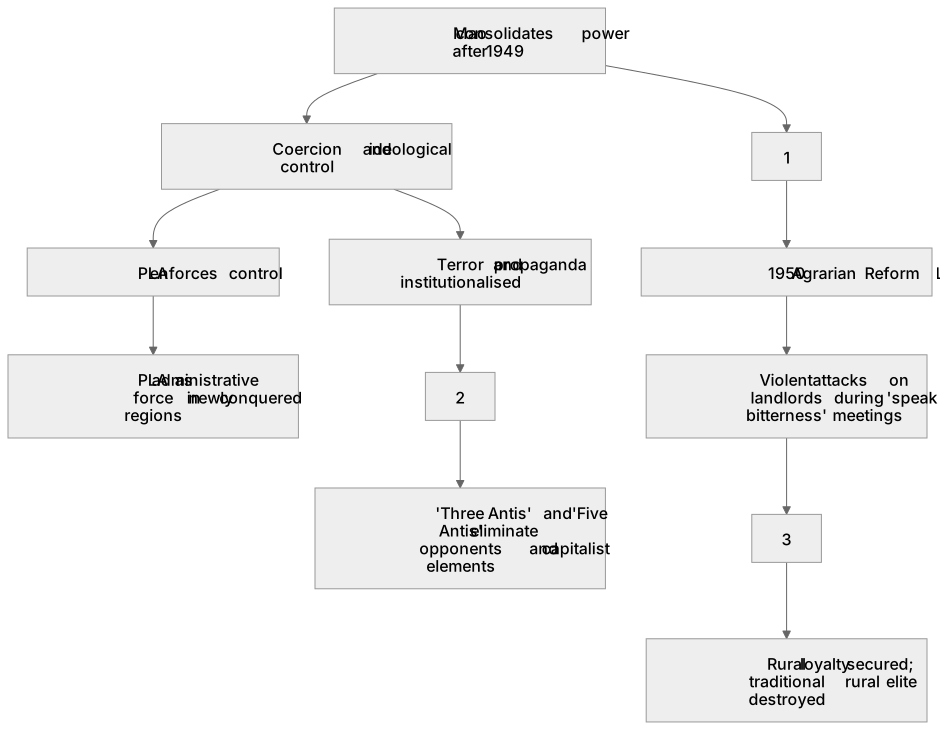
Some boxes have lost their names. Pick the right name for each number.
1Box 1
2Box 2
3Box 3
There is more to this lesson
The full lesson goes on to check your understanding and help you earn the marks. Create a free account to carry on, with your progress saved.
A week of Premium from your first lesson · Then the free plan continues · No card, no charge
Test your understanding of 2P The Transformation of China, 1936–1997 – Communist victory and the consolidation of Mao's rule, 1946–1952: The consolidation of power: mass mobilisation campaigns and purges; the role of the PLA; the use of terror and propaganda; land reform; attacks on landlords and land redistribution
Active recall beats re-reading. Take an instant quiz now to test what you’ve learned and lock it into long-term memory.
A week of Premium from your first lesson · Then the free plan continues · No card, no charge