AQA · A-Level · History
Course version: 7042 · Version from Sept 2017
The People's Republic of China: Mao's position in government; the power…
Full specification wording
2P The Transformation of China, 1936–1997 – Communist victory and the consolidation of Mao's rule, 1946–1952: The People's Republic of China: Mao's position in government; the power structure and influence of the CCP; mass party membership; democratic centralism
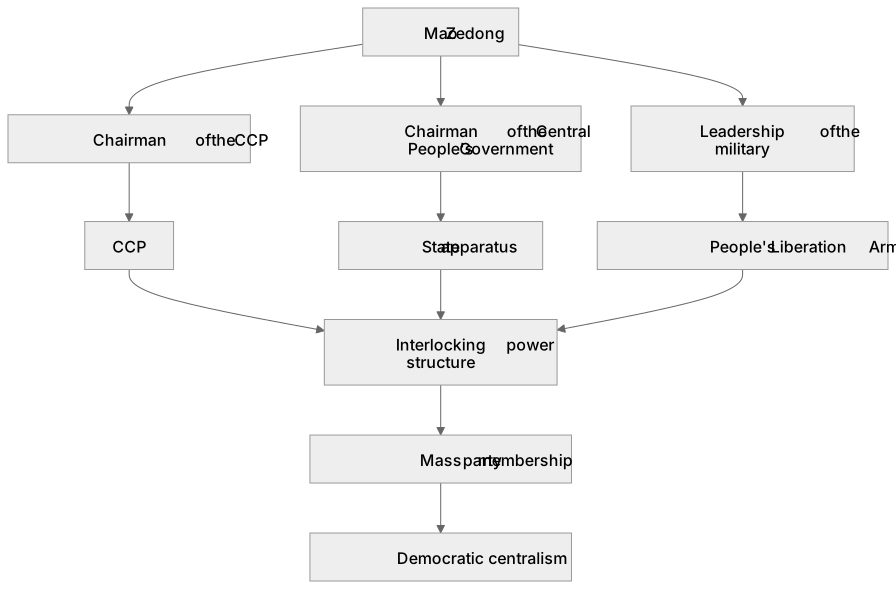
Upon establishing the PRC, Mao Zedong secured absolute authority by holding the top positions in the Party, State, and military, acting as Chairman of the CCP and the Central People's Government.
Checked against the AQA 7042 specification (opens in a new tab) on .
- Point 2 of 4
Study notes
From the checked teaching notes for this specification point.
The idea
Upon establishing the PRC, Mao Zedong secured absolute authority by holding the top positions in the Party, State, and military, acting as Chairman of the CCP and the Central People's Government. The power structure was heavily intertwined, with the CCP exerting total influence over all state apparatus and the People's Liberation Army. To consolidate control at the grassroots level, the CCP rapidly expanded mass party membership, recruiting millions of peasants and workers to implement policies locally. This vast network operated under the principle of democratic centralism. While this theoretically allowed democratic discussion at lower levels, in practice, it dictated that once the central leadership made a decision, absolute obedience was required.
What earns the marks
- Detail Mao's specific roles within the new government, highlighting his simultaneous leadership of the Party, State, and military.
- Analyse the interlocking power structure of the PRC, demonstrating how the CCP maintained influence over the state bureaucracy and the PLA.
- Explain the strategic purpose of expanding mass party membership to enforce central directives at the local and provincial levels.
- Define democratic centralism and evaluate how it functioned in practice to suppress dissent and enforce top-down compliance.
Common mistakes and how to put them right
Treating the CCP and the State government as entirely separate, independent entities.
Put it right: Explain that the power structure was interlocking, with senior CCP officials holding the key State and military positions.
Misunderstanding democratic centralism as a genuinely democratic system.
Put it right: Clarify that while discussion occurred at the bottom, the 'centralism' aspect meant strict, unquestioning obedience to decisions made by the Politburo.
Underestimating the role of ordinary citizens in the power structure.
Put it right: Highlight how mass party membership was actively used to embed CCP influence into everyday life and local administration.
Exam tips
- Use the term 'interlocking directorate' to describe how the Party, State, and military structures overlapped under Mao's leadership.
- When discussing democratic centralism, contrast its theoretical definition with its practical application as a tool for authoritarian control.
- Connect mass party membership to the consolidation of power, showing how a large grassroots base helped the CCP execute national campaigns.
Try the lesson
The start of the 2P The Transformation of China, 1936–1997 – Communist victory and the consolidation of Mao's rule, 1946–1952: The People's Republic of China: Mao's position in government; the power structure and influence of the CCP; mass party membership; democratic centralism lesson, made from checked teaching notes for this specification point.
Have a go first
Which political principle was officially used to organise the power structure of the Chinese Communist Party and the state in the early years of the People's Republic?
Listen
Upon establishing the PRC, Mao Zedong secured absolute authority by holding the top positions in the Party, State, and military, acting as Chairman of the CCP and the Central People's Government. The power structure was heavily intertwined, with the CCP exerting total influence over all state apparatus and the People's Liberation Army. To consolidate control at the grassroots level, the CCP rapidly expanded mass party membership, recruiting millions of peasants and workers to implement policies locally. This vast network operated under the principle of democratic centralism. While this theoretically allowed democratic discussion at lower levels, in practice, it dictated that once the central leadership made a decision, absolute obedience was required. A strong answer earns marks for these points. Detail Mao's specific roles within the new government, highlighting his simultaneous leadership of the Party, State, and military. Analyse the interlocking power structure of the PRC, demonstrating how the CCP maintained influence over the state bureaucracy and the PLA. Explain the strategic purpose of expanding mass party membership to enforce central directives at the local and provincial levels. Define democratic centralism and evaluate how it functioned in practice to suppress dissent and enforce top-down compliance. A common slip: Treating the CCP and the State government as entirely separate, independent entities. Instead, Explain that the power structure was interlocking, with senior CCP officials holding the key State and military positions. Exam tip: Use the term 'interlocking directorate' to describe how the Party, State, and military structures overlapped under Mao's leadership.
See it
Label the diagram
Some boxes have lost their names. Pick the right name for each number.
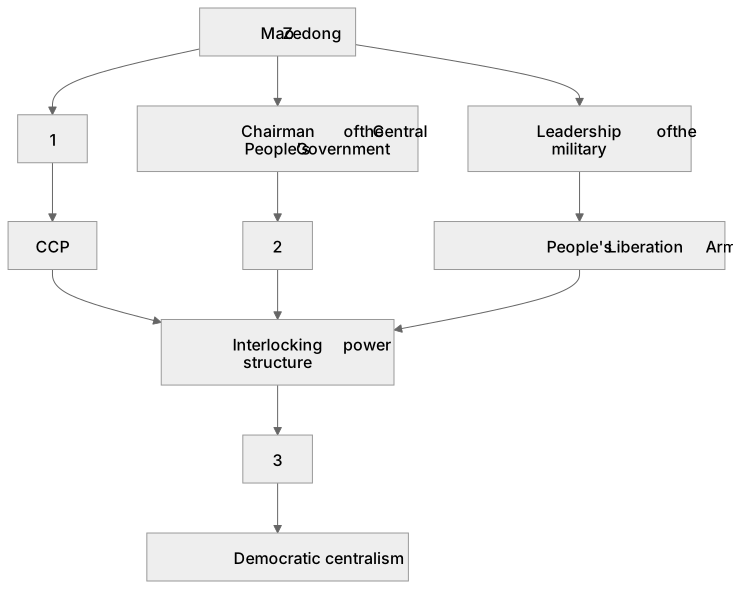
1Box 1
2Box 2
3Box 3
There is more to this lesson
The full lesson goes on to check your understanding and help you earn the marks. Create a free account to carry on, with your progress saved.
A week of Premium from your first lesson · Then the free plan continues · No card, no charge
Test your understanding of 2P The Transformation of China, 1936–1997 – Communist victory and the consolidation of Mao's rule, 1946–1952: The People's Republic of China: Mao's position in government; the power structure and influence of the CCP; mass party membership; democratic centralism
Active recall beats re-reading. Take an instant quiz now to test what you’ve learned and lock it into long-term memory.
A week of Premium from your first lesson · Then the free plan continues · No card, no charge