AQA · A-Level · History
Course version: 7042 · Version from Sept 2017
Foreign affairs: deterioration of relations with USSR and border conflict…
Full specification wording
2P The Transformation of China, 1936–1997 – The Cultural Revolution, 1966–1976 (A-level only): Foreign affairs: deterioration of relations with USSR and border conflict of 1969; improved relations with USA; Kissinger and Nixon's visits and ping-pong diplomacy; condition of China internally and externally at Mao's death
China's foreign policy shifted dramatically during this period.
Checked against the AQA 7042 specification (opens in a new tab) on .
- Point 4 of 4
- 4 key terms
Study notes
From the checked teaching notes for this specification point.
The idea
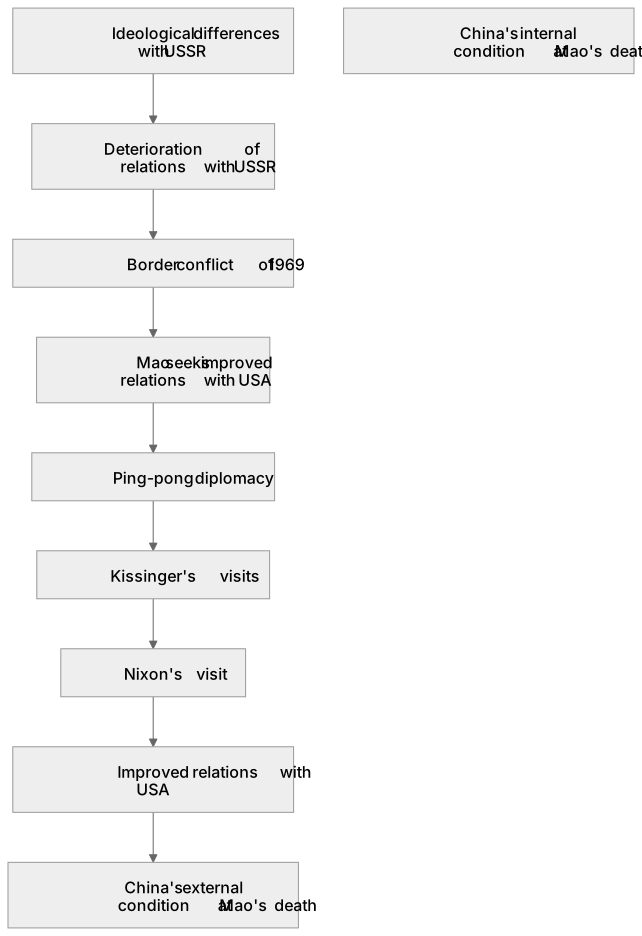
China's foreign policy shifted dramatically during this period. Ideological differences caused a severe deterioration of relations with the USSR, culminating in the violent 1969 Zhenbao Island border conflict. Fearing Soviet aggression, Mao sought improved relations with the USA. This rapprochement began informally through 'ping-pong diplomacy' in 1971, paving the way for Henry Kissinger's secret meetings and President Nixon's historic 1972 visit. By Mao's death in 1976, China's external condition had transformed, securing UN recognition and US alignment against the Soviets. Internally, however, the condition of China was precarious, scarred by a decade of political purges, economic stagnation, and a looming succession crisis.
What earns the marks
- Analyse the ideological and geopolitical factors leading to the deterioration of Sino-Soviet relations and the 1969 border conflict.
- Evaluate the strategic motivations behind China's pursuit of improved relations with the USA as a counterbalance to the USSR.
- Assess the significance of 'ping-pong diplomacy' and the subsequent visits by Kissinger and Nixon in breaking China's diplomatic isolation.
- Examine China's external condition at Mao's death, noting its enhanced global standing and membership in the United Nations.
- Evaluate China's internal condition in 1976, focusing on the economic damage of the Cultural Revolution and the political instability surrounding Mao's succession.
Common mistakes and how to put them right
Stating that the USA and China became formal allies.
Put it right: Clarify that they achieved a strategic rapprochement and normalised relations, but did not form a formal military alliance.
Attributing the Sino-Soviet split solely to the 1969 border conflict.
Put it right: Explain that the border conflict was the culmination of long-standing ideological disputes dating back to Khrushchev's de-Stalinisation.
Assuming China was internally stable by 1976 due to its diplomatic successes.
Put it right: Contrast the external diplomatic triumphs with the internal economic stagnation and political factionalism at the time of Mao's death.
Exam tips
- Contrast China's external diplomatic successes in the 1970s with its internal political and economic turmoil to provide a balanced assessment of Mao's final years.
- Use the 1969 Sino-Soviet border conflict as the crucial turning point that motivated Mao to seek rapprochement with the USA.
- Highlight the role of 'ping-pong diplomacy' as a deliberate, low-risk strategy to signal diplomatic intentions before formal political negotiations.
Try the lesson
The start of the 2P The Transformation of China, 1936–1997 – The Cultural Revolution, 1966–1976 (A-level only): Foreign affairs: deterioration of relations with USSR and border conflict of 1969; improved relations with USA; Kissinger and Nixon's visits and ping-pong diplomacy; condition of China internally and externally at Mao's death lesson, made from checked teaching notes for this specification point.
Have a go first
Which event in 1971 served as a highly publicised diplomatic breakthrough, paving the way for improved relations between China and the United States?
Listen
China's foreign policy shifted dramatically during this period. Ideological differences caused a severe deterioration of relations with the USSR, culminating in the violent 1969 Zhenbao Island border conflict. Fearing Soviet aggression, Mao sought improved relations with the USA. This rapprochement began informally through 'ping-pong diplomacy' in 1971, paving the way for Henry Kissinger's secret meetings and President Nixon's historic 1972 visit. By Mao's death in 1976, China's external condition had transformed, securing UN recognition and US alignment against the Soviets. Internally, however, the condition of China was precarious, scarred by a decade of political purges, economic stagnation, and a looming succession crisis. A strong answer earns marks for these points. Analyse the ideological and geopolitical factors leading to the deterioration of Sino-Soviet relations and the 1969 border conflict. Evaluate the strategic motivations behind China's pursuit of improved relations with the USA as a counterbalance to the USSR. Assess the significance of 'ping-pong diplomacy' and the subsequent visits by Kissinger and Nixon in breaking China's diplomatic isolation. Examine China's external condition at Mao's death, noting its enhanced global standing and membership in the United Nations. A common slip: Stating that the USA and China became formal allies. Instead, clarify that they achieved a strategic rapprochement and normalised relations, but did not form a formal military alliance. Exam tip: Contrast China's external diplomatic successes in the 1970s with its internal political and economic turmoil to provide a balanced assessment of Mao's final years.
See it
Put the events in order
Put these events in the order they happened, earliest first.
- 1. Border conflict with the USSR
- 2. President Nixon's historic visit
- 3. Ping-pong diplomacy began informally
Key words
Say what each word means before you turn the card.
Geopolitical realignment and the Cold War
Try answering aloud or in your head before turning the card.
Ideological conflict versus national security
Try answering aloud or in your head before turning the card.
Diplomatic isolation and integration
Try answering aloud or in your head before turning the card.
Domestic instability versus international prestige
Try answering aloud or in your head before turning the card.
See every definition
- Geopolitical realignment and the Cold War
- A dramatic shift in China's foreign policy, from severe deterioration of relations with the USSR to improved relations with the USA as a counterbalance to the Soviets.
- Ideological conflict versus national security
- Ideological differences caused a severe deterioration of relations with the USSR, while fear of Soviet aggression led Mao to seek improved relations with the USA.
- Diplomatic isolation and integration
- Ping-pong diplomacy and the visits by Kissinger and Nixon broke China's diplomatic isolation, securing UN recognition and US alignment against the Soviets.
- Domestic instability versus international prestige
- By Mao's death China's external condition had transformed, yet internally it was precarious, scarred by political purges, economic stagnation and a looming succession crisis.
Label the diagram
Some boxes have lost their names. Pick the right name for each number.
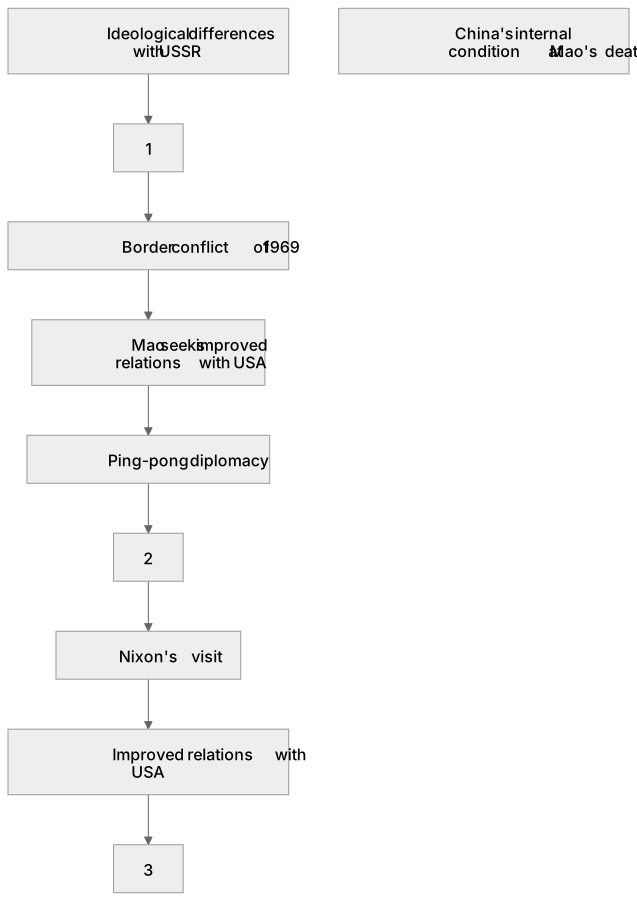
1Box 1
2Box 2
3Box 3
There is more to this lesson
The full lesson goes on to check your understanding and help you earn the marks. Create a free account to carry on, with your progress saved.
A week of Premium from your first lesson · Then the free plan continues · No card, no charge
Test your understanding of 2P The Transformation of China, 1936–1997 – The Cultural Revolution, 1966–1976 (A-level only): Foreign affairs: deterioration of relations with USSR and border conflict of 1969; improved relations with USA; Kissinger and Nixon's visits and ping-pong diplomacy; condition of China internally and externally at Mao's death
Active recall beats re-reading. Take an instant quiz now to test what you’ve learned and lock it into long-term memory.
A week of Premium from your first lesson · Then the free plan continues · No card, no charge