AQA · A-Level · History
Course version: 7042 · Version from Sept 2017
The economic, social and cultural impact of the Cultural Revolution:…
Full specification wording
2P The Transformation of China, 1936–1997 – The Cultural Revolution, 1966–1976 (A-level only): The economic, social and cultural impact of the Cultural Revolution: effect on economic growth; effect on young people; the 'four olds’; anarchy, repression and rectification; censorship and cultural stagnation; Mao's 'little red book'
The Cultural Revolution profoundly disrupted China.
Checked against the AQA 7042 specification (opens in a new tab) on .
- Point 3 of 4
- 4 key terms
Study notes
From the checked teaching notes for this specification point.
The idea
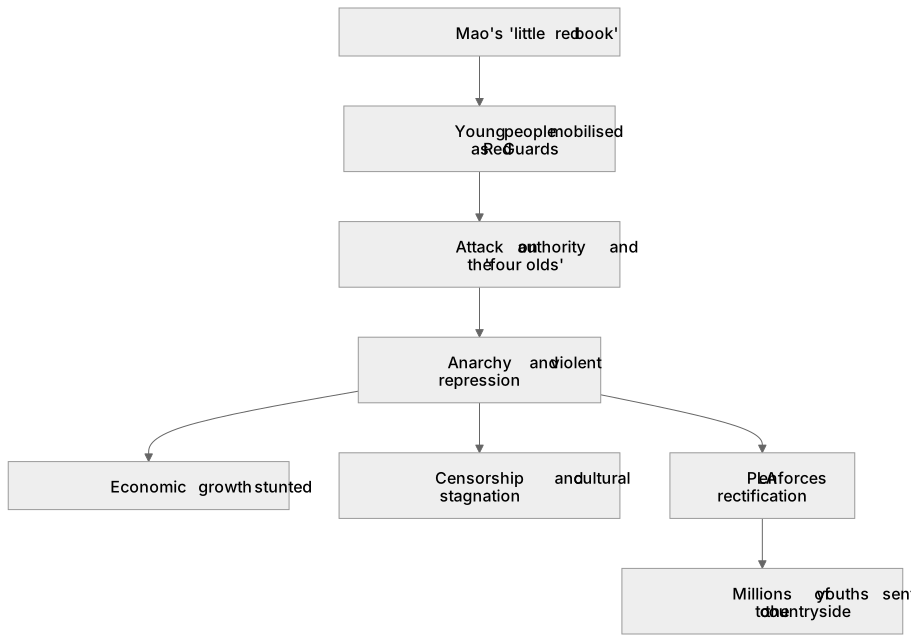
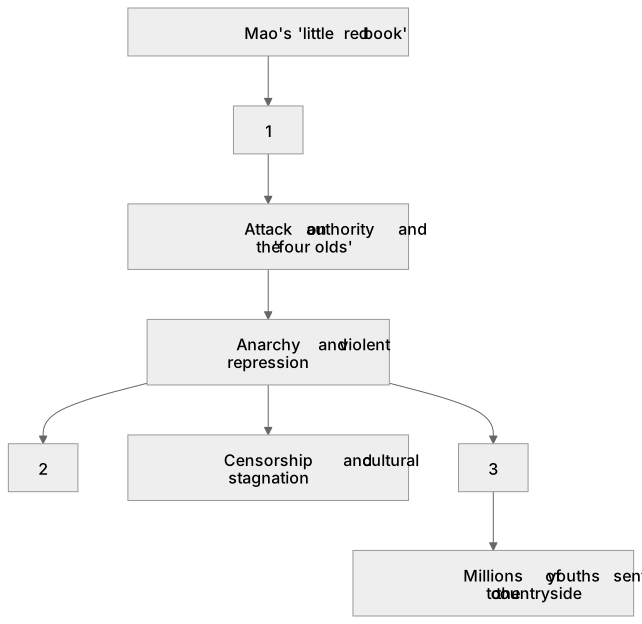
The Cultural Revolution profoundly disrupted China. Economically, industrial output plummeted as workers engaged in political struggle rather than production, severely stunting economic growth. Socially, young people were mobilised as Red Guards, empowered by Mao's 'little red book' to attack authority figures and destroy the 'four olds' (customs, culture, habits, and ideas). This unleashed widespread anarchy and violent repression, eventually requiring the PLA to enforce rectification and restore order by sending millions of youths to the countryside. Culturally, Jiang Qing's strict censorship led to severe cultural stagnation, with traditional arts replaced by eight model operas, stifling all creative expression and intellectual life.
What earns the marks
- Assess the disruption to economic growth, noting the decline in industrial and agricultural output due to political factionalism and mass mobilisation.
- Evaluate the mobilisation of young people as Red Guards and their subsequent 'rustication' during the rectification phase.
- Analyse the campaign against the 'four olds' and how Mao's 'little red book' provided the ideological justification for violence and rebellion.
- Examine the descent into anarchy, the repressive violence of the Red Guards, and the PLA's role in restoring order during the rectification campaign.
- Discuss the impact of censorship under Jiang Qing, leading to cultural stagnation and the promotion of proletarian model works at the expense of traditional culture.
Common mistakes and how to put them right
Assuming the Cultural Revolution was solely a top-down political purge.
Put it right: Recognise the genuine, albeit manipulated, grassroots mobilisation of young people.
Confusing the 'four olds' with the 'four modernisations'.
Put it right: The 'four olds' were targets for destruction (customs, culture, habits, ideas), whereas the modernisations were later economic goals.
Believing economic growth completely collapsed for the entire decade.
Put it right: Acknowledge that while the initial anarchic phase (1966-1969) caused severe economic disruption, some recovery occurred in the early 1970s.
Exam tips
- Link the destruction of the 'four olds' directly to the cultural stagnation and censorship enforced by Jiang Qing to show interconnected impacts.
- Use the 'little red book' as a concrete example of how Mao's cult of personality facilitated mass mobilisation and justified anarchy.
- When discussing rectification, highlight the role of the PLA in suppressing the Red Guards to demonstrate the limits of Mao's tolerance for anarchy.
Try the lesson
The start of the 2P The Transformation of China, 1936–1997 – The Cultural Revolution, 1966–1976 (A-level only): The economic, social and cultural impact of the Cultural Revolution: effect on economic growth; effect on young people; the 'four olds’; anarchy, repression and rectification; censorship and cultural stagnation; Mao's 'little red book' lesson, made from checked teaching notes for this specification point.
Have a go first
Which of the following was explicitly targeted for destruction by the Red Guards during the campaign against the 'Four Olds' in the Cultural Revolution?
Listen
The Cultural Revolution profoundly disrupted China. Economically, industrial output plummeted as workers engaged in political struggle rather than production, severely stunting economic growth. Socially, young people were mobilised as Red Guards, empowered by Mao's 'little red book' to attack authority figures and destroy the 'four olds' (customs, culture, habits, and ideas). This unleashed widespread anarchy and violent repression, eventually requiring the PLA to enforce rectification and restore order by sending millions of youths to the countryside. Culturally, Jiang Qing's strict censorship led to severe cultural stagnation, with traditional arts replaced by eight model operas, stifling all creative expression and intellectual life. A strong answer earns marks for these points. Assess the disruption to economic growth, noting the decline in industrial and agricultural output due to political factionalism and mass mobilisation. Evaluate the mobilisation of young people as Red Guards and their subsequent 'rustication' during the rectification phase. Analyse the campaign against the 'four olds' and how Mao's 'little red book' provided the ideological justification for violence and rebellion. Examine the descent into anarchy, the repressive violence of the Red Guards, and the PLA's role in restoring order during the rectification campaign. A common slip: Assuming the Cultural Revolution was solely a top-down political purge. Instead, recognise the genuine, albeit manipulated, grassroots mobilisation of young people. Exam tip: Link the destruction of the 'four olds' directly to the cultural stagnation and censorship enforced by Jiang Qing to show interconnected impacts.
See it
Key words
Say what each word means before you turn the card.
four olds
Try answering aloud or in your head before turning the card.
little red book
Try answering aloud or in your head before turning the card.
rectification
Try answering aloud or in your head before turning the card.
censorship
Try answering aloud or in your head before turning the card.
See every definition
- four olds
- Customs, culture, habits and ideas that young people were mobilised to destroy during the Cultural Revolution.
- little red book
- Mao's book that empowered young people mobilised as Red Guards to attack authority figures and destroy the 'four olds'.
- rectification
- The phase in which the PLA enforced order and sent millions of youths to the countryside.
- censorship
- Jiang Qing's strict control that led to severe cultural stagnation, with traditional arts replaced by eight model operas.
Label the diagram
Some boxes have lost their names. Pick the right name for each number.
1Box 1
2Box 2
3Box 3
There is more to this lesson
The full lesson goes on to check your understanding and help you earn the marks. Create a free account to carry on, with your progress saved.
A week of Premium from your first lesson · Then the free plan continues · No card, no charge
Test your understanding of 2P The Transformation of China, 1936–1997 – The Cultural Revolution, 1966–1976 (A-level only): The economic, social and cultural impact of the Cultural Revolution: effect on economic growth; effect on young people; the 'four olds’; anarchy, repression and rectification; censorship and cultural stagnation; Mao's 'little red book'
Active recall beats re-reading. Take an instant quiz now to test what you’ve learned and lock it into long-term memory.
A week of Premium from your first lesson · Then the free plan continues · No card, no charge