AQA · A-Level · History
Course version: 7042 · Version from Sept 2017
Economic developments: industry and agriculture; voluntary and compulsory…
Full specification wording
2P The Transformation of China, 1936–1997 – The transition to Socialism, 1952–1962: Economic developments: industry and agriculture; voluntary and compulsory collectivisation; the first Five Year Plan for industry and the Great Leap Forward; purge of Peng Dehuai; reasons for the failure of GLF and its aftermath; debates over economic policy
China's economy transformed via the First Five Year Plan, expanding heavy industry.
Checked against the AQA 7042 specification (opens in a new tab) on .
- Point 2 of 4
- 4 key terms
Study notes
From the checked teaching notes for this specification point.
The idea
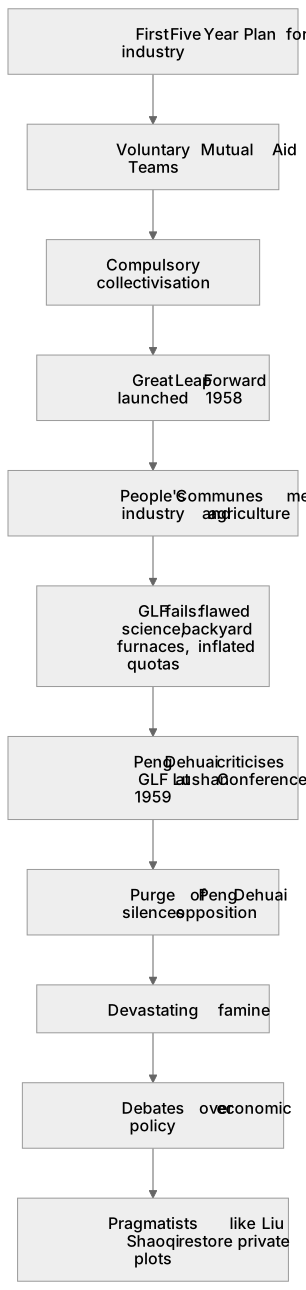
China's economy transformed via the First Five Year Plan, expanding heavy industry. Agriculture shifted from voluntary Mutual Aid Teams to compulsory collectivisation. Seeking rapid growth, Mao launched the Great Leap Forward (GLF) in 1958, merging industry and agriculture into People's Communes. The GLF failed disastrously due to flawed science, backyard furnaces producing useless steel, and inflated quotas. When Peng Dehuai criticised the GLF at the 1959 Lushan Conference, his purge silenced opposition. The aftermath brought a devastating famine and intense debates over economic policy, allowing pragmatists like Liu Shaoqi to restore private plots to recover the economy.
What earns the marks
- Contrast the relative success of the First Five Year Plan in heavy industry with the catastrophic failures of the Great Leap Forward.
- Trace the escalation of agricultural policy from voluntary Mutual Aid Teams to compulsory collectivisation and the establishment of People's Communes.
- Analyse the reasons for the GLF's failure, including ideological rigidity, fear of reporting true figures, and the diversion of peasant labour to backyard furnaces.
- Evaluate the significance of Peng Dehuai's purge at Lushan in demonstrating Mao's refusal to accept criticism and its role in exacerbating the famine.
- Assess the debates over economic policy in the aftermath of the GLF, focusing on the pragmatic reforms introduced by Liu Shaoqi and Deng Xiaoping.
Common mistakes and how to put them right
Stating that collectivisation was compulsory from the very beginning of CCP rule.
Put it right: Clarify that early stages involving Mutual Aid Teams were voluntary, with compulsory collectivisation accelerating later in the 1950s.
Blaming the failure of the Great Leap Forward solely on natural disasters.
Put it right: Emphasise that while weather played a role, human factors like inflated production figures, backyard furnaces, and the purge of Peng Dehuai were the primary causes.
Confusing the First Five Year Plan with the Great Leap Forward.
Put it right: Distinguish the First Five Year Plan as a Soviet-style, centrally planned industrial success, whereas the GLF was a decentralised, utopian failure.
Exam tips
- Use the purge of Peng Dehuai to link economic failures with political developments, showing how fear dictated economic reporting.
- When discussing debates over economic policy, contrast Mao's ideological focus on mass mobilisation with the pragmatism of Liu Shaoqi and Deng Xiaoping.
- Quantify the human cost of the GLF's failure, specifically the Great Famine, to underscore the severity of the policy's aftermath.
Try the lesson
The start of the 2P The Transformation of China, 1936–1997 – The transition to Socialism, 1952–1962: Economic developments: industry and agriculture; voluntary and compulsory collectivisation; the first Five Year Plan for industry and the Great Leap Forward; purge of Peng Dehuai; reasons for the failure of GLF and its aftermath; debates over economic policy lesson, made from checked teaching notes for this specification point.
Have a go first
Which sector of the economy was the primary focus of China's First Five-Year Plan (1953–1957)?
Listen
China's economy transformed via the First Five Year Plan, expanding heavy industry. Agriculture shifted from voluntary Mutual Aid Teams to compulsory collectivisation. Seeking rapid growth, Mao launched the Great Leap Forward (GLF) in 1958, merging industry and agriculture into People's Communes. The GLF failed disastrously due to flawed science, backyard furnaces producing useless steel, and inflated quotas. When Peng Dehuai criticised the GLF at the 1959 Lushan Conference, his purge silenced opposition. The aftermath brought a devastating famine and intense debates over economic policy, allowing pragmatists like Liu Shaoqi to restore private plots to recover the economy. A strong answer earns marks for these points. Contrast the relative success of the First Five Year Plan in heavy industry with the catastrophic failures of the Great Leap Forward. Trace the escalation of agricultural policy from voluntary Mutual Aid Teams to compulsory collectivisation and the establishment of People's Communes. Analyse the reasons for the GLF's failure, including ideological rigidity, fear of reporting true figures, and the diversion of peasant labour to backyard furnaces. Evaluate the significance of Peng Dehuai's purge at Lushan in demonstrating Mao's refusal to accept criticism and its role in exacerbating the famine. A common slip: Stating that collectivisation was compulsory from the very beginning of CCP rule. Instead, Clarify that early stages involving Mutual Aid Teams were voluntary, with compulsory collectivisation accelerating later in the 1950s. Exam tip: Use the purge of Peng Dehuai to link economic failures with political developments, showing how fear dictated economic reporting.
See it
Key words
Say what each word means before you turn the card.
Economic Transformation
Try answering aloud or in your head before turning the card.
Ideology vs Pragmatism
Try answering aloud or in your head before turning the card.
State Control and Coercion
Try answering aloud or in your head before turning the card.
Leadership and Accountability
Try answering aloud or in your head before turning the card.
See every definition
- Economic Transformation
- The economy was transformed through the First Five Year Plan, which expanded heavy industry, and through agriculture shifting from voluntary Mutual Aid Teams to compulsory collectivisation.
- Ideology vs Pragmatism
- Mao's ideological focus on mass mobilisation is contrasted with the pragmatism of Liu Shaoqi and Deng Xiaoping, who restored private plots to recover the economy.
- State Control and Coercion
- Agriculture moved from voluntary Mutual Aid Teams to compulsory collectivisation, and the purge of Peng Dehuai silenced opposition.
- Leadership and Accountability
- When Peng Dehuai criticised the Great Leap Forward at the 1959 Lushan Conference, his purge demonstrated Mao's refusal to accept criticism.
Label the diagram
Some boxes have lost their names. Pick the right name for each number.
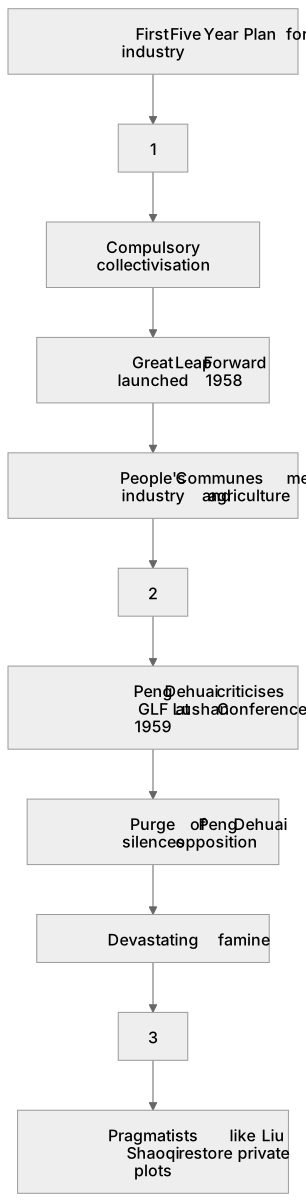
1Box 1
2Box 2
3Box 3
There is more to this lesson
The full lesson goes on to check your understanding and help you earn the marks. Create a free account to carry on, with your progress saved.
A week of Premium from your first lesson · Then the free plan continues · No card, no charge
Test your understanding of 2P The Transformation of China, 1936–1997 – The transition to Socialism, 1952–1962: Economic developments: industry and agriculture; voluntary and compulsory collectivisation; the first Five Year Plan for industry and the Great Leap Forward; purge of Peng Dehuai; reasons for the failure of GLF and its aftermath; debates over economic policy
Active recall beats re-reading. Take an instant quiz now to test what you’ve learned and lock it into long-term memory.
A week of Premium from your first lesson · Then the free plan continues · No card, no charge