AQA · A-Level · History
Course version: 7042 · Version from Sept 2017
Political developments: issues of leadership and purges of the CCP; the…
Full specification wording
2P The Transformation of China, 1936–1997 – The transition to Socialism, 1952–1962: Political developments: issues of leadership and purges of the CCP; the 100 Flowers campaign; Mao's resignation as Chairman of PRC
Between 1952 and 1962, Mao consolidated control through intense political manoeuvring.
Checked against the AQA 7042 specification (opens in a new tab) on .
- Point 1 of 4
- 4 key terms
Study notes
From the checked teaching notes for this specification point.
The idea
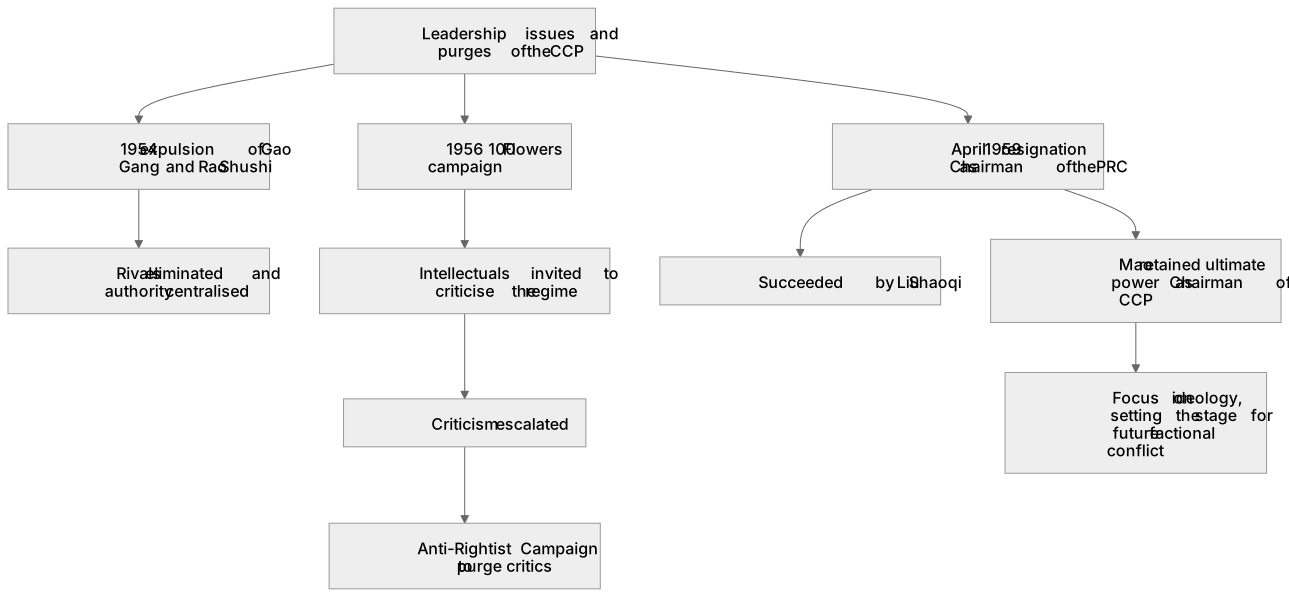
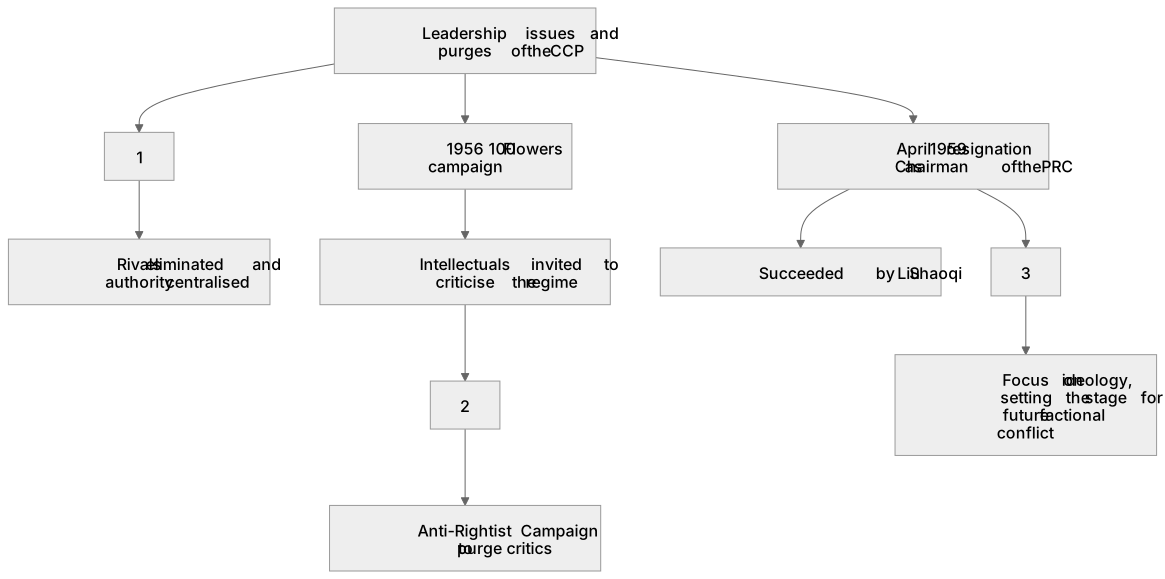
Between 1952 and 1962, Mao consolidated control through intense political manoeuvring. Leadership issues and purges of the CCP, like the 1954 expulsion of Gao Gang and Rao Shushi, eliminated rivals and centralised authority. In 1956, Mao launched the 100 Flowers campaign, inviting intellectuals to criticise the regime. When criticism escalated, Mao reversed course, launching the Anti-Rightist Campaign to purge critics. In April 1959, before the full catastrophic failure of the Great Leap Forward was acknowledged at Lushan, Mao enacted his resignation as Chairman of the PRC. He was succeeded by Liu Shaoqi, though Mao retained ultimate power as Chairman of the CCP to focus on ideology, setting the stage for future factional conflict.
What earns the marks
- Explain the motivations behind the 100 Flowers campaign, distinguishing between a genuine desire for feedback and a trap to expose dissidents.
- Assess the impact of the Anti-Rightist Campaign on the CCP's relationship with intellectuals and the stifling of technical expertise.
- Analyse the significance of the Gao Gang and Rao Shushi purge in establishing Mao's intolerance for factionalism within the CCP leadership.
- Evaluate the political consequences of Mao's resignation as PRC Chairman, noting the division of labour between Mao focusing on ideology and Liu Shaoqi managing administration.
Common mistakes and how to put them right
Claiming Mao resigned from all leadership positions in 1959.
Put it right: Specify that Mao only resigned as Chairman of the PRC (Head of State), but retained his crucial role as Chairman of the CCP.
Confusing the 100 Flowers campaign with the Cultural Revolution.
Put it right: Place the 100 Flowers campaign in 1956 to 1957, focusing on intellectuals, whereas the Cultural Revolution began in 1966 with broader societal upheaval.
Assuming the CCP leadership was entirely united before the Great Leap Forward.
Put it right: Highlight the Gao Gang affair of 1954 to demonstrate early factionalism and leadership disputes.
Exam tips
- Link political purges to economic policies; for example, explain how the Anti-Rightist Campaign silenced experts who might have warned against the Great Leap Forward.
- When discussing Mao's resignation as PRC Chairman, evaluate whether this was a strategic retreat or a genuine loss of political influence.
- Use the 100 Flowers campaign to demonstrate Mao's complex and often contradictory approach to mass mobilisation and party discipline.
Try the lesson
The start of the 2P The Transformation of China, 1936–1997 – The transition to Socialism, 1952–1962: Political developments: issues of leadership and purges of the CCP; the 100 Flowers campaign; Mao's resignation as Chairman of PRC lesson, made from checked teaching notes for this specification point.
Have a go first
What was the primary consequence of the Hundred Flowers Campaign for those who openly criticised the Chinese Communist Party?
Listen
Between 1952 and 1962, Mao consolidated control through intense political manoeuvring. Leadership issues and purges of the CCP, like the 1954 expulsion of Gao Gang and Rao Shushi, eliminated rivals and centralised authority. In 1956, Mao launched the 100 Flowers campaign, inviting intellectuals to criticise the regime. When criticism escalated, Mao reversed course, launching the Anti-Rightist Campaign to purge critics. In April 1959, before the full catastrophic failure of the Great Leap Forward was acknowledged at Lushan, Mao enacted his resignation as Chairman of the PRC. He was succeeded by Liu Shaoqi, though Mao retained ultimate power as Chairman of the CCP to focus on ideology, setting the stage for future factional conflict. A strong answer earns marks for these points. Explain the motivations behind the 100 Flowers campaign, distinguishing between a genuine desire for feedback and a trap to expose dissidents. Assess the impact of the Anti-Rightist Campaign on the CCP's relationship with intellectuals and the stifling of technical expertise. Analyse the significance of the Gao Gang and Rao Shushi purge in establishing Mao's intolerance for factionalism within the CCP leadership. Evaluate the political consequences of Mao's resignation as PRC Chairman, noting the division of labour between Mao focusing on ideology and Liu Shaoqi managing administration. A common slip: Claiming Mao resigned from all leadership positions in 1959. Instead, Specify that Mao only resigned as Chairman of the PRC (Head of State), but retained his crucial role as Chairman of the CCP. Exam tip: Link political purges to economic policies; for example, explain how the Anti-Rightist Campaign silenced experts who might have warned against the Great Leap Forward.
See it
Key words
Say what each word means before you turn the card.
Consolidation of Power
Try answering aloud or in your head before turning the card.
Factionalism and Purges
Try answering aloud or in your head before turning the card.
Mass Mobilisation
Try answering aloud or in your head before turning the card.
Ideology vs Pragmatism
Try answering aloud or in your head before turning the card.
See every definition
- Consolidation of Power
- Mao consolidated control through intense political manoeuvring, eliminating rivals and centralising authority.
- Factionalism and Purges
- Purges of the CCP, like the 1954 expulsion of Gao Gang and Rao Shushi, eliminated rivals and established intolerance for factionalism within the leadership.
- Mass Mobilisation
- The 100 Flowers campaign invited intellectuals to criticise the regime, demonstrating a complex and often contradictory approach to mass mobilisation and party discipline.
- Ideology vs Pragmatism
- Mao retained ultimate power as Chairman of the CCP to focus on ideology, while Liu Shaoqi managed administration.
Label the diagram
Some boxes have lost their names. Pick the right name for each number.
1Box 1
2Box 2
3Box 3
There is more to this lesson
The full lesson goes on to check your understanding and help you earn the marks. Create a free account to carry on, with your progress saved.
A week of Premium from your first lesson · Then the free plan continues · No card, no charge
Test your understanding of 2P The Transformation of China, 1936–1997 – The transition to Socialism, 1952–1962: Political developments: issues of leadership and purges of the CCP; the 100 Flowers campaign; Mao's resignation as Chairman of PRC
Active recall beats re-reading. Take an instant quiz now to test what you’ve learned and lock it into long-term memory.
A week of Premium from your first lesson · Then the free plan continues · No card, no charge