AQA · A-Level · History
Course version: 7042 · Version from Sept 2017
Reality and illusion, 1945–1980 – Eisenhower: tranquility and crisis,…
Full specification wording
2Q The American Dream: reality and illusion, 1945–1980 – Eisenhower: tranquility and crisis, 1952–1960: African-Americans in North and South: the emergence of the Civil Rights Movement; the policies and attitudes of the main political parties; the responses of the state and federal authorities
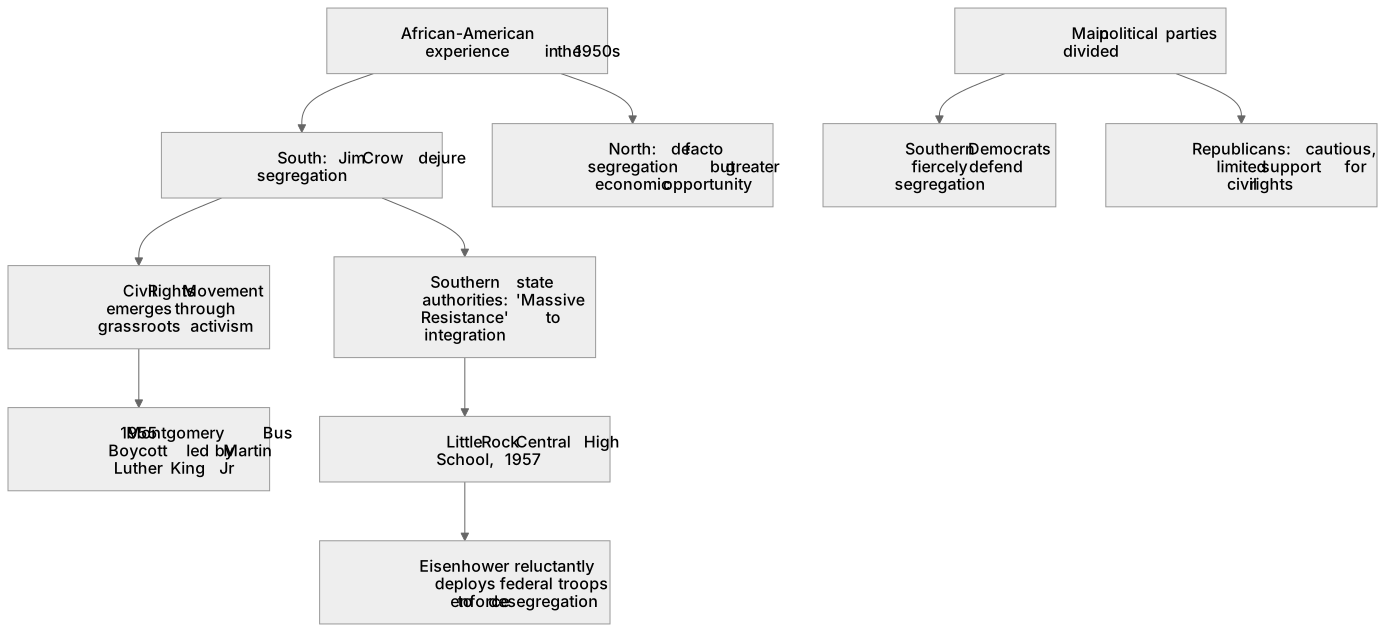
During the 1950s, the African-American experience diverged: the South enforced strict Jim Crow segregation, while the North offered de facto segregation but greater economic opportunity.
Checked against the AQA 7042 specification (opens in a new tab) on .
- Point 4 of 4
- 4 key terms
Study notes
From the checked teaching notes for this specification point.
The idea
During the 1950s, the African-American experience diverged: the South enforced strict Jim Crow segregation, while the North offered de facto segregation but greater economic opportunity. The Civil Rights Movement emerged powerfully through grassroots activism, notably the 1955 Montgomery Bus Boycott led by Martin Luther King Jr. The main political parties were divided; Southern Democrats fiercely defended segregation, while Republicans showed cautious, limited support for civil rights. State authorities in the South responded with 'Massive Resistance' to integration. Conversely, federal authorities began to intervene, as seen when Eisenhower reluctantly deployed federal troops to enforce the desegregation of Little Rock Central High School in 1957.
What earns the marks
- Compare the lived experiences of African-Americans facing de jure segregation in the South and de facto segregation in the North.
- Evaluate the significance of key events in the emergence of the Civil Rights Movement, such as the Montgomery Bus Boycott and the formation of the SCLC.
- Analyse the internal divisions within the Democratic Party regarding civil rights, contrasting Southern Dixiecrats with Northern liberals.
- Assess the conflict between state and federal authorities, using the Little Rock crisis (1957) as a primary example of federal intervention against state resistance.
Common mistakes and how to put them right
Stating that the Republican Party was universally supportive of civil rights during the 1950s.
Put it right: Recognise that Eisenhower and the Republicans were often cautious and reluctant to alienate white Southern voters, offering only moderate support.
Assuming segregation only existed in the Southern states.
Put it right: Distinguish between the legal (de jure) segregation of the South and the systemic, housing, and employment (de facto) segregation experienced by African-Americans in the North.
Claiming Eisenhower enthusiastically supported the Brown v. Board of Education ruling.
Put it right: Note that Eisenhower privately disagreed with the ruling and only intervened at Little Rock to uphold federal authority, not out of moral zeal for integration.
Exam tips
- Use the 1954 Brown v. Board of Education Supreme Court decision as a catalyst for both the emergence of the Civil Rights Movement and the Southern 'Massive Resistance'.
- Highlight the role of the media, particularly television, in bringing the realities of Southern segregation and the Montgomery Bus Boycott to a national audience.
- Discuss the limitations of the 1957 and 1960 Civil Rights Acts to demonstrate the cautious approach of the federal government and the main political parties.
Try the lesson
The start of the 2Q The American Dream: reality and illusion, 1945–1980 – Eisenhower: tranquility and crisis, 1952–1960: African-Americans in North and South: the emergence of the Civil Rights Movement; the policies and attitudes of the main political parties; the responses of the state and federal authorities lesson, made from checked teaching notes for this specification point.
Have a go first
How did President Eisenhower respond to the Arkansas governor's use of the National Guard to prevent African-American students from entering Little Rock Central High School in 1957?
Listen
During the 1950s, the African-American experience diverged: the South enforced strict Jim Crow segregation, while the North offered de facto segregation but greater economic opportunity. The Civil Rights Movement emerged powerfully through grassroots activism, notably the 1955 Montgomery Bus Boycott led by Martin Luther King Jr. The main political parties were divided; Southern Democrats fiercely defended segregation, while Republicans showed cautious, limited support for civil rights. State authorities in the South responded with 'Massive Resistance' to integration. Conversely, federal authorities began to intervene, as seen when Eisenhower reluctantly deployed federal troops to enforce the desegregation of Little Rock Central High School in 1957. A strong answer earns marks for these points. Compare the lived experiences of African-Americans facing de jure segregation in the South and de facto segregation in the North. Evaluate the significance of key events in the emergence of the Civil Rights Movement, such as the Montgomery Bus Boycott and the formation of the SCLC. Analyse the internal divisions within the Democratic Party regarding civil rights, contrasting Southern Dixiecrats with Northern liberals. Assess the conflict between state and federal authorities, using the Little Rock crisis (1957) as a primary example of federal intervention against state resistance. A common slip: Stating that the Republican Party was universally supportive of civil rights during the 1950s. Instead, Recognise that Eisenhower and the Republicans were often cautious and reluctant to alienate white Southern voters, offering only moderate support. Exam tip: Use the 1954 Brown v. Board of Education Supreme Court decision as a catalyst for both the emergence of the Civil Rights Movement and the Southern 'Massive Resistance'.
See it
Key words
Say what each word means before you turn the card.
Grassroots Activism vs. Federal Action
Try answering aloud or in your head before turning the card.
States' Rights vs. Federal Authority
Try answering aloud or in your head before turning the card.
De Jure vs. De Facto Segregation
Try answering aloud or in your head before turning the card.
Political Realignment and Party Factions
Try answering aloud or in your head before turning the card.
See every definition
- Grassroots Activism vs. Federal Action
- The Civil Rights Movement emerged powerfully through grassroots activism, while federal authorities began to intervene, as seen when Eisenhower reluctantly deployed federal troops.
- States' Rights vs. Federal Authority
- State authorities in the South responded with 'Massive Resistance' to integration, while federal authorities began to intervene to enforce desegregation.
- De Jure vs. De Facto Segregation
- The South enforced strict Jim Crow segregation, while the North offered de facto segregation but greater economic opportunity.
- Political Realignment and Party Factions
- The main political parties were divided, with Southern Democrats fiercely defending segregation while Republicans showed cautious, limited support for civil rights.
Label the diagram
Some boxes have lost their names. Pick the right name for each number.
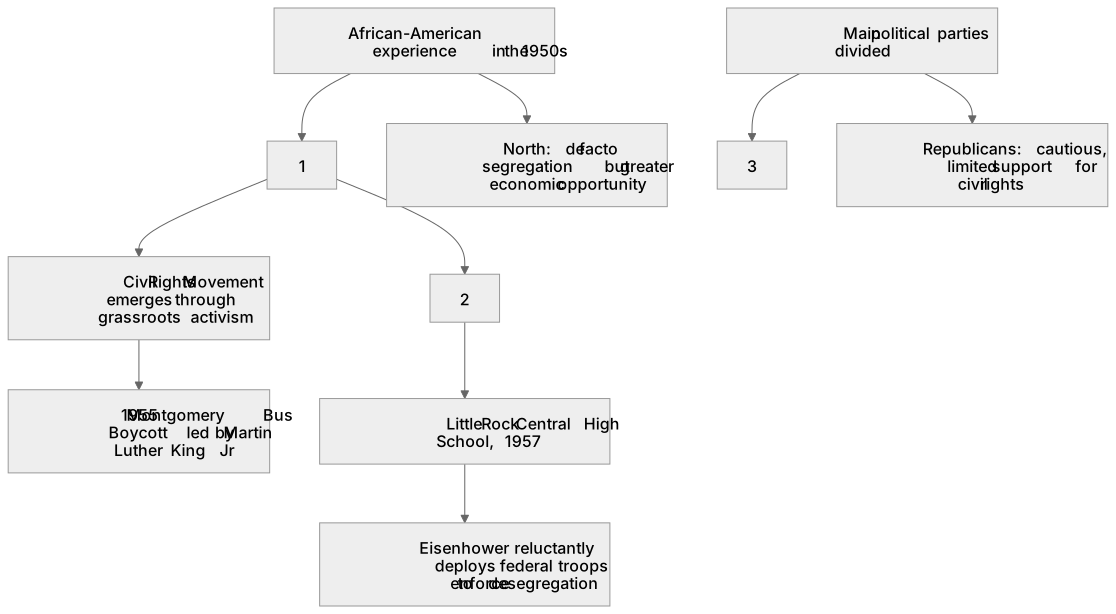
1Box 1
2Box 2
3Box 3
There is more to this lesson
The full lesson goes on to check your understanding and help you earn the marks. Create a free account to carry on, with your progress saved.
A week of Premium from your first lesson · Then the free plan continues · No card, no charge
Test your understanding of 2Q The American Dream: reality and illusion, 1945–1980 – Eisenhower: tranquility and crisis, 1952–1960: African-Americans in North and South: the emergence of the Civil Rights Movement; the policies and attitudes of the main political parties; the responses of the state and federal authorities
Active recall beats re-reading. Take an instant quiz now to test what you’ve learned and lock it into long-term memory.
A week of Premium from your first lesson · Then the free plan continues · No card, no charge