AQA · A-Level · History
Course version: 7042 · Version from Sept 2017
Reality and illusion, 1945–1980 – Eisenhower: tranquility and crisis,…
Full specification wording
2Q The American Dream: reality and illusion, 1945–1980 – Eisenhower: tranquility and crisis, 1952–1960: The presidency: Eisenhower’s personality and the policies of ‘dynamic conservatism’; Nixon as Vice-President; the Republican Party; the end of McCarthyism
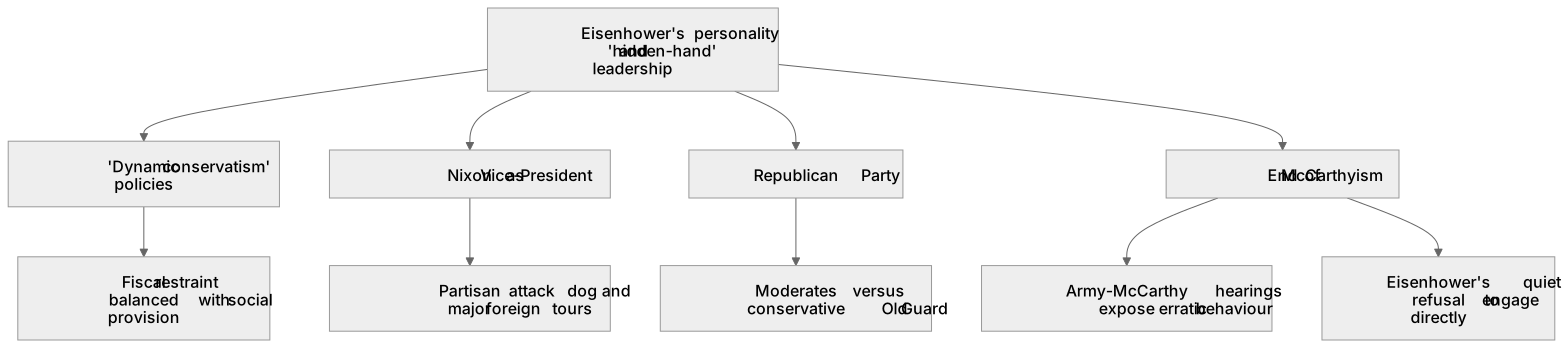
Eisenhower’s ‘hidden-hand’ leadership and grandfatherly personality projected calm during the Cold War.
Checked against the AQA 7042 specification (opens in a new tab) on .
- Point 1 of 4
- 4 key terms
Study notes
From the checked teaching notes for this specification point.
The idea
Eisenhower’s ‘hidden-hand’ leadership and grandfatherly personality projected calm during the Cold War. His domestic agenda, ‘dynamic conservatism’, balanced fiscal restraint with social provision, exemplified by expanding Social Security and creating the Interstate Highway System. Richard Nixon was a highly active Vice-President, acting as the partisan attack dog and undertaking major foreign tours. The Republican Party remained divided between Eisenhower's moderates and the conservative Old Guard. The end of McCarthyism occurred when Senator McCarthy’s anti-communist crusade collapsed following his erratic performance during the 1954 Army-McCarthy hearings, aided by Eisenhower’s quiet refusal to engage directly.
What earns the marks
- Evaluate Eisenhower's 'hidden-hand' leadership and how his public grandfatherly persona masked a shrewd political operator.
- Analyse the principles of 'dynamic conservatism', noting the balance between fiscal conservatism and social liberalism.
- Assess Nixon's role as Vice-President, particularly his partisan campaigning which allowed Eisenhower to remain above the political fray.
- Examine the internal divisions within the Republican Party between the moderate Eastern establishment and the conservative Old Guard.
- Explain the factors leading to the end of McCarthyism, including the televised Army-McCarthy hearings and the Senate's censure of McCarthy.
Common mistakes and how to put them right
Claiming Eisenhower was a passive or inactive president.
Put it right: Recognise his 'hidden-hand' leadership style, where he actively managed policy behind the scenes while maintaining a serene public image.
Stating that 'dynamic conservatism' aimed to dismantle the New Deal.
Put it right: Explain that Eisenhower accepted and even expanded core New Deal programmes like Social Security, while seeking to limit federal spending.
Assuming McCarthyism ended solely because of Eisenhower's public condemnation.
Put it right: Note that Eisenhower deliberately avoided publicly criticising McCarthy, relying instead on the Army-McCarthy hearings to expose McCarthy's erratic behaviour.
Exam tips
- Use the Interstate Highway Act of 1956 as a prime example of 'dynamic conservatism' in action, highlighting its economic and defence benefits.
- Contrast Nixon's aggressive political campaigning with Eisenhower's 'above politics' stance to demonstrate how they functioned as a complementary team.
- When discussing the Republican Party, explicitly differentiate between the moderate wing and the conservative Old Guard led by figures like Robert Taft.
Try the lesson
The start of the 2Q The American Dream: reality and illusion, 1945–1980 – Eisenhower: tranquility and crisis, 1952–1960: The presidency: Eisenhower’s personality and the policies of ‘dynamic conservatism’; Nixon as Vice-President; the Republican Party; the end of McCarthyism lesson, made from checked teaching notes for this specification point.
Have a go first
Which of the following best describes President Dwight D. Eisenhower's domestic policy approach, known as 'dynamic conservatism'?
Listen
Eisenhower’s ‘hidden-hand’ leadership and grandfatherly personality projected calm during the Cold War. His domestic agenda, ‘dynamic conservatism’, balanced fiscal restraint with social provision, exemplified by expanding Social Security and creating the Interstate Highway System. Richard Nixon was a highly active Vice-President, acting as the partisan attack dog and undertaking major foreign tours. The Republican Party remained divided between Eisenhower's moderates and the conservative Old Guard. The end of McCarthyism occurred when Senator McCarthy’s anti-communist crusade collapsed following his erratic performance during the 1954 Army-McCarthy hearings, aided by Eisenhower’s quiet refusal to engage directly. A strong answer earns marks for these points. Evaluate Eisenhower's 'hidden-hand' leadership and how his public grandfatherly persona masked a shrewd political operator. Analyse the principles of 'dynamic conservatism', noting the balance between fiscal conservatism and social liberalism. Assess Nixon's role as Vice-President, particularly his partisan campaigning which allowed Eisenhower to remain above the political fray. Examine the internal divisions within the Republican Party between the moderate Eastern establishment and the conservative Old Guard. A common slip: Claiming Eisenhower was a passive or inactive president. Instead, Recognise his 'hidden-hand' leadership style, where he actively managed policy behind the scenes while maintaining a serene public image. Exam tip: Use the Interstate Highway Act of 1956 as a prime example of 'dynamic conservatism' in action, highlighting its economic and defence benefits.
See it
Key words
Say what each word means before you turn the card.
Dynamic conservatism
Try answering aloud or in your head before turning the card.
Hidden-hand leadership
Try answering aloud or in your head before turning the card.
Grandfatherly personality
Try answering aloud or in your head before turning the card.
Old Guard
Try answering aloud or in your head before turning the card.
See every definition
- Dynamic conservatism
- A domestic agenda that balanced fiscal restraint with social provision, exemplified by expanding Social Security and creating the Interstate Highway System.
- Hidden-hand leadership
- A style in which policy was actively managed behind the scenes while a serene public image was maintained.
- Grandfatherly personality
- A public persona that projected calm during the Cold War.
- Old Guard
- The conservative wing of the Republican Party, divided from Eisenhower's moderates.
Label the diagram
Some boxes have lost their names. Pick the right name for each number.
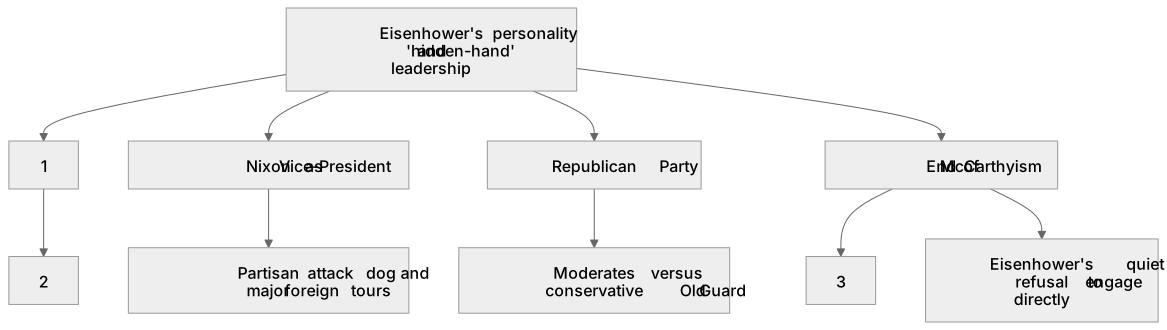
1Box 1
2Box 2
3Box 3
There is more to this lesson
The full lesson goes on to check your understanding and help you earn the marks. Create a free account to carry on, with your progress saved.
A week of Premium from your first lesson · Then the free plan continues · No card, no charge
Test your understanding of 2Q The American Dream: reality and illusion, 1945–1980 – Eisenhower: tranquility and crisis, 1952–1960: The presidency: Eisenhower’s personality and the policies of ‘dynamic conservatism’; Nixon as Vice-President; the Republican Party; the end of McCarthyism
Active recall beats re-reading. Take an instant quiz now to test what you’ve learned and lock it into long-term memory.
A week of Premium from your first lesson · Then the free plan continues · No card, no charge