AQA · A-Level · History
Course version: 7042 · Version from Sept 2017
Reality and illusion, 1945–1980 – Eisenhower: tranquility and crisis,…
Full specification wording
2Q The American Dream: reality and illusion, 1945–1980 – Eisenhower: tranquility and crisis, 1952–1960: The growth of the American economy in the 1950s and the impact of the ‘consumer society’
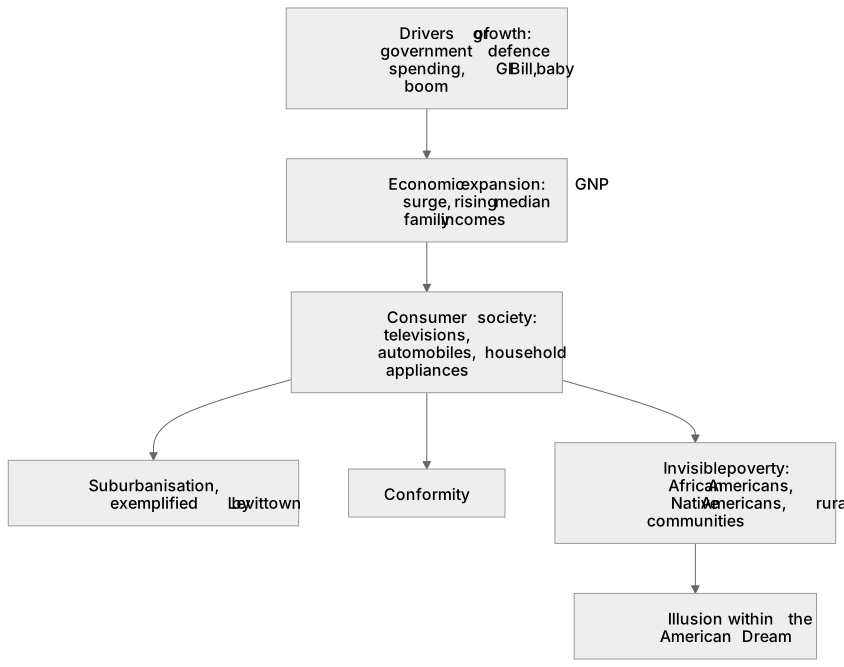
The 1950s witnessed unprecedented growth in the American economy, driven by post-war government spending, the GI Bill, and a boom in manufacturing.
Checked against the AQA 7042 specification (opens in a new tab) on .
- Point 2 of 4
- 4 key terms
Study notes
From the checked teaching notes for this specification point.
The idea
The 1950s witnessed unprecedented growth in the American economy, driven by post-war government spending, the GI Bill, and a boom in manufacturing. Gross National Product surged, creating a robust middle class and widespread prosperity. This economic expansion fuelled the impact of the ‘consumer society’, where purchasing goods became a defining feature of the American Dream. The proliferation of televisions, automobiles, and household appliances transformed daily life and spurred suburbanisation, exemplified by Levittown. However, this consumerism also fostered conformity and masked underlying poverty, as minorities and rural populations were often excluded from this newfound affluence, highlighting the illusion within the American Dream.
What earns the marks
- Identify the drivers of 1950s economic growth, including government defence spending during the Cold War, the GI Bill, and the baby boom.
- Analyse the statistical evidence of economic expansion, such as the significant increase in Gross National Product and rising median family incomes.
- Evaluate the impact of the 'consumer society' on American culture, noting the rise of television advertising, credit cards, and planned obsolescence.
- Assess the relationship between the consumer boom and suburbanisation, highlighting the reliance on the automobile and the growth of out-of-town shopping malls.
- Critique the limitations of the consumer society, acknowledging the 'invisible poverty' experienced by African Americans, Native Americans, and rural communities.
Common mistakes and how to put them right
Assuming the 1950s economic boom benefited all Americans equally.
Put it right: Emphasise that significant pockets of poverty remained, particularly among ethnic minorities and in regions like Appalachia, which were excluded from the consumer society.
Attributing economic growth solely to free-market capitalism.
Put it right: Acknowledge the crucial role of federal government intervention, such as military-industrial spending and the GI Bill, in stimulating the economy.
Treating the 'consumer society' merely as an economic phenomenon.
Put it right: Discuss the profound cultural impacts of consumerism, including the promotion of conformity, changing gender roles, and the rise of youth culture.
Exam tips
- Use specific statistics, such as the increase in automobile ownership or television sales, to substantiate claims about the scale of the consumer boom.
- Link the growth of the consumer society to the broader theme of the 'American Dream', contrasting the reality of suburban affluence with the illusion of universal prosperity.
- Discuss the concept of 'planned obsolescence' to demonstrate a sophisticated understanding of how the consumer economy sustained its rapid growth.
Try the lesson
The start of the 2Q The American Dream: reality and illusion, 1945–1980 – Eisenhower: tranquility and crisis, 1952–1960: The growth of the American economy in the 1950s and the impact of the ‘consumer society’ lesson, made from checked teaching notes for this specification point.
Have a go first
Which of the following was a defining characteristic of the American 'consumer society' that emerged during the economic boom of the 1950s?
Listen
The 1950s witnessed unprecedented growth in the American economy, driven by post-war government spending, the GI Bill, and a boom in manufacturing. Gross National Product surged, creating a robust middle class and widespread prosperity. This economic expansion fuelled the impact of the ‘consumer society’, where purchasing goods became a defining feature of the American Dream. The proliferation of televisions, automobiles, and household appliances transformed daily life and spurred suburbanisation, exemplified by Levittown. However, this consumerism also fostered conformity and masked underlying poverty, as minorities and rural populations were often excluded from this newfound affluence, highlighting the illusion within the American Dream. A strong answer earns marks for these points. Identify the drivers of 1950s economic growth, including government defence spending during the Cold War, the GI Bill, and the baby boom. Analyse the statistical evidence of economic expansion, such as the significant increase in Gross National Product and rising median family incomes. Evaluate the impact of the 'consumer society' on American culture, noting the rise of television advertising, credit cards, and planned obsolescence. Assess the relationship between the consumer boom and suburbanisation, highlighting the reliance on the automobile and the growth of out-of-town shopping malls. A common slip: Assuming the 1950s economic boom benefited all Americans equally. Instead, Emphasise that significant pockets of poverty remained, particularly among ethnic minorities and in regions like Appalachia, which were excluded from the consumer society. Exam tip: Use specific statistics, such as the increase in automobile ownership or television sales, to substantiate claims about the scale of the consumer boom.
See it
Key words
Say what each word means before you turn the card.
Economic prosperity
Try answering aloud or in your head before turning the card.
Social conformity
Try answering aloud or in your head before turning the card.
Inequality
Try answering aloud or in your head before turning the card.
Suburbanisation
Try answering aloud or in your head before turning the card.
See every definition
- Economic prosperity
- Unprecedented growth in the American economy driven by post-war government spending, the GI Bill and a boom in manufacturing, creating a robust middle class.
- Social conformity
- A feature fostered by consumerism, discussed as a cultural impact of the consumer society alongside changing gender roles and the rise of youth culture.
- Inequality
- Underlying poverty masked by consumerism, as minorities and rural populations were often excluded from newfound affluence, highlighting the illusion within the American Dream.
- Suburbanisation
- Spurred by the proliferation of televisions, automobiles and household appliances, exemplified by Levittown and linked to reliance on the automobile and out-of-town shopping malls.
Label the diagram
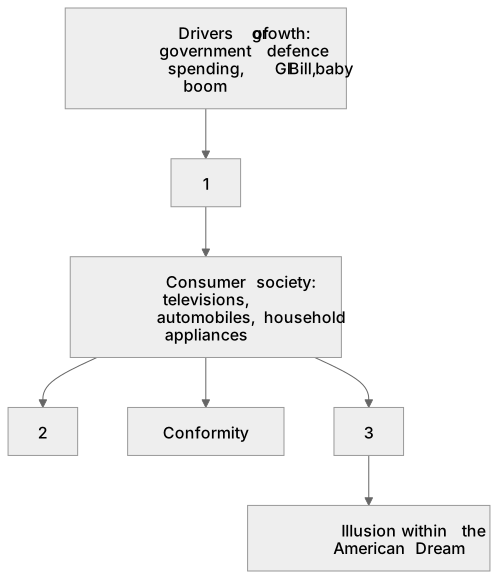
Some boxes have lost their names. Pick the right name for each number.
1Box 1
2Box 2
3Box 3
There is more to this lesson
The full lesson goes on to check your understanding and help you earn the marks. Create a free account to carry on, with your progress saved.
A week of Premium from your first lesson · Then the free plan continues · No card, no charge
Test your understanding of 2Q The American Dream: reality and illusion, 1945–1980 – Eisenhower: tranquility and crisis, 1952–1960: The growth of the American economy in the 1950s and the impact of the ‘consumer society’
Active recall beats re-reading. Take an instant quiz now to test what you’ve learned and lock it into long-term memory.
A week of Premium from your first lesson · Then the free plan continues · No card, no charge