AQA · A-Level · History
Course version: 7042 · Version from Sept 2017
Reality and illusion, 1945–1980 – only) The Johnson Presidency, 1963–1968…
Full specification wording
2Q The American Dream: reality and illusion, 1945–1980 – only) The Johnson Presidency, 1963–1968 (A-level only): African-Americans in North and South: developments in the Civil Rights Movement; Johnson’s role in passing Civil Rights legislation; the impact of change including urban riots
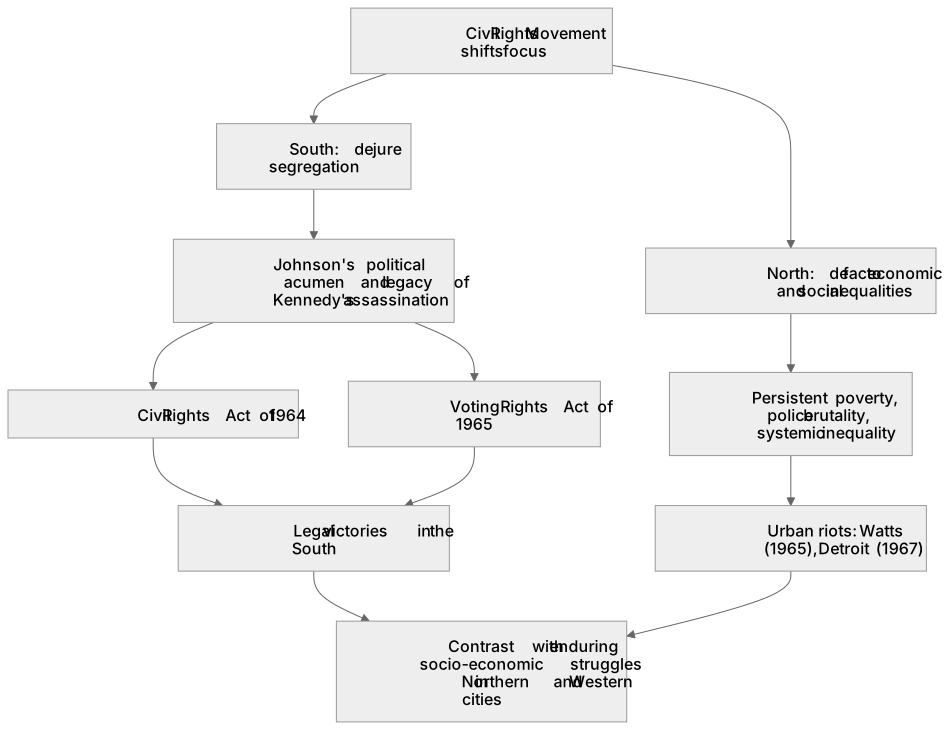
During Johnson’s presidency, the Civil Rights Movement shifted focus from de jure segregation in the South to de facto economic and social inequalities in the North.
Checked against the AQA 7042 specification (opens in a new tab) on .
- Point 3 of 4
Study notes
From the checked teaching notes for this specification point.
The idea
During Johnson’s presidency, the Civil Rights Movement shifted focus from de jure segregation in the South to de facto economic and social inequalities in the North. Johnson played a pivotal role in passing landmark legislation, utilising his political acumen and the legacy of Kennedy’s assassination to secure the Civil Rights Act of 1964 and the Voting Rights Act of 1965. However, legislative success did not immediately translate to improved living conditions for many African-Americans. The resulting frustration over persistent poverty, police brutality, and systemic inequality culminated in severe urban riots, such as those in Watts (1965) and Detroit (1967). This highlighted the stark contrast between legal victories in the South and the enduring socio-economic struggles in Northern and Western cities, fundamentally altering the movement's trajectory.
What earns the marks
- Evaluate Johnson's political skills (the 'Johnson Treatment') in overcoming Southern filibusters to pass the 1964 Civil Rights Act and 1965 Voting Rights Act.
- Contrast the specific grievances of African-Americans in the South (disenfranchisement, Jim Crow laws) with those in the North (ghettoisation, unemployment, de facto segregation).
- Analyse the causes of the urban riots (e.g., Watts, Newark, Detroit), focusing on police relations and the findings of the Kerner Commission.
- Assess the limitations of Johnson's legislative achievements in addressing the deep-rooted economic inequalities highlighted by the Northern civil rights campaigns, such as King's Chicago Freedom Movement.
Common mistakes and how to put them right
Assuming the Civil Rights Act of 1964 solved all racial inequalities.
Put it right: Distinguish between the end of legal (de jure) segregation in the South and the persistence of economic (de facto) segregation in the North.
Attributing the passage of civil rights legislation solely to Martin Luther King Jr.
Put it right: Acknowledge Johnson's crucial legislative maneuvering and the pressure exerted by grassroots activists.
Viewing the urban riots as unprovoked violence.
Put it right: Contextualise the riots as a reaction to systemic poverty, police brutality, and the failure of legislative changes to improve daily life in Northern ghettos.
Exam tips
- Use the findings of the 1968 Kerner Commission to provide contemporary evidence on the causes of the urban riots.
- When evaluating Johnson's role, balance his genuine commitment to civil rights against his political pragmatism and the pressure from the movement.
- Explicitly compare the differing aims and methods of the Civil Rights Movement in the North versus the South during the mid-1960s.
Try the lesson
The start of the 2Q The American Dream: reality and illusion, 1945–1980 – only) The Johnson Presidency, 1963–1968 (A-level only): African-Americans in North and South: developments in the Civil Rights Movement; Johnson’s role in passing Civil Rights legislation; the impact of change including urban riots lesson, made from checked teaching notes for this specification point.
Have a go first
How did President Lyndon B. Johnson primarily secure the passage of the landmark Civil Rights Act of 1964 through a reluctant Congress?
Listen
During Johnson’s presidency, the Civil Rights Movement shifted focus from de jure segregation in the South to de facto economic and social inequalities in the North. Johnson played a pivotal role in passing landmark legislation, utilising his political acumen and the legacy of Kennedy’s assassination to secure the Civil Rights Act of 1964 and the Voting Rights Act of 1965. However, legislative success did not immediately translate to improved living conditions for many African-Americans. The resulting frustration over persistent poverty, police brutality, and systemic inequality culminated in severe urban riots, such as those in Watts (1965) and Detroit (1967). This highlighted the stark contrast between legal victories in the South and the enduring socio-economic struggles in Northern and Western cities, fundamentally altering the movement's trajectory. A strong answer earns marks for these points. Evaluate Johnson's political skills (the 'Johnson Treatment') in overcoming Southern filibusters to pass the 1964 Civil Rights Act and 1965 Voting Rights Act. Contrast the specific grievances of African-Americans in the South (disenfranchisement, Jim Crow laws) with those in the North (ghettoisation, unemployment, de facto segregation). Analyse the causes of the urban riots (e.g., Watts, Newark, Detroit), focusing on police relations and the findings of the Kerner Commission. Assess the limitations of Johnson's legislative achievements in addressing the deep-rooted economic inequalities highlighted by the Northern civil rights campaigns, such as King's Chicago Freedom Movement. A common slip: Assuming the Civil Rights Act of 1964 solved all racial inequalities. Instead, distinguish between the end of legal (de jure) segregation in the South and the persistence of economic (de facto) segregation in the North. Exam tip: Use the findings of the 1968 Kerner Commission to provide contemporary evidence on the causes of the urban riots.
See it
Put the events in order
Put these events in the order they happened, earliest first.
- 1. Civil Rights Act passed
- 2. Kerner Commission reported
- 3. Voting Rights Act passed
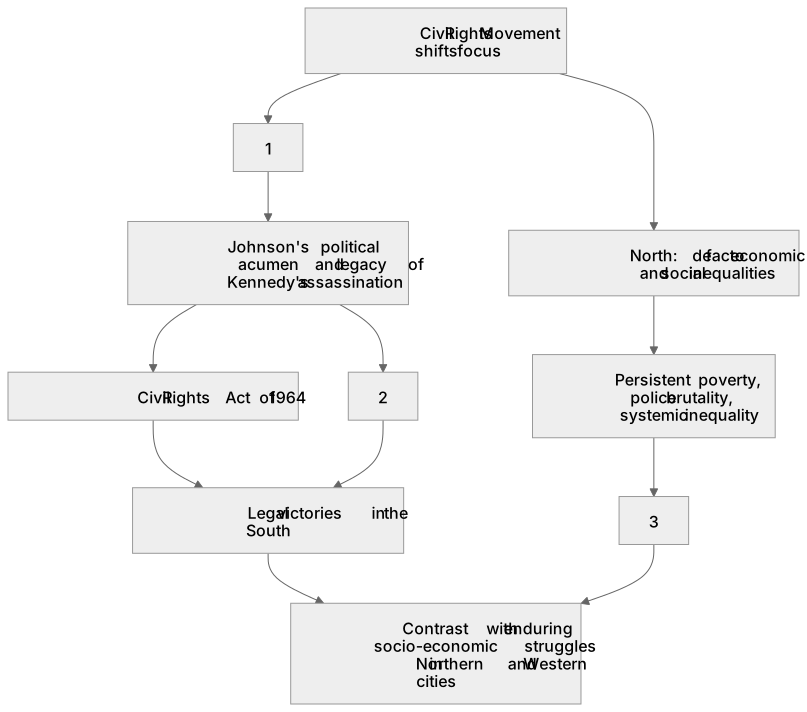
Label the diagram
Some boxes have lost their names. Pick the right name for each number.
1Box 1
2Box 2
3Box 3
There is more to this lesson
The full lesson goes on to check your understanding and help you earn the marks. Create a free account to carry on, with your progress saved.
A week of Premium from your first lesson · Then the free plan continues · No card, no charge
Test your understanding of 2Q The American Dream: reality and illusion, 1945–1980 – only) The Johnson Presidency, 1963–1968 (A-level only): African-Americans in North and South: developments in the Civil Rights Movement; Johnson’s role in passing Civil Rights legislation; the impact of change including urban riots
Active recall beats re-reading. Take an instant quiz now to test what you’ve learned and lock it into long-term memory.
A week of Premium from your first lesson · Then the free plan continues · No card, no charge