AQA · A-Level · History
Course version: 7042 · Version from Sept 2017
Reality and illusion, 1945–1980 – only) The Johnson Presidency, 1963–1968…
Full specification wording
2Q The American Dream: reality and illusion, 1945–1980 – only) The Johnson Presidency, 1963–1968 (A-level only): Maintaining American world power: escalation of the war in Vietnam; relations between the USA and its Western allies
Johnson’s foreign policy focused on maintaining American world power, dominated by the disastrous escalation of the Vietnam War.
Checked against the AQA 7042 specification (opens in a new tab) on .
- Point 2 of 4
- 4 key terms
Study notes
From the checked teaching notes for this specification point.
The idea
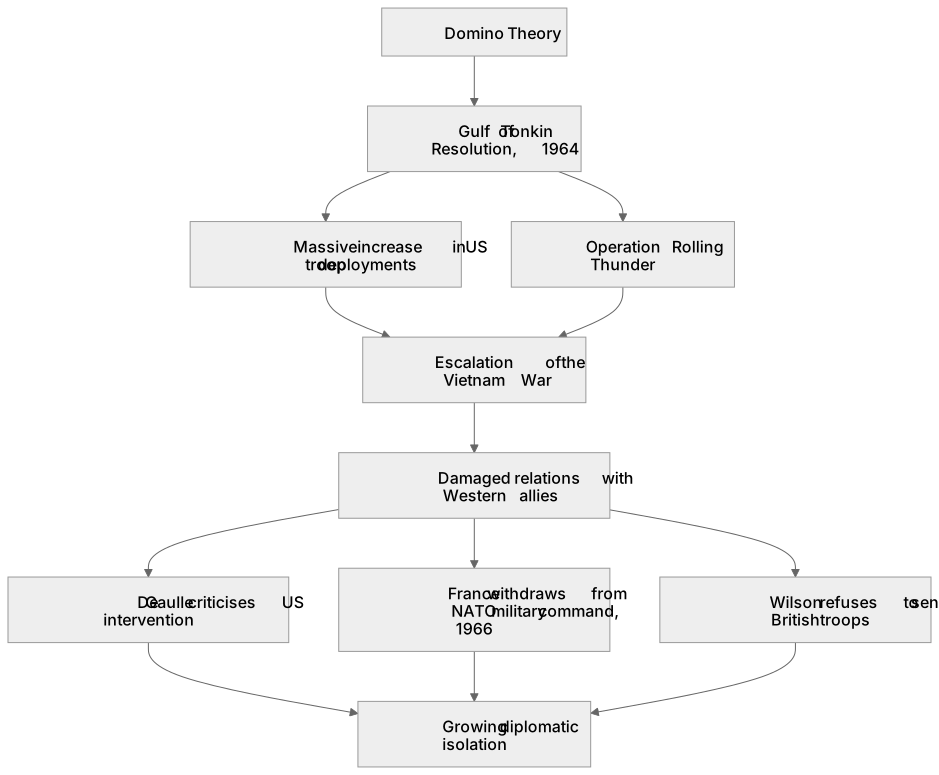
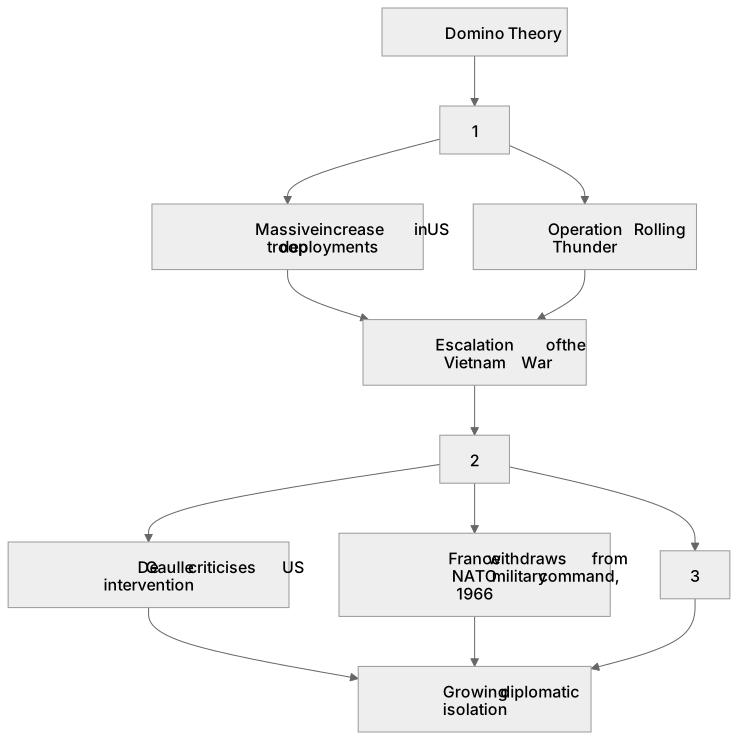
Johnson’s foreign policy focused on maintaining American world power, dominated by the disastrous escalation of the Vietnam War. Driven by the Domino Theory, Johnson used the 1964 Gulf of Tonkin Resolution to justify a massive increase in US troop deployments and the sustained bombing campaign, Operation Rolling Thunder. This escalation severely damaged relations between the USA and its Western allies. France's Charles de Gaulle openly criticised American intervention, withdrawing France from NATO's military command in 1966. Even close allies like Britain's Harold Wilson refused to send troops, highlighting America's growing diplomatic isolation and the immense strain the Vietnam conflict placed on the broader Western alliance.
What earns the marks
- Analyse the ideological and political motivations behind Johnson's decision to escalate US military involvement in Vietnam.
- Evaluate the significance of the Gulf of Tonkin Resolution in expanding presidential war powers and facilitating escalation.
- Assess the impact of the Vietnam War on America's global standing and its ability to maintain world power.
- Examine the deterioration of relations with Western allies, specifically focusing on French withdrawal from NATO command and British reluctance to provide military support.
Common mistakes and how to put them right
Assuming all Western allies supported the US intervention in Vietnam.
Put it right: Emphasise that key allies, notably France and Britain, refused to provide military support and often criticised US policy.
Stating Johnson started the Vietnam War.
Put it right: Clarify that Johnson escalated an existing conflict that had already seen involvement from Truman, Eisenhower, and Kennedy.
Confusing the Gulf of Tonkin Resolution with a formal declaration of war.
Put it right: Define the Resolution as a congressional authorisation for the President to use conventional military force without a formal declaration of war.
Exam tips
- Link the escalation in Vietnam directly to the concept of 'maintaining American world power' and the pressures of the Cold War containment policy.
- Contrast the US expectation of allied solidarity with the reality of European diplomatic resistance, using De Gaulle and Wilson as specific examples.
- Consider how the financial and military drain of Vietnam undermined America's ability to project power in other global spheres.
Try the lesson
The start of the 2Q The American Dream: reality and illusion, 1945–1980 – only) The Johnson Presidency, 1963–1968 (A-level only): Maintaining American world power: escalation of the war in Vietnam; relations between the USA and its Western allies lesson, made from checked teaching notes for this specification point.
Have a go first
Which 1964 event was used by President Johnson to justify a significant escalation of US military involvement in Vietnam?
Listen
Johnson’s foreign policy focused on maintaining American world power, dominated by the disastrous escalation of the Vietnam War. Driven by the Domino Theory, Johnson used the 1964 Gulf of Tonkin Resolution to justify a massive increase in US troop deployments and the sustained bombing campaign, Operation Rolling Thunder. This escalation severely damaged relations between the USA and its Western allies. France's Charles de Gaulle openly criticised American intervention, withdrawing France from NATO's military command in 1966. Even close allies like Britain's Harold Wilson refused to send troops, highlighting America's growing diplomatic isolation and the immense strain the Vietnam conflict placed on the broader Western alliance. A strong answer earns marks for these points. Analyse the ideological and political motivations behind Johnson's decision to escalate US military involvement in Vietnam. Evaluate the significance of the Gulf of Tonkin Resolution in expanding presidential war powers and facilitating escalation. Assess the impact of the Vietnam War on America's global standing and its ability to maintain world power. Examine the deterioration of relations with Western allies, specifically focusing on French withdrawal from NATO command and British reluctance to provide military support. A common slip: Assuming all Western allies supported the US intervention in Vietnam. Instead, Emphasise that key allies, notably France and Britain, refused to provide military support and often criticised US policy. Exam tip: Link the escalation in Vietnam directly to the concept of 'maintaining American world power' and the pressures of the Cold War containment policy.
See it
Key words
Say what each word means before you turn the card.
Cold War geopolitics
Try answering aloud or in your head before turning the card.
Military conflict and escalation
Try answering aloud or in your head before turning the card.
International diplomacy and alliances
Try answering aloud or in your head before turning the card.
Presidential authority in foreign affairs
Try answering aloud or in your head before turning the card.
See every definition
- Cold War geopolitics
- The pressures of the Cold War containment policy shaped the aim of maintaining American world power.
- Military conflict and escalation
- A massive increase in US troop deployments and the sustained bombing campaign, Operation Rolling Thunder, driven by the Domino Theory.
- International diplomacy and alliances
- Relations between the USA and its Western allies were severely damaged, with France withdrawing from NATO's military command and Britain refusing to send troops.
- Presidential authority in foreign affairs
- The 1964 Gulf of Tonkin Resolution was used to justify escalation, acting as a congressional authorisation to use conventional military force without a formal declaration of war.
Label the diagram
Some boxes have lost their names. Pick the right name for each number.
1Box 1
2Box 2
3Box 3
There is more to this lesson
The full lesson goes on to check your understanding and help you earn the marks. Create a free account to carry on, with your progress saved.
A week of Premium from your first lesson · Then the free plan continues · No card, no charge
Test your understanding of 2Q The American Dream: reality and illusion, 1945–1980 – only) The Johnson Presidency, 1963–1968 (A-level only): Maintaining American world power: escalation of the war in Vietnam; relations between the USA and its Western allies
Active recall beats re-reading. Take an instant quiz now to test what you’ve learned and lock it into long-term memory.
A week of Premium from your first lesson · Then the free plan continues · No card, no charge