AQA · A-Level · History
Course version: 7042 · Version from Sept 2017
Reality and illusion, 1945–1980 – only) The Johnson Presidency, 1963–1968…
Full specification wording
2Q The American Dream: reality and illusion, 1945–1980 – only) The Johnson Presidency, 1963–1968 (A-level only): Johnson as President: personality and policies; his pursuit of the ‘Great Society’; the impact of the Kennedy legacy; economic developments
Lyndon B. Johnson’s presidency was shaped by his domineering personality, known as the 'Johnson Treatment', which he used to force domestic policies through Congress.
Checked against the AQA 7042 specification (opens in a new tab) on .
- Point 1 of 4
- 4 key terms
Study notes
From the checked teaching notes for this specification point.
The idea
Lyndon B. Johnson’s presidency was shaped by his domineering personality, known as the 'Johnson Treatment', which he used to force domestic policies through Congress. Inheriting the office after Kennedy's assassination, Johnson leveraged the Kennedy legacy and national mourning to pass stalled legislation, notably the 1964 Civil Rights Act. His ambitious 'Great Society' programme aimed to eliminate poverty and racial injustice, introducing Medicare and federal education funding. Economically, Johnson initially oversaw a booming economy with low unemployment, but his commitment to both the Great Society and the escalating Vietnam War created severe inflationary pressures, straining federal finances and limiting his domestic achievements.
What earns the marks
- Evaluate how Johnson's political experience and intimidating personality facilitated legislative success.
- Assess the extent to which the 'Great Society' achieved its goals of reducing poverty and improving healthcare.
- Analyse how Johnson utilised the emotional aftermath of Kennedy's assassination to pass the 1964 Civil Rights Act and the 1964 Tax Reduction Act.
- Examine the economic trajectory of the 1960s, contrasting early prosperity with the later inflation caused by funding both domestic reform and the Vietnam War.
Common mistakes and how to put them right
Claiming the Great Society was entirely Johnson's original idea.
Put it right: Acknowledge that many Great Society initiatives, such as civil rights and tax cuts, were continuations of Kennedy's 'New Frontier' proposals.
Stating that the US economy was in a depression during Johnson's term.
Put it right: Note that the mid-1960s saw strong economic growth, but inflation became a significant issue later due to deficit spending.
Ignoring Johnson's legislative skills when discussing his policy successes.
Put it right: Explicitly link his passage of complex legislation to his extensive congressional experience and the 'Johnson Treatment'.
Exam tips
- When evaluating the Great Society, balance its legislative triumphs against the practical limitations imposed by Vietnam War funding.
- Use specific examples of Great Society legislation, such as the Voting Rights Act 1965 or the Elementary and Secondary Education Act, to support your arguments.
- Consider how the 'Kennedy legacy' acted as both a catalyst for Johnson's early success and a shadow that he struggled to escape politically.
Try the lesson
The start of the 2Q The American Dream: reality and illusion, 1945–1980 – only) The Johnson Presidency, 1963–1968 (A-level only): Johnson as President: personality and policies; his pursuit of the ‘Great Society’; the impact of the Kennedy legacy; economic developments lesson, made from checked teaching notes for this specification point.
Have a go first
Which of the following best describes the primary domestic goal of Lyndon B. Johnson's 'Great Society' programme?
Listen
Lyndon B. Johnson’s presidency was shaped by his domineering personality, known as the 'Johnson Treatment', which he used to force domestic policies through Congress. Inheriting the office after Kennedy's assassination, Johnson leveraged the Kennedy legacy and national mourning to pass stalled legislation, notably the 1964 Civil Rights Act. His ambitious 'Great Society' programme aimed to eliminate poverty and racial injustice, introducing Medicare and federal education funding. Economically, Johnson initially oversaw a booming economy with low unemployment, but his commitment to both the Great Society and the escalating Vietnam War created severe inflationary pressures, straining federal finances and limiting his domestic achievements. A strong answer earns marks for these points. Evaluate how Johnson's political experience and intimidating personality facilitated legislative success. Assess the extent to which the 'Great Society' achieved its goals of reducing poverty and improving healthcare. Analyse how Johnson utilised the emotional aftermath of Kennedy's assassination to pass the 1964 Civil Rights Act and the 1964 Tax Reduction Act. Examine the economic trajectory of the 1960s, contrasting early prosperity with the later inflation caused by funding both domestic reform and the Vietnam War. A common slip: Claiming the Great Society was entirely Johnson's original idea. Instead, Acknowledge that many Great Society initiatives, such as civil rights and tax cuts, were continuations of Kennedy's 'New Frontier' proposals. Exam tip: When evaluating the Great Society, balance its legislative triumphs against the practical limitations imposed by Vietnam War funding.
See it
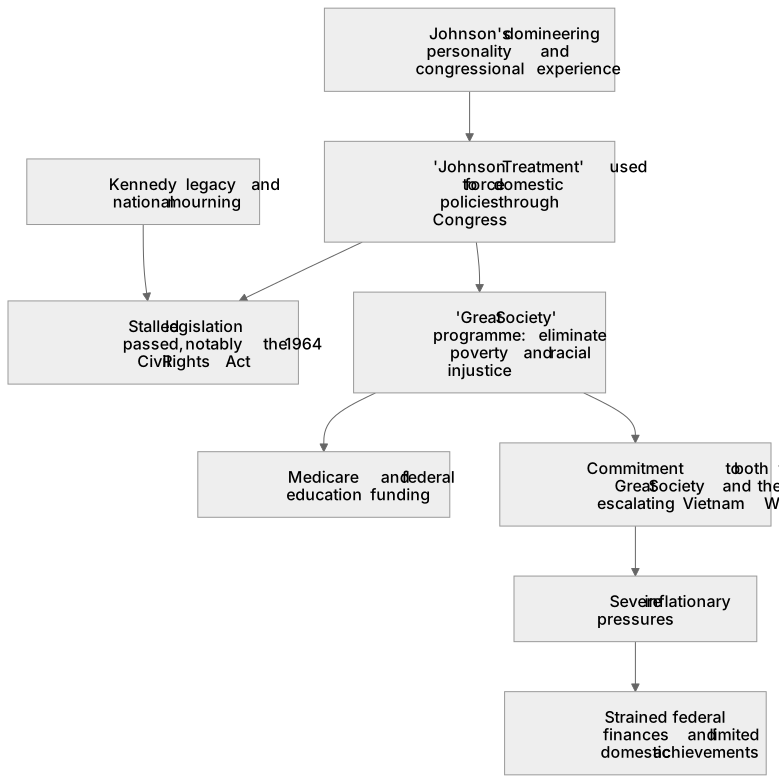
Key words
Say what each word means before you turn the card.
Domestic policy and reform
Try answering aloud or in your head before turning the card.
Presidential power and leadership
Try answering aloud or in your head before turning the card.
Economic management and inflation
Try answering aloud or in your head before turning the card.
Continuity and change
Try answering aloud or in your head before turning the card.
See every definition
- Domestic policy and reform
- Policies pursued at home, including the 'Great Society' programme, which aimed to eliminate poverty and racial injustice.
- Presidential power and leadership
- Shaped by a domineering personality, known as the 'Johnson Treatment', used to force domestic policies through Congress.
- Economic management and inflation
- Initially a booming economy with low unemployment, later severe inflationary pressures from funding both the Great Society and the Vietnam War.
- Continuity and change
- Many initiatives, such as civil rights and tax cuts, were continuations of Kennedy's 'New Frontier' proposals rather than entirely original.
Label the diagram
Some boxes have lost their names. Pick the right name for each number.
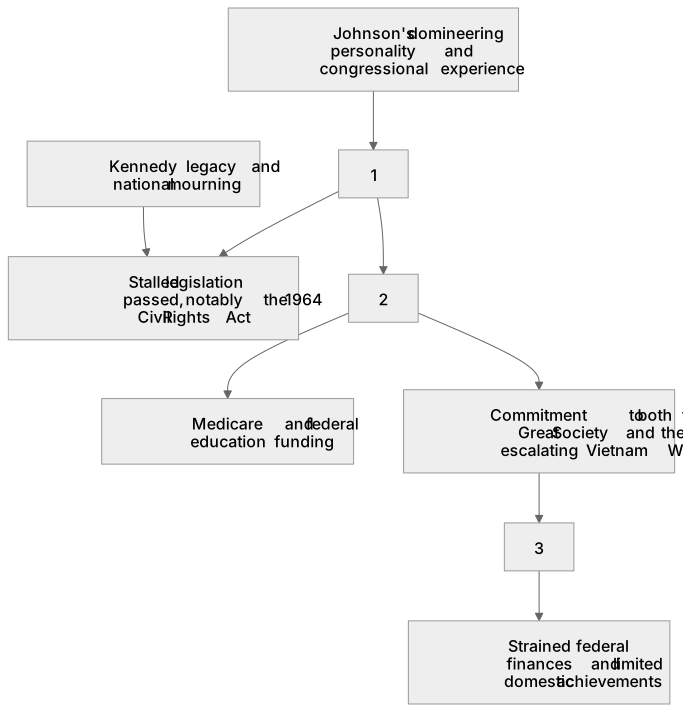
1Box 1
2Box 2
3Box 3
There is more to this lesson
The full lesson goes on to check your understanding and help you earn the marks. Create a free account to carry on, with your progress saved.
A week of Premium from your first lesson · Then the free plan continues · No card, no charge
Test your understanding of 2Q The American Dream: reality and illusion, 1945–1980 – only) The Johnson Presidency, 1963–1968 (A-level only): Johnson as President: personality and policies; his pursuit of the ‘Great Society’; the impact of the Kennedy legacy; economic developments
Active recall beats re-reading. Take an instant quiz now to test what you’ve learned and lock it into long-term memory.
A week of Premium from your first lesson · Then the free plan continues · No card, no charge