AQA · A-Level · History
Course version: 7042 · Version from Sept 2017
Reality and illusion, 1945–1980 – The USA after Nixon, 1974–1980 (A-level…
Full specification wording
2Q The American Dream: reality and illusion, 1945–1980 – The USA after Nixon, 1974–1980 (A-level only): Ford and Carter as presidents: responses to social divisions; political corruption and the loss of national self-confidence
Gerald Ford and Jimmy Carter inherited a deeply fractured nation following the Watergate scandal and the Vietnam War.
Checked against the AQA 7042 specification (opens in a new tab) on .
- Point 1 of 4
- 3 key terms
Study notes
From the checked teaching notes for this specification point.
The idea
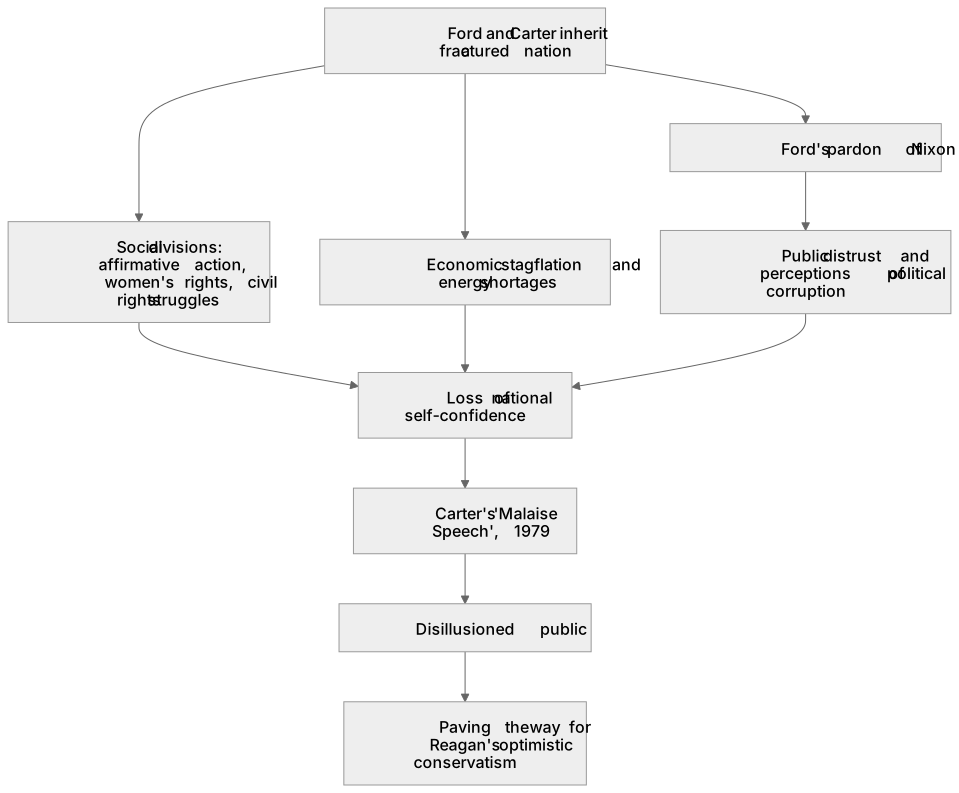
Gerald Ford and Jimmy Carter inherited a deeply fractured nation following the Watergate scandal and the Vietnam War. Ford’s controversial pardon of Nixon aimed to heal the country but instead exacerbated public distrust and highlighted ongoing political corruption. Both presidents struggled to address widening social divisions, including debates over affirmative action, women's rights (such as the ERA), and the lingering civil rights struggles. Carter’s 'Malaise Speech' in 1979 epitomised the profound loss of national self-confidence, attempting to address a 'crisis of confidence' amidst economic stagflation and energy shortages. Ultimately, their inability to project strong leadership or resolve these deep-seated domestic crises left the American public disillusioned, paving the way for Reagan's optimistic conservatism.
What earns the marks
- Evaluate Ford's pardon of Nixon and its impact on public trust and perceptions of political corruption.
- Analyse Carter's 'Malaise Speech' (Crisis of Confidence) as a reflection of, and response to, the loss of national self-confidence.
- Assess both presidents' responses to social divisions, including the Equal Rights Amendment (ERA) and racial tensions such as the Boston busing crisis.
- Examine the impact of economic stagnation and the energy crisis on the national mood and the perceived effectiveness of the presidency.
Common mistakes and how to put them right
Assuming Carter's 'Malaise Speech' was well-received.
Put it right: In reality, while initially praised, it quickly backfired and deepened the public's sense of despair and lack of confidence in his leadership.
Viewing Ford's pardon of Nixon purely as a corrupt bargain.
Put it right: It should be evaluated as a flawed but genuine attempt to move the nation past the Watergate paralysis.
Exam tips
- Link domestic economic issues, such as the OPEC oil embargoes, directly to the psychological 'loss of national self-confidence'.
- Compare Ford and Carter's leadership styles to demonstrate how both ultimately failed to restore faith in the federal government.
- Use specific examples of social divisions, such as the rise of the New Right or affirmative action debates, to substantiate arguments about a fractured society.
Try the lesson
The start of the 2Q The American Dream: reality and illusion, 1945–1980 – The USA after Nixon, 1974–1980 (A-level only): Ford and Carter as presidents: responses to social divisions; political corruption and the loss of national self-confidence lesson, made from checked teaching notes for this specification point.
Have a go first
Which action taken by President Gerald Ford shortly after assuming office significantly hindered his ability to restore national self-confidence following the Watergate scandal?
Listen
Gerald Ford and Jimmy Carter inherited a deeply fractured nation following the Watergate scandal and the Vietnam War. Ford’s controversial pardon of Nixon aimed to heal the country but instead exacerbated public distrust and highlighted ongoing political corruption. Both presidents struggled to address widening social divisions, including debates over affirmative action, women's rights (such as the ERA), and the lingering civil rights struggles. Carter’s 'Malaise Speech' in 1979 epitomised the profound loss of national self-confidence, attempting to address a 'crisis of confidence' amidst economic stagflation and energy shortages. Ultimately, their inability to project strong leadership or resolve these deep-seated domestic crises left the American public disillusioned, paving the way for Reagan's optimistic conservatism. A strong answer earns marks for these points. Evaluate Ford's pardon of Nixon and its impact on public trust and perceptions of political corruption. Analyse Carter's 'Malaise Speech' (Crisis of Confidence) as a reflection of, and response to, the loss of national self-confidence. Assess both presidents' responses to social divisions, including the Equal Rights Amendment (ERA) and racial tensions such as the Boston busing crisis. Examine the impact of economic stagnation and the energy crisis on the national mood and the perceived effectiveness of the presidency. Exam tip: Link domestic economic issues, such as the OPEC oil embargoes, directly to the psychological 'loss of national self-confidence'.
See it
Key words
Say what each word means before you turn the card.
Political corruption
Try answering aloud or in your head before turning the card.
Social divisions
Try answering aloud or in your head before turning the card.
Loss of national self-confidence
Try answering aloud or in your head before turning the card.
See every definition
- Political corruption
- Ongoing concern highlighted by Ford's controversial pardon of Nixon, which exacerbated public distrust rather than healing the country.
- Social divisions
- Widening divisions both presidents struggled to address, including debates over affirmative action, women's rights such as the ERA, and lingering civil rights struggles.
- Loss of national self-confidence
- Profound loss epitomised by Carter's 'Malaise Speech' in 1979, which attempted to address a 'crisis of confidence' amidst economic stagflation and energy shortages.
Label the diagram
Some boxes have lost their names. Pick the right name for each number.
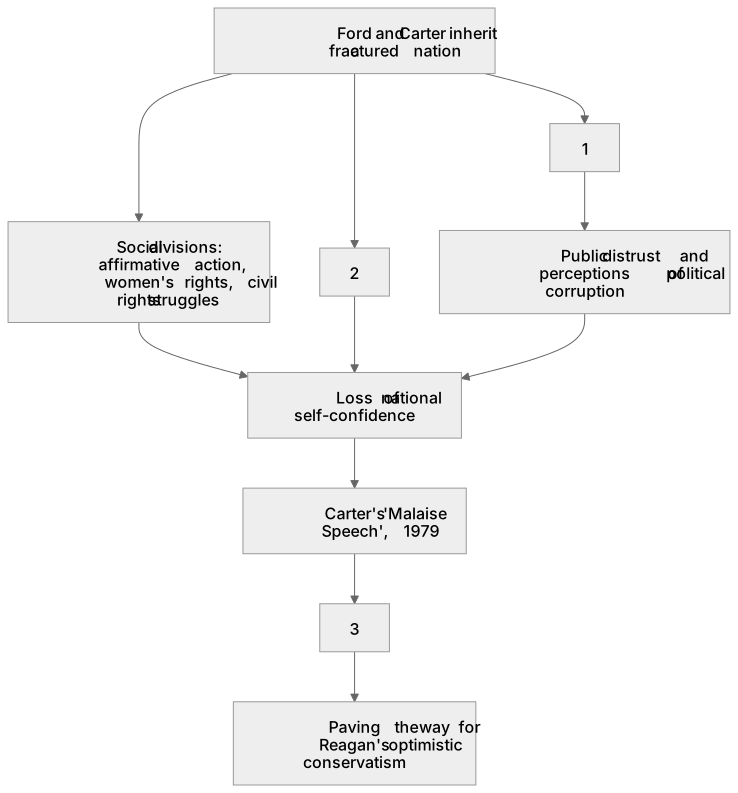
1Box 1
2Box 2
3Box 3
There is more to this lesson
The full lesson goes on to check your understanding and help you earn the marks. Create a free account to carry on, with your progress saved.
A week of Premium from your first lesson · Then the free plan continues · No card, no charge
Test your understanding of 2Q The American Dream: reality and illusion, 1945–1980 – The USA after Nixon, 1974–1980 (A-level only): Ford and Carter as presidents: responses to social divisions; political corruption and the loss of national self-confidence
Active recall beats re-reading. Take an instant quiz now to test what you’ve learned and lock it into long-term memory.
A week of Premium from your first lesson · Then the free plan continues · No card, no charge