AQA · A-Level · History
Course version: 7042 · Version from Sept 2017
Reality and illusion, 1945–1980 – The USA after Nixon, 1974–1980 (A-level…
Full specification wording
2Q The American Dream: reality and illusion, 1945–1980 – The USA after Nixon, 1974–1980 (A-level only): The position of the USA as a world power: the final withdrawal from Vietnam; relations with the USSR and China; the response to crises in the Middle East; Iran and Afghanistan
The late 1970s challenged the USA's position as a global superpower.
Checked against the AQA 7042 specification (opens in a new tab) on .
- Point 2 of 4
Study notes
From the checked teaching notes for this specification point.
The idea
The late 1970s challenged the USA's position as a global superpower. The humiliating final withdrawal from Vietnam in 1975, symbolised by the chaotic evacuation of Saigon, severely damaged American prestige. Concurrently, relations with the USSR and China evolved; while Carter formally recognised the PRC in 1979, détente with the USSR collapsed following the Soviet invasion of Afghanistan, prompting the Carter Doctrine and a US Olympic boycott. In the Middle East, Carter achieved a diplomatic triumph with the 1978 Camp David Accords between Egypt and Israel. However, this was overshadowed by the 1979 Iranian Revolution and the subsequent Iran hostage crisis, which projected an image of American impotence and fatally undermined Carter’s presidency.
What earns the marks
- Assess the psychological and geopolitical impact of the fall of Saigon (1975) on the USA's status as a world power.
- Evaluate the successes and limitations of Carter's foreign policy in the Middle East, specifically the Camp David Accords.
- Analyse the deterioration of détente with the USSR, focusing on the SALT II treaty and the response to the 1979 invasion of Afghanistan.
- Examine the devastating political impact of the Iran hostage crisis on the perception of American global strength and Carter's leadership.
- Discuss the continuation of Sino-American normalisation, culminating in formal diplomatic recognition of China in 1979.
Common mistakes and how to put them right
Confusing the 1973 Paris Peace Accords with the final withdrawal.
Put it right: The final withdrawal and fall of Saigon occurred in 1975 under Ford, not Nixon.
Assuming détente ended abruptly with Reagan.
Put it right: The breakdown began under Carter, specifically triggered by the Soviet invasion of Afghanistan in December 1979.
Overlooking the Camp David Accords when evaluating Carter; students often focus solely on the Iran hostage crisis, ignoring his significant diplomatic success in the Middle East.
Exam tips
- Contrast Carter's human rights-based foreign policy with the realpolitik of the Nixon and Kissinger era to evaluate its effectiveness.
- Use the Iran hostage crisis as a primary case study to argue how international events directly influenced domestic politics and the 1980 election.
- Connect the Soviet invasion of Afghanistan to the broader Cold War context, noting how it shifted US policy back towards containment.
Try the lesson
The start of the 2Q The American Dream: reality and illusion, 1945–1980 – The USA after Nixon, 1974–1980 (A-level only): The position of the USA as a world power: the final withdrawal from Vietnam; relations with the USSR and China; the response to crises in the Middle East; Iran and Afghanistan lesson, made from checked teaching notes for this specification point.
Have a go first
Which event in April 1975 marked the final withdrawal of the United States from Vietnam and symbolised a significant blow to its position as a world power?
Listen
The late 1970s challenged the USA's position as a global superpower. The humiliating final withdrawal from Vietnam in 1975, symbolised by the chaotic evacuation of Saigon, severely damaged American prestige. Concurrently, relations with the USSR and China evolved; while Carter formally recognised the PRC in 1979, détente with the USSR collapsed following the Soviet invasion of Afghanistan, prompting the Carter Doctrine and a US Olympic boycott. In the Middle East, Carter achieved a diplomatic triumph with the 1978 Camp David Accords between Egypt and Israel. However, this was overshadowed by the 1979 Iranian Revolution and the subsequent Iran hostage crisis, which projected an image of American impotence and fatally undermined Carter’s presidency. A strong answer earns marks for these points. Assess the psychological and geopolitical impact of the fall of Saigon (1975) on the USA's status as a world power. Evaluate the successes and limitations of Carter's foreign policy in the Middle East, specifically the Camp David Accords. Analyse the deterioration of détente with the USSR, focusing on the SALT II treaty and the response to the 1979 invasion of Afghanistan. Examine the devastating political impact of the Iran hostage crisis on the perception of American global strength and Carter's leadership. Exam tip: Contrast Carter's human rights-based foreign policy with the realpolitik of the Nixon and Kissinger era to evaluate its effectiveness.
See it
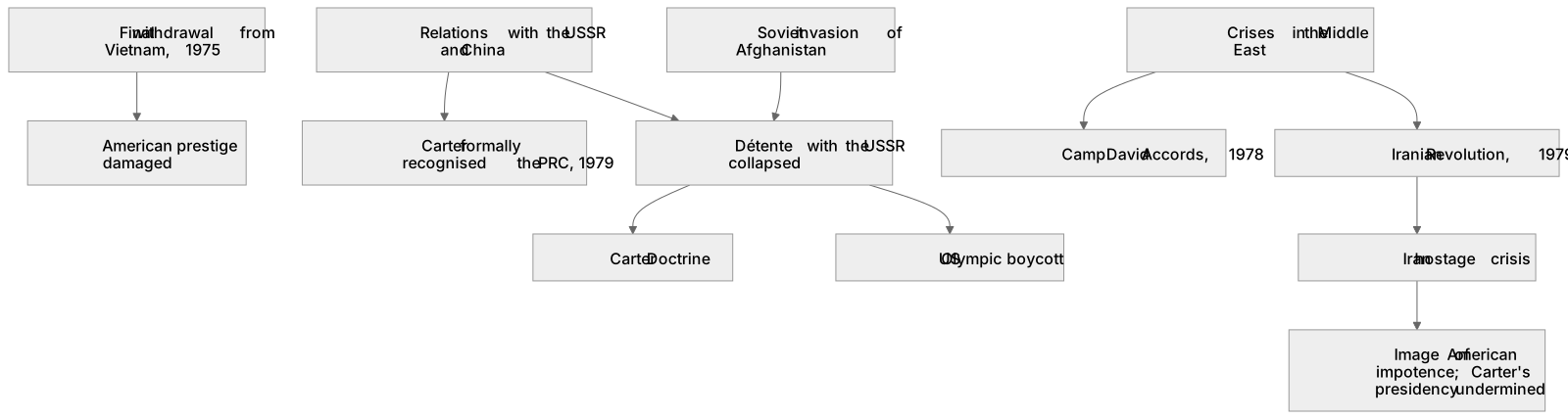
Put the events in order
Put these events in the order they happened, earliest first.
- 1. Final withdrawal from Vietnam and fall of Saigon
- 2. Formal diplomatic recognition of China
- 3. Camp David Accords between Egypt and Israel
Label the diagram
Some boxes have lost their names. Pick the right name for each number.
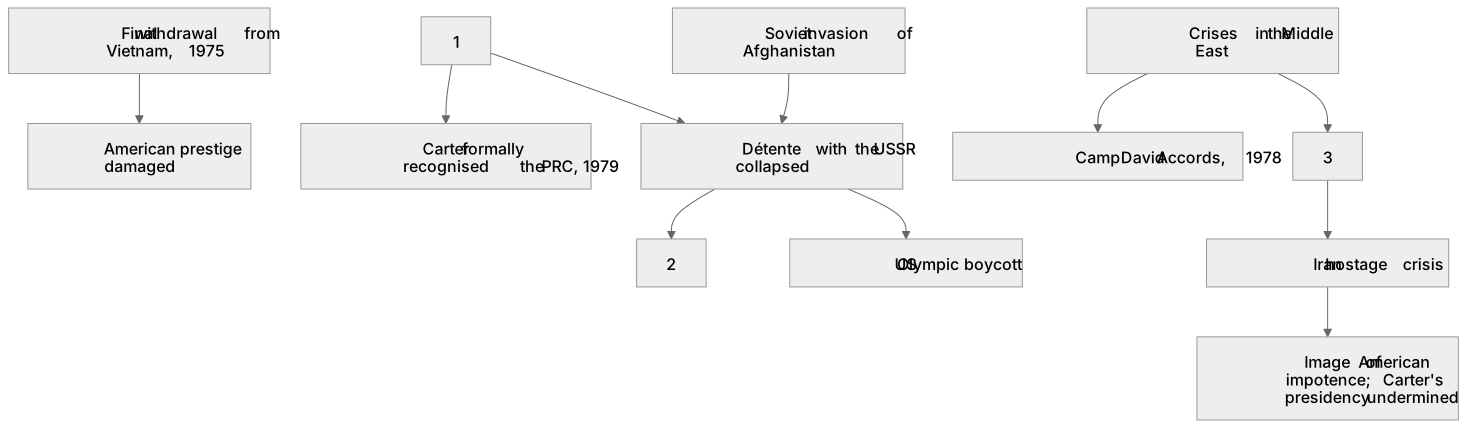
1Box 1
2Box 2
3Box 3
There is more to this lesson
The full lesson goes on to check your understanding and help you earn the marks. Create a free account to carry on, with your progress saved.
A week of Premium from your first lesson · Then the free plan continues · No card, no charge
Test your understanding of 2Q The American Dream: reality and illusion, 1945–1980 – The USA after Nixon, 1974–1980 (A-level only): The position of the USA as a world power: the final withdrawal from Vietnam; relations with the USSR and China; the response to crises in the Middle East; Iran and Afghanistan
Active recall beats re-reading. Take an instant quiz now to test what you’ve learned and lock it into long-term memory.
A week of Premium from your first lesson · Then the free plan continues · No card, no charge