AQA · A-Level · History
Course version: 7042 · Version from Sept 2017
Reality and illusion, 1945–1980 – The USA after Nixon, 1974–1980 (A-level…
Full specification wording
2Q The American Dream: reality and illusion, 1945–1980 – The USA after Nixon, 1974–1980 (A-level only): The USA by 1980: its position as a Superpower; the extent of social and economic change; the reasons for Reagan’s victory in the presidential election.
By 1980, the USA faced a profound crisis of confidence.
Checked against the AQA 7042 specification (opens in a new tab) on .
- Point 4 of 4
- 4 key terms
Study notes
From the checked teaching notes for this specification point.
The idea
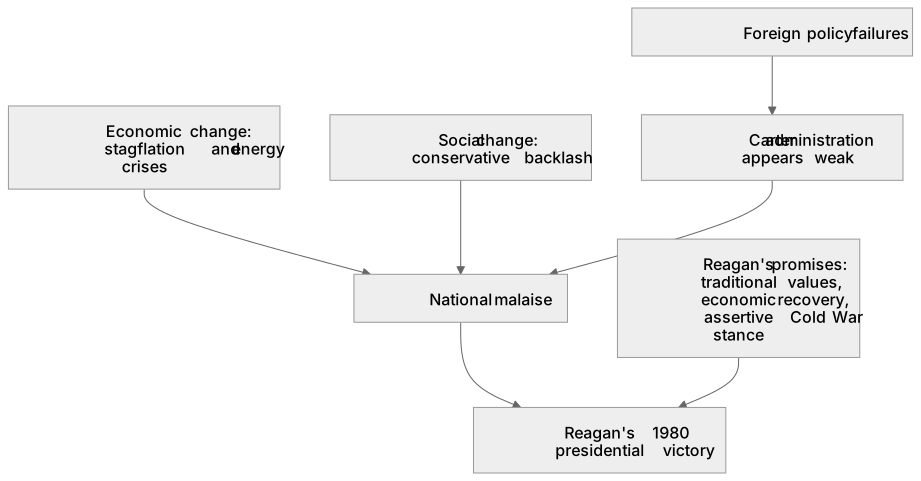
By 1980, the USA faced a profound crisis of confidence. Its position as a Superpower was severely undermined by the humiliating Iran Hostage Crisis and the Soviet invasion of Afghanistan, which made the Carter administration appear weak. Domestically, the extent of economic change was defined by crippling stagflation, energy crises, and the decline of traditional manufacturing. Socially, the nation grappled with the legacy of the 1960s, seeing a rise in conservative backlash against progressive movements. These factors culminated in Ronald Reagan’s 1980 presidential victory. Reagan capitalised on this national malaise by promising a return to traditional values, robust economic recovery through supply-side economics, and a renewed, assertive stance in Cold War foreign policy.
What earns the marks
- Evaluate the impact of foreign policy failures, such as the Iran Hostage Crisis, on the perception of the USA as a declining Superpower by 1980.
- Analyse the economic challenges of the late 1970s, specifically stagflation and the energy crisis, and their effect on the American public.
- Assess the extent of social change, focusing on the rise of the New Right and the conservative backlash against the social liberalism of the 1960s and 1970s.
- Explain the reasons for Reagan's 1980 victory, linking his optimistic campaign promises to Carter's perceived domestic and international failures.
Common mistakes and how to put them right
Attributing Reagan's victory solely to his personal charisma.
Put it right: Root Reagan's success in the specific economic (stagflation) and foreign policy (Iran Hostage Crisis) failures of the Carter administration.
Ignoring the social dimensions of the 1980 election.
Put it right: Include the mobilisation of the Religious Right and conservative reactions to social changes (like feminism and civil rights) as key factors in Reagan's coalition.
Stating the USA was no longer a Superpower in 1980.
Put it right: Clarify that while the USA's perception and confidence as a Superpower were damaged, it retained immense military and economic capabilities.
Exam tips
- Connect domestic economic struggles, such as the oil shocks, directly to voter dissatisfaction in the 1980 presidential election.
- Use the Iran Hostage Crisis as a primary case study to demonstrate the perceived weakness of US foreign policy under Jimmy Carter.
- When evaluating social change, contrast the continuing push for minority and women's rights with the growing organisational power of conservative groups like the Moral Majority.
Try the lesson
The start of the 2Q The American Dream: reality and illusion, 1945–1980 – The USA after Nixon, 1974–1980 (A-level only): The USA by 1980: its position as a Superpower; the extent of social and economic change; the reasons for Reagan’s victory in the presidential election. lesson, made from checked teaching notes for this specification point.
Have a go first
Which of the following was a key demographic shift that significantly contributed to Ronald Reagan's victory in the 1980 presidential election?
Listen
By 1980, the USA faced a profound crisis of confidence. Its position as a Superpower was severely undermined by the humiliating Iran Hostage Crisis and the Soviet invasion of Afghanistan, which made the Carter administration appear weak. Domestically, the extent of economic change was defined by crippling stagflation, energy crises, and the decline of traditional manufacturing. Socially, the nation grappled with the legacy of the 1960s, seeing a rise in conservative backlash against progressive movements. These factors culminated in Ronald Reagan’s 1980 presidential victory. Reagan capitalised on this national malaise by promising a return to traditional values, robust economic recovery through supply-side economics, and a renewed, assertive stance in Cold War foreign policy. A strong answer earns marks for these points. Evaluate the impact of foreign policy failures, such as the Iran Hostage Crisis, on the perception of the USA as a declining Superpower by 1980. Analyse the economic challenges of the late 1970s, specifically stagflation and the energy crisis, and their effect on the American public. Assess the extent of social change, focusing on the rise of the New Right and the conservative backlash against the social liberalism of the 1960s and 1970s. Explain the reasons for Reagan's 1980 victory, linking his optimistic campaign promises to Carter's perceived domestic and international failures. A common slip: Attributing Reagan's victory solely to his personal charisma. Instead, Root Reagan's success in the specific economic (stagflation) and foreign policy (Iran Hostage Crisis) failures of the Carter administration. Exam tip: Connect domestic economic struggles, such as the oil shocks, directly to voter dissatisfaction in the 1980 presidential election.
See it
Key words
Say what each word means before you turn the card.
Cold War and Foreign Policy
Try answering aloud or in your head before turning the card.
Economic Decline and Stagflation
Try answering aloud or in your head before turning the card.
Conservatism and the New Right
Try answering aloud or in your head before turning the card.
Presidential Leadership and Elections
Try answering aloud or in your head before turning the card.
See every definition
- Cold War and Foreign Policy
- The USA's position as a Superpower was undermined by the Iran Hostage Crisis and the Soviet invasion of Afghanistan, making the Carter administration appear weak.
- Economic Decline and Stagflation
- Crippling stagflation, energy crises and the decline of traditional manufacturing defined the extent of economic change domestically.
- Conservatism and the New Right
- A conservative backlash against progressive movements rose, with the New Right reacting against the social liberalism of the 1960s and 1970s.
- Presidential Leadership and Elections
- Reagan won in 1980 by promising a return to traditional values, economic recovery through supply-side economics and an assertive Cold War stance.
Label the diagram
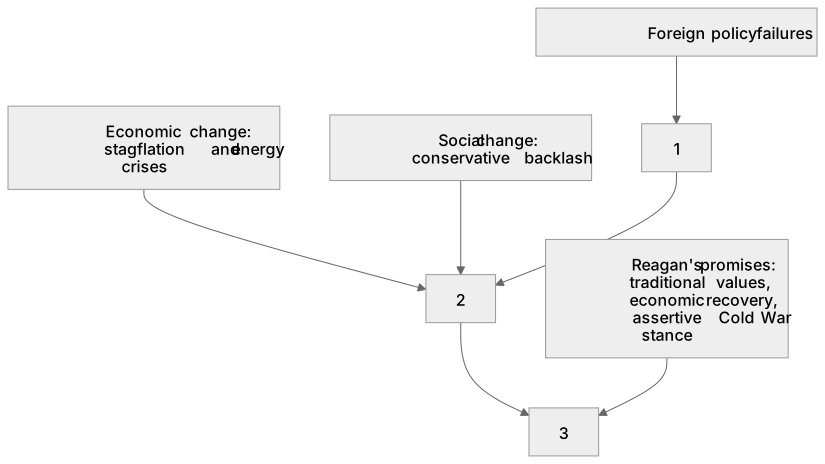
Some boxes have lost their names. Pick the right name for each number.
1Box 1
2Box 2
3Box 3
There is more to this lesson
The full lesson goes on to check your understanding and help you earn the marks. Create a free account to carry on, with your progress saved.
A week of Premium from your first lesson · Then the free plan continues · No card, no charge
Test your understanding of 2Q The American Dream: reality and illusion, 1945–1980 – The USA after Nixon, 1974–1980 (A-level only): The USA by 1980: its position as a Superpower; the extent of social and economic change; the reasons for Reagan’s victory in the presidential election.
Active recall beats re-reading. Take an instant quiz now to test what you’ve learned and lock it into long-term memory.
A week of Premium from your first lesson · Then the free plan continues · No card, no charge