AQA · A-Level · History
Course version: 7042 · Version from Sept 2017
Reality and illusion, 1945–1980 – The USA after Nixon, 1974–1980 (A-level…
Full specification wording
2Q The American Dream: reality and illusion, 1945–1980 – The USA after Nixon, 1974–1980 (A-level only): African-Americans in North and South: the impact of civil rights legislation; change and continuity in the ‘New South’
By the late 1970s, the impact of landmark civil rights legislation was evident but uneven for African-Americans across the North and South.
Checked against the AQA 7042 specification (opens in a new tab) on .
- Point 3 of 4
- 4 key terms
Study notes
From the checked teaching notes for this specification point.
The idea
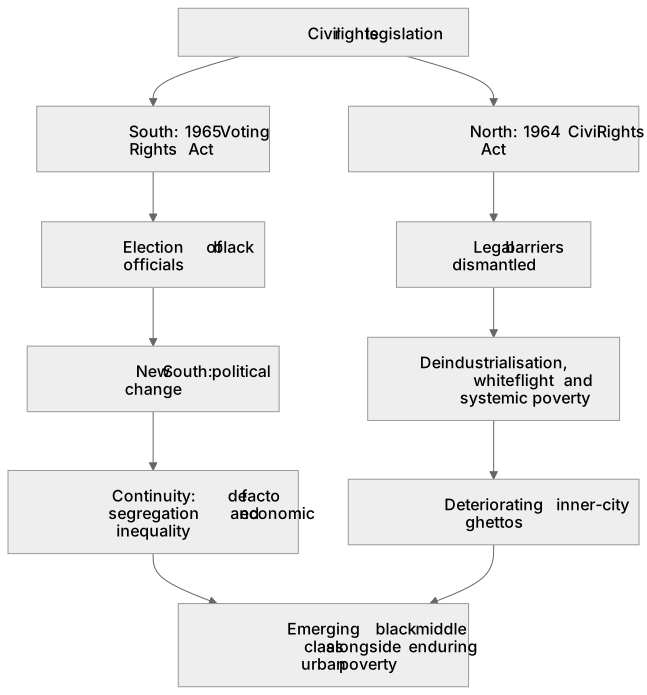
By the late 1970s, the impact of landmark civil rights legislation was evident but uneven for African-Americans across the North and South. In the 'New South', political change was significant; the 1965 Voting Rights Act enabled the election of black officials like Maynard Jackson, Atlanta's first black mayor. However, continuity persisted through de facto segregation and economic inequality. In the North, African-Americans faced different challenges. While the 1964 Civil Rights Act dismantled legal barriers, northern cities suffered from deindustrialisation, white flight, and systemic poverty, leading to deteriorating inner-city ghettos.
What earns the marks
- Assess the long-term impact of the 1964 Civil Rights Act and 1965 Voting Rights Act on African-American political representation by 1980.
- Contrast the economic progress of the emerging black middle class with the persistent poverty experienced by African-Americans in northern inner-city ghettos.
- Evaluate the concept of the 'New South', noting the increase in black elected officials alongside the continuity of informal social segregation.
- Analyse the effects of northern deindustrialisation and 'white flight' on African-American communities during the 1970s.
Common mistakes and how to put them right
Assuming civil rights legislation immediately ended all forms of segregation.
Put it right: Distinguish between the end of de jure (legal) segregation in the South and the persistence of de facto (social and economic) segregation nationwide.
Treating the African-American experience as identical across the USA.
Put it right: Explicitly contrast the political transformations in the 'New South' with the economic and urban decay affecting African-Americans in the North.
Claiming the 'New South' represented a complete break from the past.
Put it right: Acknowledge the continuity of economic disparity and racial tensions that remained despite increased political representation.
Exam tips
- Use specific examples of political progress, such as the election of black mayors in major southern cities, to demonstrate the impact of the Voting Rights Act.
- When discussing the North, link the African-American experience to broader economic trends of the 1970s, such as stagflation and deindustrialisation.
- Always balance evidence of change (e.g. the growing black middle class) with evidence of continuity (e.g. disproportionate poverty rates) to build a nuanced argument.
Try the lesson
The start of the 2Q The American Dream: reality and illusion, 1945–1980 – The USA after Nixon, 1974–1980 (A-level only): African-Americans in North and South: the impact of civil rights legislation; change and continuity in the ‘New South’ lesson, made from checked teaching notes for this specification point.
Have a go first
Which of the following best describes a significant political change for African-Americans in the 'New South' during the late 1970s?
Listen
By the late 1970s, the impact of landmark civil rights legislation was evident but uneven for African-Americans across the North and South. In the 'New South', political change was significant; the 1965 Voting Rights Act enabled the election of black officials like Maynard Jackson, Atlanta's first black mayor. However, continuity persisted through de facto segregation and economic inequality. In the North, African-Americans faced different challenges. While the 1964 Civil Rights Act dismantled legal barriers, northern cities suffered from deindustrialisation, white flight, and systemic poverty, leading to deteriorating inner-city ghettos. A strong answer earns marks for these points. Assess the long-term impact of the 1964 Civil Rights Act and 1965 Voting Rights Act on African-American political representation by 1980. Contrast the economic progress of the emerging black middle class with the persistent poverty experienced by African-Americans in northern inner-city ghettos. Evaluate the concept of the 'New South', noting the increase in black elected officials alongside the continuity of informal social segregation. Analyse the effects of northern deindustrialisation and 'white flight' on African-American communities during the 1970s. A common slip: Assuming civil rights legislation immediately ended all forms of segregation. Instead, Distinguish between the end of de jure (legal) segregation in the South and the persistence of de facto (social and economic) segregation nationwide. Exam tip: Use specific examples of political progress, such as the election of black mayors in major southern cities, to demonstrate the impact of the Voting Rights Act.
See it
Key words
Say what each word means before you turn the card.
Civil Rights and Race Relations
Try answering aloud or in your head before turning the card.
Economic Inequality
Try answering aloud or in your head before turning the card.
Regional Differences
Try answering aloud or in your head before turning the card.
Political Representation
Try answering aloud or in your head before turning the card.
See every definition
- Civil Rights and Race Relations
- The impact of landmark civil rights legislation was evident but uneven for African-Americans across the North and South.
- Economic Inequality
- Continuity persisted through de facto segregation and economic inequality, with northern cities suffering from systemic poverty and deteriorating inner-city ghettos.
- Regional Differences
- In the North, African-Americans faced different challenges from the South, including deindustrialisation, white flight and systemic poverty.
- Political Representation
- In the 'New South', political change was significant, as the 1965 Voting Rights Act enabled the election of black officials like Maynard Jackson.
Label the diagram
Some boxes have lost their names. Pick the right name for each number.
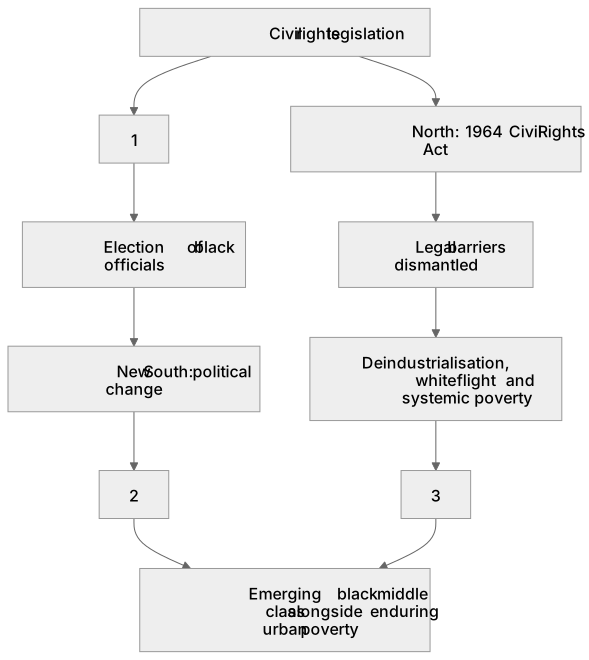
1Box 1
2Box 2
3Box 3
There is more to this lesson
The full lesson goes on to check your understanding and help you earn the marks. Create a free account to carry on, with your progress saved.
A week of Premium from your first lesson · Then the free plan continues · No card, no charge
Test your understanding of 2Q The American Dream: reality and illusion, 1945–1980 – The USA after Nixon, 1974–1980 (A-level only): African-Americans in North and South: the impact of civil rights legislation; change and continuity in the ‘New South’
Active recall beats re-reading. Take an instant quiz now to test what you’ve learned and lock it into long-term memory.
A week of Premium from your first lesson · Then the free plan continues · No card, no charge