AQA · A-Level · History
Course version: 7042 · Version from Sept 2017
Reality and illusion, 1945–1980 – Truman and Post-war America, 1945–1952:…
Full specification wording
2Q The American Dream: reality and illusion, 1945–1980 – Truman and Post-war America, 1945–1952: African-Americans in North and South: the impact of the Second World War; campaigns for Civil Rights; the responses of the federal and state authorities
The post-war era saw contrasting experiences for African-Americans in the segregated South (Jim Crow laws) and the North (de facto segregation and redlining).
Checked against the AQA 7042 specification (opens in a new tab) on .
- Point 4 of 4
- 4 key terms
Study notes
From the checked teaching notes for this specification point.
The idea
The post-war era saw contrasting experiences for African-Americans in the segregated South (Jim Crow laws) and the North (de facto segregation and redlining). The Second World War profoundly impacted civil rights, as the 'Double V' campaign and the Great Migration raised expectations and political consciousness. Campaigns for Civil Rights gained momentum through organisations like the NAACP, which pursued legal challenges against segregation, notably in higher education (e.g., Sweatt v. Painter). Responses varied significantly: federal authorities showed tentative progress, such as Truman’s Executive Order 9981 desegregating the military and his civil rights committee ('To Secure These Rights'), while Southern state authorities fiercely resisted, employing voter suppression and violence.
What earns the marks
- Compare the de jure segregation experienced by African-Americans in the South with the de facto segregation and economic discrimination in the North.
- Analyse how the Second World War, including the Double V campaign and the GI Bill's unequal application, catalysed the civil rights movement.
- Evaluate the effectiveness of early civil rights campaigns, particularly the NAACP's legal strategy targeting educational segregation.
- Assess the significance of Truman's federal actions, such as the desegregation of the armed forces, against the entrenched resistance of Southern state authorities.
Common mistakes and how to put them right
Treating the North as a region free from racial discrimination.
Put it right: Explicitly discuss de facto segregation, housing covenants, and employment discrimination in Northern cities.
Stating that the civil rights movement only began in the 1950s.
Put it right: Trace the origins of the movement back to the impact of the Second World War and early NAACP legal victories in the 1940s.
Overstating Truman's success in passing civil rights legislation.
Put it right: Clarify that while Truman used executive orders, his legislative civil rights proposals were blocked by Southern Democrats in Congress.
Exam tips
- Use specific examples of NAACP legal cases from the Truman era to demonstrate the groundwork being laid for later landmark rulings like Brown v. Board of Education.
- Contrast the federal executive response (Truman's orders) with the legislative response (congressional blocking) to provide a nuanced view of federal action.
- Discuss the demographic shift of the Second Great Migration to explain the changing political influence of African-Americans in Northern states.
Try the lesson
The start of the 2Q The American Dream: reality and illusion, 1945–1980 – Truman and Post-war America, 1945–1952: African-Americans in North and South: the impact of the Second World War; campaigns for Civil Rights; the responses of the federal and state authorities lesson, made from checked teaching notes for this specification point.
Have a go first
What was a major demographic impact of the Second World War on the African-American population in the United States?
Listen
The post-war era saw contrasting experiences for African-Americans in the segregated South (Jim Crow laws) and the North (de facto segregation and redlining). The Second World War profoundly impacted civil rights, as the 'Double V' campaign and the Great Migration raised expectations and political consciousness. Campaigns for Civil Rights gained momentum through organisations like the NAACP, which pursued legal challenges against segregation, notably in higher education (e.g., Sweatt v. Painter). Responses varied significantly: federal authorities showed tentative progress, such as Truman’s Executive Order 9981 desegregating the military and his civil rights committee ('To Secure These Rights'), while Southern state authorities fiercely resisted, employing voter suppression and violence. A strong answer earns marks for these points. Compare the de jure segregation experienced by African-Americans in the South with the de facto segregation and economic discrimination in the North. Analyse how the Second World War, including the Double V campaign and the GI Bill's unequal application, catalysed the civil rights movement. Evaluate the effectiveness of early civil rights campaigns, particularly the NAACP's legal strategy targeting educational segregation. Assess the significance of Truman's federal actions, such as the desegregation of the armed forces, against the entrenched resistance of Southern state authorities. A common slip: Treating the North as a region free from racial discrimination. Instead, explicitly discuss de facto segregation, housing covenants, and employment discrimination in Northern cities. Exam tip: Use specific examples of NAACP legal cases from the Truman era to demonstrate the groundwork being laid for later landmark rulings like Brown v. Board of Education.
See it
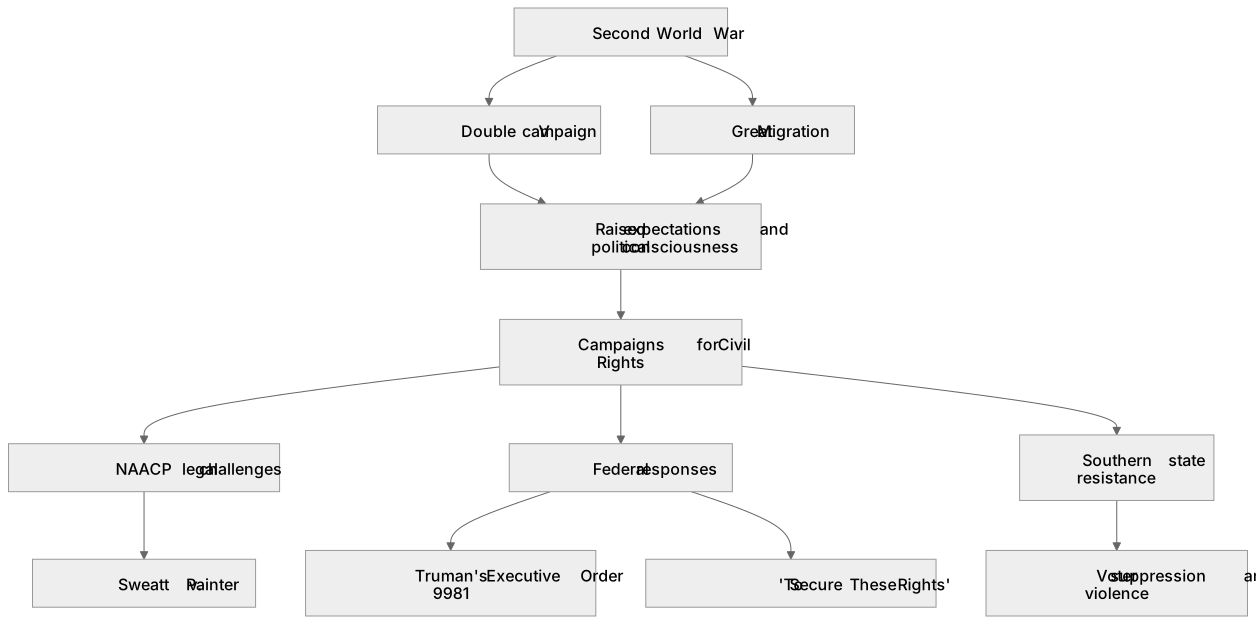
Key words
Say what each word means before you turn the card.
Regional differences in segregation
Try answering aloud or in your head before turning the card.
The catalyst of global conflict on domestic rights
Try answering aloud or in your head before turning the card.
Legal and grassroots activism
Try answering aloud or in your head before turning the card.
Federal versus state power
Try answering aloud or in your head before turning the card.
See every definition
- Regional differences in segregation
- Contrasting experiences for African-Americans in the segregated South under Jim Crow laws and in the North with de facto segregation and redlining.
- The catalyst of global conflict on domestic rights
- The Second World War profoundly impacted civil rights, as the 'Double V' campaign and the Great Migration raised expectations and political consciousness.
- Legal and grassroots activism
- Campaigns for Civil Rights gained momentum through organisations like the NAACP, which pursued legal challenges against segregation, notably in higher education.
- Federal versus state power
- Federal authorities showed tentative progress, such as Truman's Executive Order 9981 and his civil rights committee, while Southern state authorities fiercely resisted with voter suppression and violence.
Label the diagram
Some boxes have lost their names. Pick the right name for each number.
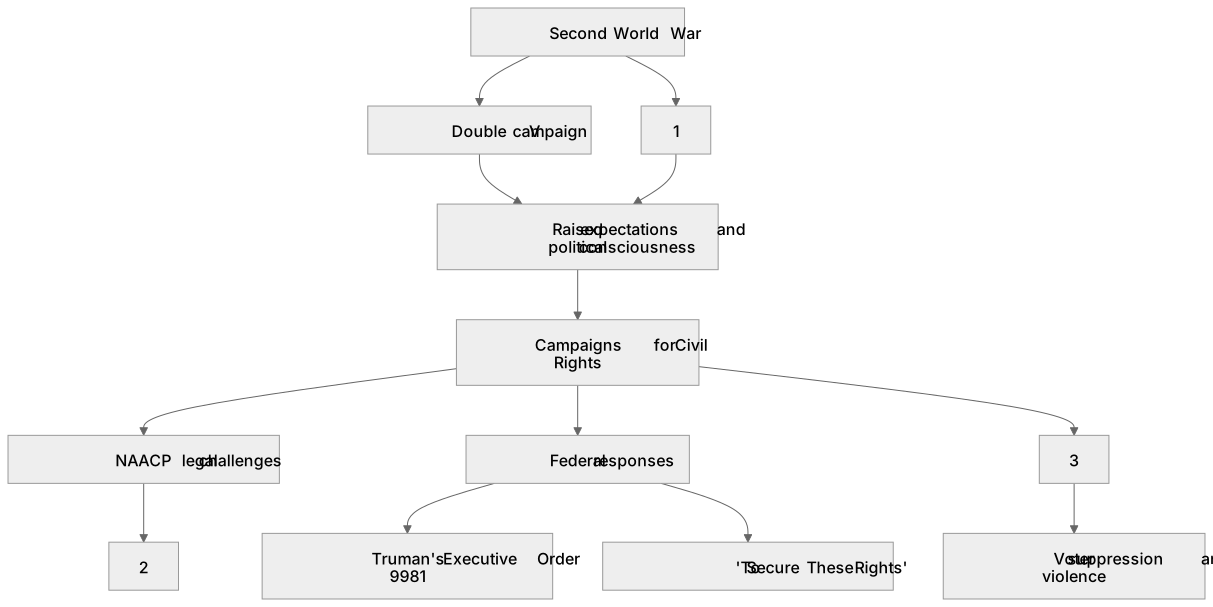
1Box 1
2Box 2
3Box 3
There is more to this lesson
The full lesson goes on to check your understanding and help you earn the marks. Create a free account to carry on, with your progress saved.
A week of Premium from your first lesson · Then the free plan continues · No card, no charge
Test your understanding of 2Q The American Dream: reality and illusion, 1945–1980 – Truman and Post-war America, 1945–1952: African-Americans in North and South: the impact of the Second World War; campaigns for Civil Rights; the responses of the federal and state authorities
Active recall beats re-reading. Take an instant quiz now to test what you’ve learned and lock it into long-term memory.
A week of Premium from your first lesson · Then the free plan continues · No card, no charge