AQA · A-Level · History
Course version: 7042 · Version from Sept 2017
Reality and illusion, 1945–1980 – Truman and Post-war America, 1945–1952:…
Full specification wording
2Q The American Dream: reality and illusion, 1945–1980 – Truman and Post-war America, 1945–1952: Truman and post-war reconstruction: the economy; political divisions and domestic problems; the rise of McCarthyism
Harry S. Truman’s presidency (1945–1953) oversaw a complex post-war reconstruction.
Checked against the AQA 7042 specification (opens in a new tab) on .
- Point 3 of 4
- 4 key terms
Study notes
From the checked teaching notes for this specification point.
The idea
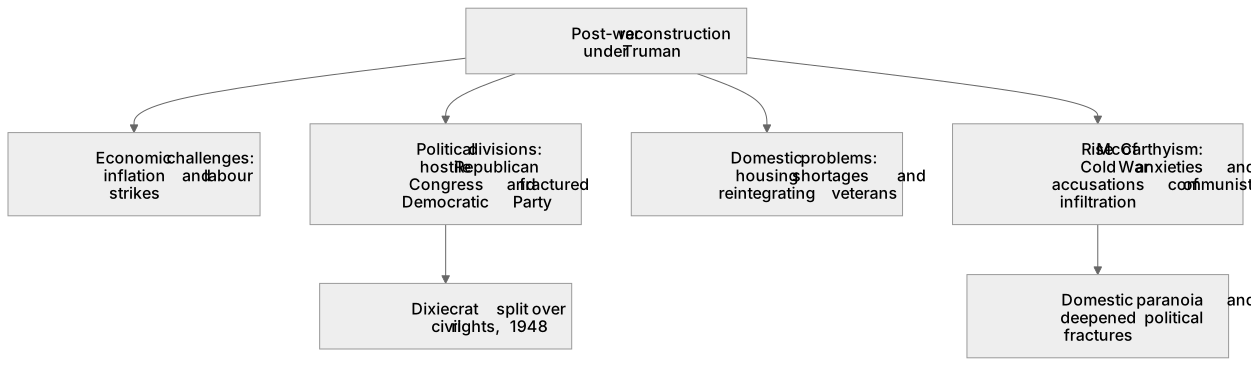
Harry S. Truman’s presidency (1945–1953) oversaw a complex post-war reconstruction. Economically, the US transitioned from wartime production to a consumer boom, though Truman faced severe inflation and widespread labour strikes, such as the 1946 railroad strike. Politically, he navigated deep divisions, facing a hostile Republican Congress from 1946 and a fractured Democratic Party, culminating in the Dixiecrat split over civil rights in 1948. Domestic problems included housing shortages and the challenge of reintegrating millions of veterans via the GI Bill. Concurrently, the rise of McCarthyism exploited Cold War anxieties; Senator Joseph McCarthy’s baseless accusations of communist infiltration in government exacerbated domestic paranoia and deepened political fractures.
What earns the marks
- Evaluate the success of Truman's 'Fair Deal' policies in addressing post-war economic challenges like inflation and housing shortages.
- Analyse the causes and consequences of the post-war strike wave and Truman's response, including his veto of the Taft-Hartley Act.
- Assess the reasons for political divisions within the Democratic Party, specifically the 1948 Dixiecrat and Progressive splits.
- Explain the factors contributing to the rise of McCarthyism, including the HUAC hearings, the Alger Hiss case, and the broader context of the Cold War.
Common mistakes and how to put them right
Claiming Truman had full control over domestic policy.
Put it right: Acknowledge the significant opposition he faced from the conservative coalition in Congress.
Confusing the First Red Scare with McCarthyism.
Put it right: Ensure McCarthyism is specifically situated in the post-WWII context of the late 1940s and early 1950s.
Assuming the post-war economy was immediately prosperous without issues.
Put it right: Detail the severe inflation and labour unrest that characterised the immediate transition period before the consumer boom stabilised.
Exam tips
- Link domestic economic policies, such as the GI Bill, to broader social changes and the growth of the American middle class.
- When discussing McCarthyism, distinguish between Truman's own loyalty programme (Executive Order 9835) and McCarthy's later, more extreme congressional witch-hunts.
- Use the 1948 election as a key case study to demonstrate the extent of political divisions and Truman's unexpected resilience.
Try the lesson
The start of the 2Q The American Dream: reality and illusion, 1945–1980 – Truman and Post-war America, 1945–1952: Truman and post-war reconstruction: the economy; political divisions and domestic problems; the rise of McCarthyism lesson, made from checked teaching notes for this specification point.
Have a go first
Which economic challenge most severely disrupted the United States' transition to a peacetime economy immediately following the end of the Second World War in 1945-1946?
Listen
Harry S. Truman’s presidency (1945–1953) oversaw a complex post-war reconstruction. Economically, the US transitioned from wartime production to a consumer boom, though Truman faced severe inflation and widespread labour strikes, such as the 1946 railroad strike. Politically, he navigated deep divisions, facing a hostile Republican Congress from 1946 and a fractured Democratic Party, culminating in the Dixiecrat split over civil rights in 1948. Domestic problems included housing shortages and the challenge of reintegrating millions of veterans via the GI Bill. Concurrently, the rise of McCarthyism exploited Cold War anxieties; Senator Joseph McCarthy’s baseless accusations of communist infiltration in government exacerbated domestic paranoia and deepened political fractures. A strong answer earns marks for these points. Evaluate the success of Truman's 'Fair Deal' policies in addressing post-war economic challenges like inflation and housing shortages. Analyse the causes and consequences of the post-war strike wave and Truman's response, including his veto of the Taft-Hartley Act. Assess the reasons for political divisions within the Democratic Party, specifically the 1948 Dixiecrat and Progressive splits. Explain the factors contributing to the rise of McCarthyism, including the HUAC hearings, the Alger Hiss case, and the broader context of the Cold War. A common slip: Claiming Truman had full control over domestic policy. Instead, acknowledge the significant opposition he faced from the conservative coalition in Congress. Exam tip: Link domestic economic policies, such as the GI Bill, to broader social changes and the growth of the American middle class.
See it
Put the events in order
Put these events in the order they happened, earliest first.
- 1. Truman's presidency began
- 2. Dixiecrat split over civil rights
- 3. Truman faced a hostile Republican Congress
Key words
Say what each word means before you turn the card.
Economic transition and consumerism
Try answering aloud or in your head before turning the card.
Political polarisation and bipartisanship
Try answering aloud or in your head before turning the card.
Anti-communism and civil liberties
Try answering aloud or in your head before turning the card.
Executive versus legislative power
Try answering aloud or in your head before turning the card.
See every definition
- Economic transition and consumerism
- The US moved from wartime production to a consumer boom, though Truman faced severe inflation and widespread labour strikes.
- Political polarisation and bipartisanship
- Truman navigated deep divisions, facing a hostile Republican Congress from 1946 and a fractured Democratic Party.
- Anti-communism and civil liberties
- McCarthyism exploited Cold War anxieties, with baseless accusations of communist infiltration in government exacerbating domestic paranoia and deepening political fractures.
- Executive versus legislative power
- Truman faced significant opposition from the conservative coalition in Congress, so he did not have full control over domestic policy.
Label the diagram
Some boxes have lost their names. Pick the right name for each number.
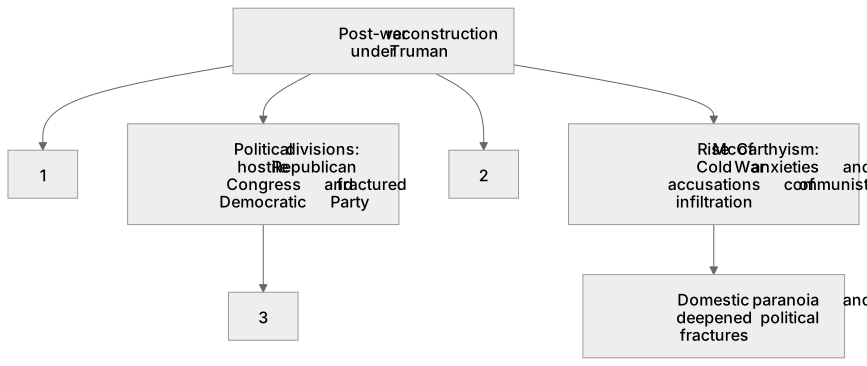
1Box 1
2Box 2
3Box 3
There is more to this lesson
The full lesson goes on to check your understanding and help you earn the marks. Create a free account to carry on, with your progress saved.
A week of Premium from your first lesson · Then the free plan continues · No card, no charge
Test your understanding of 2Q The American Dream: reality and illusion, 1945–1980 – Truman and Post-war America, 1945–1952: Truman and post-war reconstruction: the economy; political divisions and domestic problems; the rise of McCarthyism
Active recall beats re-reading. Take an instant quiz now to test what you’ve learned and lock it into long-term memory.
A week of Premium from your first lesson · Then the free plan continues · No card, no charge