AQA · A-Level · History
Course version: 7042 · Version from Sept 2017
Developing tensions: the Soviet Union occupation/control of eastern and…
Full specification wording
2R The Cold War, c1945–1991 – 1963 The Origins of the Cold War, c1945–1949: Developing tensions: the Soviet Union occupation/control of eastern and southern Europe; Kennan's Long Telegram; the Iron Curtain speech; Cominform; the Greek Civil War and the Truman Doctrine on containment
Post-1945 tensions escalated as the Soviet Union established control over eastern and southern Europe, installing compliant regimes.
Checked against the AQA 7042 specification (opens in a new tab) on .
- Point 2 of 4
- 2 key terms
Study notes
From the checked teaching notes for this specification point.
The idea
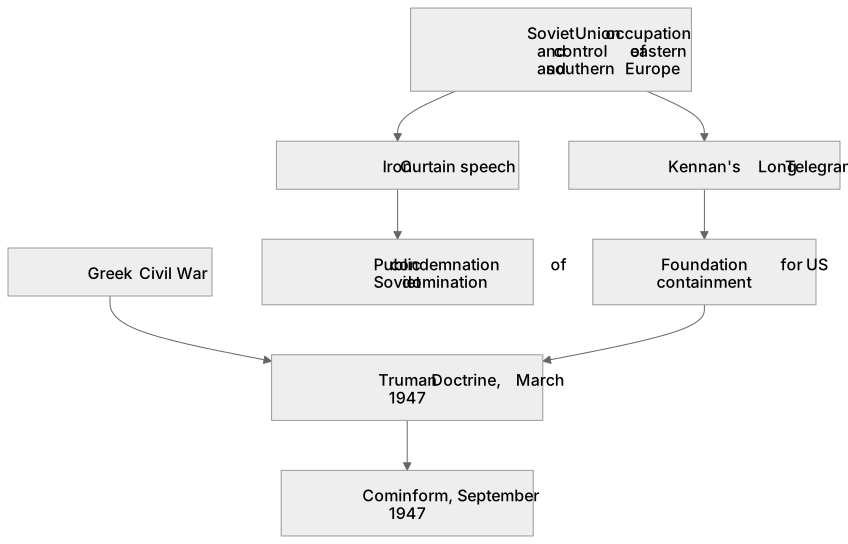
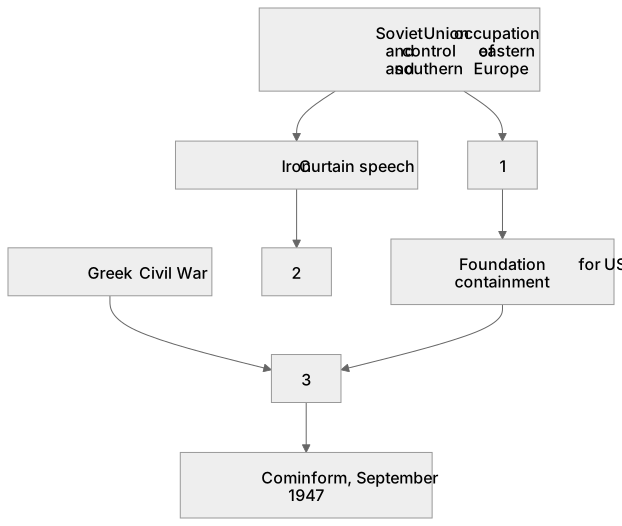
Post-1945 tensions escalated as the Soviet Union established control over eastern and southern Europe, installing compliant regimes. This prompted Kennan's 1946 Long Telegram, arguing the USSR was inherently aggressive and laying the foundation for US containment. Churchill's Iron Curtain speech then publicly condemned Soviet domination, hardening Europe's division. The crisis deepened with the Greek Civil War, where communist insurgents threatened the government. This triggered the March 1947 Truman Doctrine, officially committing the US to a policy of containment. In response to this US assertiveness, Stalin established Cominform in September 1947 to coordinate communist parties and consolidate control.
What earns the marks
- Explain the methods used by the Soviet Union to secure political and military control over eastern and southern European states.
- Analyse the significance of Kennan's Long Telegram in shifting US foreign policy towards the concept of containment.
- Evaluate the impact of Churchill's Iron Curtain speech on public perception and diplomatic relations between the East and West.
- Assess the role of the Greek Civil War as the immediate catalyst for the announcement of the Truman Doctrine.
- Define the Truman Doctrine and explain how it formalised the US policy of containment against Soviet expansionism.
- Explain the purpose of Cominform as Stalin's mechanism for tightening ideological and political control over the Eastern Bloc in response to the Truman Doctrine.
Common mistakes and how to put them right
Stating that the Truman Doctrine was a military alliance.
Put it right: Define the Truman Doctrine as a foreign policy pledge of economic and military aid to prevent the spread of communism, not a formal military alliance like NATO.
Confusing Cominform with Comecon.
Put it right: Specify that Cominform was established in September 1947 for the political and ideological coordination of communist parties, whereas Comecon was formed in 1949 for economic integration.
Assuming the US directly fought in the Greek Civil War.
Put it right: Clarify that the US provided financial and military aid to the Greek royalist government under the Truman Doctrine, rather than deploying US combat troops.
Misordering the events of 1947.
Put it right: Ensure the correct chronological sequence is maintained: the Greek Civil War crisis prompted the Truman Doctrine in March 1947, which subsequently led to the creation of Cominform in September 1947.
Exam tips
- Link Kennan's Long Telegram directly to the Truman Doctrine to show the progression from diplomatic theory to official US foreign policy.
- Use the phrase 'salami tactics' to describe how the Soviet Union gradually eliminated political opposition in eastern and southern Europe, such as in Hungary or Poland.
- Evaluate Churchill's Iron Curtain speech not just as a description of Europe, but as a deliberate provocation that accelerated the breakdown of relations.
- Emphasise the chronological causality of 1947: the Truman Doctrine was a response to the Greek Civil War, and Cominform was Stalin's retaliation to US containment.
Try the lesson
The start of the 2R The Cold War, c1945–1991 – 1963 The Origins of the Cold War, c1945–1949: Developing tensions: the Soviet Union occupation/control of eastern and southern Europe; Kennan's Long Telegram; the Iron Curtain speech; Cominform; the Greek Civil War and the Truman Doctrine on containment lesson, made from checked teaching notes for this specification point.
Have a go first
What was the central argument presented by George Kennan in his 1946 'Long Telegram' regarding Soviet foreign policy?
Listen
Post-1945 tensions escalated as the Soviet Union established control over eastern and southern Europe, installing compliant regimes. This prompted Kennan's 1946 Long Telegram, arguing the USSR was inherently aggressive and laying the foundation for US containment. Churchill's Iron Curtain speech then publicly condemned Soviet domination, hardening Europe's division. The crisis deepened with the Greek Civil War, where communist insurgents threatened the government. This triggered the March 1947 Truman Doctrine, officially committing the US to a policy of containment. In response to this US assertiveness, Stalin established Cominform in September 1947 to coordinate communist parties and consolidate control. A strong answer earns marks for these points. Explain the methods used by the Soviet Union to secure political and military control over eastern and southern European states. Analyse the significance of Kennan's Long Telegram in shifting US foreign policy towards the concept of containment. Evaluate the impact of Churchill's Iron Curtain speech on public perception and diplomatic relations between the East and West. Assess the role of the Greek Civil War as the immediate catalyst for the announcement of the Truman Doctrine. A common slip: Stating that the Truman Doctrine was a military alliance. Instead, Define the Truman Doctrine as a foreign policy pledge of economic and military aid to prevent the spread of communism, not a formal military alliance like NATO. Exam tip: Link Kennan's Long Telegram directly to the Truman Doctrine to show the progression from diplomatic theory to official US foreign policy.
See it
Key words
Say what each word means before you turn the card.
Containment
Try answering aloud or in your head before turning the card.
Soviet expansionism
Try answering aloud or in your head before turning the card.
See every definition
- Containment
- The US policy, officially committed to in the March 1947 Truman Doctrine, of preventing the spread of communism.
- Soviet expansionism
- The extension of Soviet control over eastern and southern Europe, with compliant regimes installed, which the Truman Doctrine was directed against.
Label the diagram
Some boxes have lost their names. Pick the right name for each number.
1Box 1
2Box 2
3Box 3
There is more to this lesson
The full lesson goes on to check your understanding and help you earn the marks. Create a free account to carry on, with your progress saved.
A week of Premium from your first lesson · Then the free plan continues · No card, no charge
Test your understanding of 2R The Cold War, c1945–1991 – 1963 The Origins of the Cold War, c1945–1949: Developing tensions: the Soviet Union occupation/control of eastern and southern Europe; Kennan's Long Telegram; the Iron Curtain speech; Cominform; the Greek Civil War and the Truman Doctrine on containment
Active recall beats re-reading. Take an instant quiz now to test what you’ve learned and lock it into long-term memory.
A week of Premium from your first lesson · Then the free plan continues · No card, no charge