AQA · A-Level · History
Course version: 7042 · Version from Sept 2017
US, British and USSR relations in 1945: conflicting ideologies; tensions…
Full specification wording
2R The Cold War, c1945–1991 – 1963 The Origins of the Cold War, c1945–1949: US, British and USSR relations in 1945: conflicting ideologies; tensions at Yalta; relations between Stalin, Roosevelt and Churchill; the breakdown of the Grand Alliance at Potsdam; relations between Stalin, Truman and Attlee
In 1945, the Grand Alliance fractured due to conflicting capitalist and communist ideologies.
Checked against the AQA 7042 specification (opens in a new tab) on .
- Point 1 of 4
- 4 key terms
Study notes
From the checked teaching notes for this specification point.
The idea
In 1945, the Grand Alliance fractured due to conflicting capitalist and communist ideologies. At Yalta, despite tensions over Poland, relations between Stalin, Roosevelt, and Churchill remained cooperative, securing agreements on Germany's division. By Potsdam, the dynamic had shifted. Roosevelt's death brought Truman, who adopted a hardline stance, while Churchill's defeat introduced Attlee, altering the diplomatic chemistry. Potsdam witnessed the breakdown of the Grand Alliance, as Stalin, Truman, and Attlee clashed over German reparations and Soviet control in Eastern Europe. The US atomic bomb test further emboldened Truman, destroying the fragile trust established earlier and cementing the US, British, and USSR divide.
What earns the marks
- Assess the impact of ideological differences between capitalism and communism on the underlying mistrust between the Big Three.
- Evaluate the agreements and disagreements at Yalta, particularly concerning the Declaration on Liberated Europe and the borders of Poland.
- Analyse how the change in leadership from Roosevelt and Churchill to Truman and Attlee altered the diplomatic dynamic at Potsdam.
- Explain the significance of the successful US atomic bomb test in hardening Truman's attitude towards Stalin at Potsdam.
- Identify the specific points of breakdown at Potsdam, such as disagreements over the scale of German reparations and the nature of Soviet influence in Eastern Europe.
Common mistakes and how to put them right
Confusing the attendees of the two conferences.
Put it right: Ensure you correctly identify Roosevelt and Churchill at Yalta, and Truman and Attlee at Potsdam.
Claiming the Grand Alliance broke down entirely at Yalta.
Put it right: Recognise that Yalta represented the high point of wartime cooperation, despite underlying tensions; the actual breakdown occurred at Potsdam.
Ignoring the role of Britain in the conferences.
Put it right: Acknowledge that while the US and USSR were emerging superpowers, British interests significantly influenced discussions on Poland and Germany.
Exam tips
- Contrast the personal relationship between Stalin and Roosevelt with the much more abrasive dynamic between Stalin and Truman to explain the shift between Yalta and Potsdam.
- Use the issue of Poland as a continuous thread to demonstrate how tensions evolved from vague agreements at Yalta to outright conflict at Potsdam.
- When discussing ideologies, move beyond simple definitions and explain exactly how capitalist and communist worldviews dictated incompatible post-war aims for Europe.
Try the lesson
The start of the 2R The Cold War, c1945–1991 – 1963 The Origins of the Cold War, c1945–1949: US, British and USSR relations in 1945: conflicting ideologies; tensions at Yalta; relations between Stalin, Roosevelt and Churchill; the breakdown of the Grand Alliance at Potsdam; relations between Stalin, Truman and Attlee lesson, made from checked teaching notes for this specification point.
Have a go first
Which of the following was a primary source of tension between the leaders of the Grand Alliance at the Yalta Conference in February 1945?
Listen
In 1945, the Grand Alliance fractured due to conflicting capitalist and communist ideologies. At Yalta, despite tensions over Poland, relations between Stalin, Roosevelt, and Churchill remained cooperative, securing agreements on Germany's division. By Potsdam, the dynamic had shifted. Roosevelt's death brought Truman, who adopted a hardline stance, while Churchill's defeat introduced Attlee, altering the diplomatic chemistry. Potsdam witnessed the breakdown of the Grand Alliance, as Stalin, Truman, and Attlee clashed over German reparations and Soviet control in Eastern Europe. The US atomic bomb test further emboldened Truman, destroying the fragile trust established earlier and cementing the US, British, and USSR divide. A strong answer earns marks for these points. Assess the impact of ideological differences between capitalism and communism on the underlying mistrust between the Big Three. Evaluate the agreements and disagreements at Yalta, particularly concerning the Declaration on Liberated Europe and the borders of Poland. Analyse how the change in leadership from Roosevelt and Churchill to Truman and Attlee altered the diplomatic dynamic at Potsdam. Explain the significance of the successful US atomic bomb test in hardening Truman's attitude towards Stalin at Potsdam. A common slip: Confusing the attendees of the two conferences. Instead, Ensure you correctly identify Roosevelt and Churchill at Yalta, and Truman and Attlee at Potsdam. Exam tip: Contrast the personal relationship between Stalin and Roosevelt with the much more abrasive dynamic between Stalin and Truman to explain the shift between Yalta and Potsdam.
See it
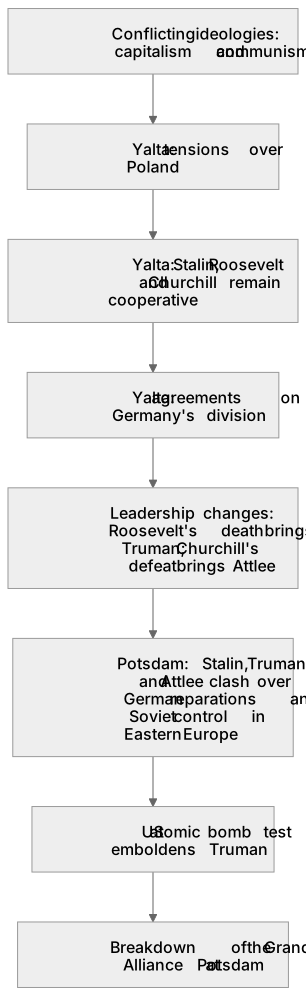
Put it in order
Put these steps in the order they happen.
- 1. Leadership changes: Roosevelt's death brings Truman; Churchill's defeat brings Attlee
- 2. Breakdown of the Grand Alliance at Potsdam
- 3. Potsdam: Stalin, Truman and Attlee clash over German reparations and Soviet control in Eastern Europe
- 4. Conflicting ideologies: capitalism and communism
- 5. Yalta: tensions over Poland
- 6. US atomic bomb test emboldens Truman
- 7. Yalta: Stalin, Roosevelt and Churchill remain cooperative
- 8. Yalta: agreements on Germany's division
Key words
Say what each word means before you turn the card.
Ideological conflict
Try answering aloud or in your head before turning the card.
Diplomacy and leadership
Try answering aloud or in your head before turning the card.
Post-war settlement
Try answering aloud or in your head before turning the card.
The emergence of superpowers
Try answering aloud or in your head before turning the card.
See every definition
- Ideological conflict
- Conflicting capitalist and communist ideologies fractured the Grand Alliance in 1945.
- Diplomacy and leadership
- Relations between Stalin, Roosevelt and Churchill at Yalta, and the changed diplomatic chemistry at Potsdam under Stalin, Truman and Attlee.
- Post-war settlement
- Agreements on Germany's division at Yalta, and clashes at Potsdam over German reparations and Soviet control in Eastern Europe.
- The emergence of superpowers
- The US and USSR emerging as superpowers, while British interests still influenced discussions on Poland and Germany.
Label the diagram
Some boxes have lost their names. Pick the right name for each number.
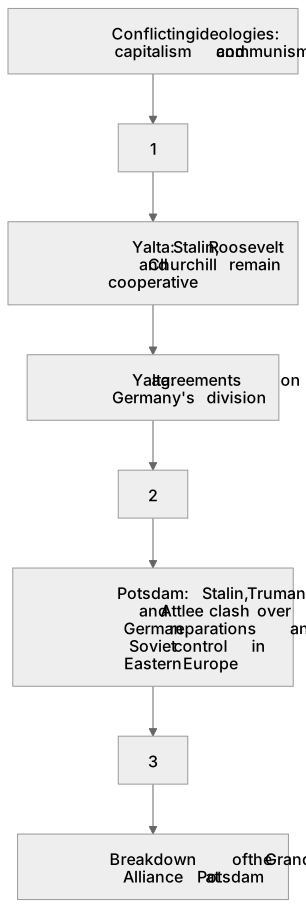
1Box 1
2Box 2
3Box 3
There is more to this lesson
The full lesson goes on to check your understanding and help you earn the marks. Create a free account to carry on, with your progress saved.
A week of Premium from your first lesson · Then the free plan continues · No card, no charge
Test your understanding of 2R The Cold War, c1945–1991 – 1963 The Origins of the Cold War, c1945–1949: US, British and USSR relations in 1945: conflicting ideologies; tensions at Yalta; relations between Stalin, Roosevelt and Churchill; the breakdown of the Grand Alliance at Potsdam; relations between Stalin, Truman and Attlee
Active recall beats re-reading. Take an instant quiz now to test what you’ve learned and lock it into long-term memory.
A week of Premium from your first lesson · Then the free plan continues · No card, no charge