AQA · A-Level · History
Course version: 7042 · Version from Sept 2017
Developments in Africa and the Americas: the impact of Cuban intervention…
Full specification wording
2R The Cold War, c1945–1991 – The Brezhnev era, 1972–1985 (A-level only): Developments in Africa and the Americas: the impact of Cuban intervention in Angola and Ethiopia; the impact of US intervention in Latin America and the Caribbean including Chile, Grenada and Nicaragua
During the Brezhnev era, the Cold War expanded into the Global South.
Checked against the AQA 7042 specification (opens in a new tab) on .
- Point 4 of 4
- 3 key terms
Study notes
From the checked teaching notes for this specification point.
The idea
During the Brezhnev era, the Cold War expanded into the Global South. In Africa, the impact of Cuban intervention decisively shaped civil conflicts. In Angola (1975), Castro deployed troops to support the Marxist MPLA against US-backed factions, securing MPLA dominance. Similarly, in Ethiopia (1977), Cuban forces aided the Marxist Derg regime in repelling a Somali invasion. In the Americas, the impact of US intervention was seen as it countered perceived socialist threats. This included CIA support for the Chilean-led 1973 coup against Salvador Allende in Chile, the 1983 military invasion of Grenada to depose a Marxist government, and covert funding of the Contras in Nicaragua to destabilise the Sandinista regime.
What earns the marks
- Assess the motivations and scale of the impact of Cuban intervention in Angola (Operation Carlota) and Ethiopia, noting Castro's ideological independence alongside Soviet logistical support.
- Evaluate the impact of Cuban intervention on the survival of the MPLA in Angola and the Derg regime in Ethiopia, shifting regional power dynamics.
- Analyse the impact of US intervention in Latin America and the Caribbean, contrasting covert CIA support in Chile (1973) and Nicaragua (Contras) with direct military action in Grenada (1983).
- Examine the consequences of US intervention on domestic politics in Chile, Grenada, and Nicaragua, focusing on the suppression of left-wing movements and the installation of US-friendly regimes.
Common mistakes and how to put them right
Assuming Cuba acted solely as a Soviet proxy in Africa.
Put it right: Recognise that the impact of Cuban intervention in Angola and Ethiopia was often driven by Castro's own revolutionary internationalism, which the USSR subsequently supported.
Confusing the methods of US intervention across the Americas.
Put it right: Distinguish between the covert CIA support for the Chilean-led coup in Chile and the direct deployment of US military forces in Grenada.
Overlooking the role of regional actors in these conflicts.
Put it right: Include the involvement of South Africa in Angola and Somalia in the Ethiopian conflict to provide a complete geopolitical picture of developments in Africa.
Exam tips
- Compare the differing approaches of the US and Cuba to intervention, contrasting direct military deployment with covert funding and proxy warfare.
- Link these regional developments in Africa and the Americas back to the broader context of detente and the Brezhnev Doctrine, evaluating how they contributed to the breakdown of superpower relations.
- Use specific dates and operation names, such as the 1973 Chilean coup or the 1983 invasion of Grenada, to substantiate arguments about the impact of US intervention.
Try the lesson
The start of the 2R The Cold War, c1945–1991 – The Brezhnev era, 1972–1985 (A-level only): Developments in Africa and the Americas: the impact of Cuban intervention in Angola and Ethiopia; the impact of US intervention in Latin America and the Caribbean including Chile, Grenada and Nicaragua lesson, made from checked teaching notes for this specification point.
Have a go first
Which of the following was the primary justification given by the United States for its military intervention in Grenada in 1983?
Listen
During the Brezhnev era, the Cold War expanded into the Global South. In Africa, the impact of Cuban intervention decisively shaped civil conflicts. In Angola (1975), Castro deployed troops to support the Marxist MPLA against US-backed factions, securing MPLA dominance. Similarly, in Ethiopia (1977), Cuban forces aided the Marxist Derg regime in repelling a Somali invasion. In the Americas, the impact of US intervention was seen as it countered perceived socialist threats. This included CIA support for the Chilean-led 1973 coup against Salvador Allende in Chile, the 1983 military invasion of Grenada to depose a Marxist government, and covert funding of the Contras in Nicaragua to destabilise the Sandinista regime. A strong answer earns marks for these points. Assess the motivations and scale of the impact of Cuban intervention in Angola (Operation Carlota) and Ethiopia, noting Castro's ideological independence alongside Soviet logistical support. Evaluate the impact of Cuban intervention on the survival of the MPLA in Angola and the Derg regime in Ethiopia, shifting regional power dynamics. Analyse the impact of US intervention in Latin America and the Caribbean, contrasting covert CIA support in Chile (1973) and Nicaragua (Contras) with direct military action in Grenada (1983). Examine the consequences of US intervention on domestic politics in Chile, Grenada, and Nicaragua, focusing on the suppression of left-wing movements and the installation of US-friendly regimes. A common slip: Assuming Cuba acted solely as a Soviet proxy in Africa. Instead, recognise that the impact of Cuban intervention in Angola and Ethiopia was often driven by Castro's own revolutionary internationalism, which the USSR subsequently supported. Exam tip: Compare the differing approaches of the US and Cuba to intervention, contrasting direct military deployment with covert funding and proxy warfare.
See it
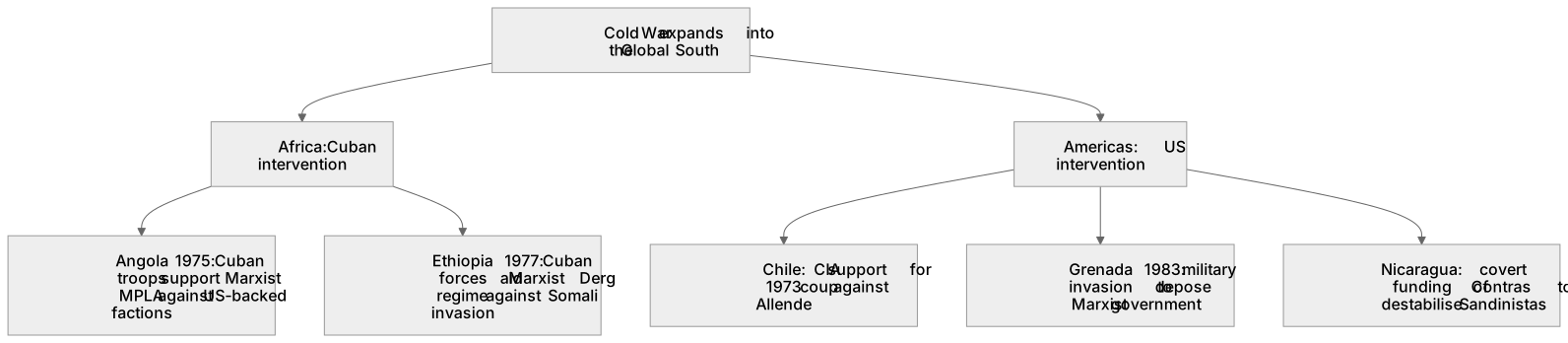
Put the events in order
Put these events in the order they happened, earliest first.
- 1. Military invasion of Grenada to depose a Marxist government
- 2. CIA support for the Chilean-led coup against Salvador Allende
- 3. Cuban forces aided the Marxist Derg regime
- 4. Castro deployed troops to support the Marxist MPLA
Key words
Say what each word means before you turn the card.
Covert operations
Try answering aloud or in your head before turning the card.
Superpower hegemony
Try answering aloud or in your head before turning the card.
Ideological expansionism
Try answering aloud or in your head before turning the card.
See every definition
- Covert operations
- Secret actions such as the CIA support for the Chilean-led 1973 coup against Salvador Allende and the covert funding of the Contras in Nicaragua.
- Superpower hegemony
- The dominance exercised by the superpowers, seen as the US countered perceived socialist threats and sought to install US-friendly regimes.
- Ideological expansionism
- The spread of a political creed into the Global South, reflected in Castro's revolutionary internationalism and the backing of Marxist regimes in Angola and Ethiopia.
Label the diagram
Some boxes have lost their names. Pick the right name for each number.
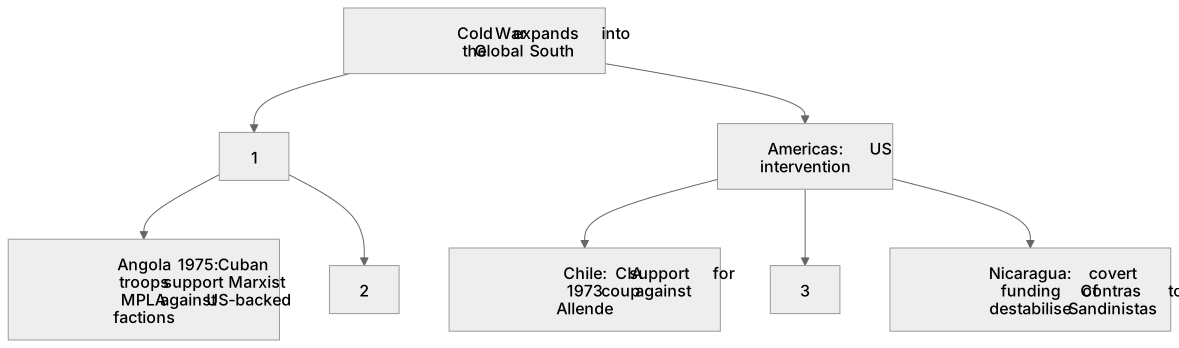
1Box 1
2Box 2
3Box 3
There is more to this lesson
The full lesson goes on to check your understanding and help you earn the marks. Create a free account to carry on, with your progress saved.
A week of Premium from your first lesson · Then the free plan continues · No card, no charge
Test your understanding of 2R The Cold War, c1945–1991 – The Brezhnev era, 1972–1985 (A-level only): Developments in Africa and the Americas: the impact of Cuban intervention in Angola and Ethiopia; the impact of US intervention in Latin America and the Caribbean including Chile, Grenada and Nicaragua
Active recall beats re-reading. Take an instant quiz now to test what you’ve learned and lock it into long-term memory.
A week of Premium from your first lesson · Then the free plan continues · No card, no charge