AQA · A-Level · History
Course version: 7042 · Version from Sept 2017
The Second Cold War: the reasons for renewed hostilities and developments,…
Full specification wording
2R The Cold War, c1945–1991 – The Brezhnev era, 1972–1985 (A-level only): The Second Cold War: the reasons for renewed hostilities and developments, including the Soviet invasion of Afghanistan; new personalities, including Reagan, Thatcher and Pope John Paul II; the crushing of Solidarity in Poland; the shooting down of KAL 007
The Second Cold War emerged in the late 1970s as Détente collapsed, triggered decisively by the 1979 Soviet invasion of Afghanistan, which prompted US sanctions and the Carter Doctrine.
Checked against the AQA 7042 specification (opens in a new tab) on .
- Point 3 of 4
Study notes
From the checked teaching notes for this specification point.
The idea
The Second Cold War emerged in the late 1970s as Détente collapsed, triggered decisively by the 1979 Soviet invasion of Afghanistan, which prompted US sanctions and the Carter Doctrine. Renewed hostilities were intensified by new, uncompromising personalities: Ronald Reagan and Margaret Thatcher adopted aggressive anti-communist rhetoric and policies, while Pope John Paul II provided spiritual inspiration to Eastern European resistance. This resistance was most visible in Poland, where the independent trade union Solidarity was crushed by martial law in 1981 under Soviet pressure. Tensions reached a dangerous peak in 1983 with the Soviet shooting down of civilian airliner KAL 007, highlighting the extreme paranoia and breakdown of communication between the superpowers.
What earns the marks
- Analyse the Soviet invasion of Afghanistan (1979) as the catalyst for the Second Cold War, leading to the US boycott of the 1980 Moscow Olympics and the end of SALT II ratification.
- Evaluate the ideological shift brought by Reagan and Thatcher, focusing on Reagan's 'Evil Empire' speech, increased US defence spending, and the Strategic Defense Initiative (SDI).
- Assess the role of Pope John Paul II in undermining Soviet authority, particularly his 1979 visit to Poland which emboldened the Catholic opposition and the Solidarity movement.
- Explain the significance of the 1981 martial law in Poland, demonstrating the Soviet Union's reliance on coercion to maintain the Warsaw Pact in the face of the Solidarity crisis.
- Examine the KAL 007 incident (1983) as a demonstration of heightened Soviet paranoia and the severe deterioration of diplomatic communication during the Able Archer period.
Common mistakes and how to put them right
Stating that Reagan single-handedly started the Second Cold War.
Put it right by noting that hostilities were already renewed under Carter following the 1979 Soviet invasion of Afghanistan.
Assuming Soviet troops directly crushed Solidarity in 1981.
Put it right by explaining that Polish General Jaruzelski declared martial law internally, albeit under intense pressure and threat of intervention from Moscow.
Describing KAL 007 as a deliberate Soviet attack on American civilians.
Put it right by clarifying that Soviet air defence mistook the civilian airliner for a US spy plane, reflecting systemic paranoia rather than a planned provocation.
Exam tips
- Connect the emergence of new personalities (Reagan, Thatcher, Pope John Paul II) to the ideological reinvigoration of the West, contrasting this with the stagnant Soviet leadership before Gorbachev.
- Use the crushing of Solidarity to illustrate the economic and political vulnerabilities of the Soviet bloc in the early 1980s.
- When discussing the KAL 007 incident, link it to the broader context of 1983, including the Able Archer exercise, to demonstrate how close the world came to accidental nuclear conflict.
Try the lesson
The start of the 2R The Cold War, c1945–1991 – The Brezhnev era, 1972–1985 (A-level only): The Second Cold War: the reasons for renewed hostilities and developments, including the Soviet invasion of Afghanistan; new personalities, including Reagan, Thatcher and Pope John Paul II; the crushing of Solidarity in Poland; the shooting down of KAL 007 lesson, made from checked teaching notes for this specification point.
Have a go first
Which event in December 1979 is widely considered to have marked the definitive end of Détente and the beginning of the Second Cold War?
Listen
The Second Cold War emerged in the late 1970s as Détente collapsed, triggered decisively by the 1979 Soviet invasion of Afghanistan, which prompted US sanctions and the Carter Doctrine. Renewed hostilities were intensified by new, uncompromising personalities: Ronald Reagan and Margaret Thatcher adopted aggressive anti-communist rhetoric and policies, while Pope John Paul II provided spiritual inspiration to Eastern European resistance. This resistance was most visible in Poland, where the independent trade union Solidarity was crushed by martial law in 1981 under Soviet pressure. Tensions reached a dangerous peak in 1983 with the Soviet shooting down of civilian airliner KAL 007, highlighting the extreme paranoia and breakdown of communication between the superpowers. A strong answer earns marks for these points. Analyse the Soviet invasion of Afghanistan (1979) as the catalyst for the Second Cold War, leading to the US boycott of the 1980 Moscow Olympics and the end of SALT II ratification. Evaluate the ideological shift brought by Reagan and Thatcher, focusing on Reagan's 'Evil Empire' speech, increased US defence spending, and the Strategic Defense Initiative (SDI). Assess the role of Pope John Paul II in undermining Soviet authority, particularly his 1979 visit to Poland which emboldened the Catholic opposition and the Solidarity movement. Explain the significance of the 1981 martial law in Poland, demonstrating the Soviet Union's reliance on coercion to maintain the Warsaw Pact in the face of the Solidarity crisis. A common slip: Stating that Reagan single-handedly started the Second Cold War. Instead, noting that hostilities were already renewed under Carter following the 1979 Soviet invasion of Afghanistan. Exam tip: Connect the emergence of new personalities (Reagan, Thatcher, Pope John Paul II) to the ideological reinvigoration of the West, contrasting this with the stagnant Soviet leadership before Gorbachev.
See it
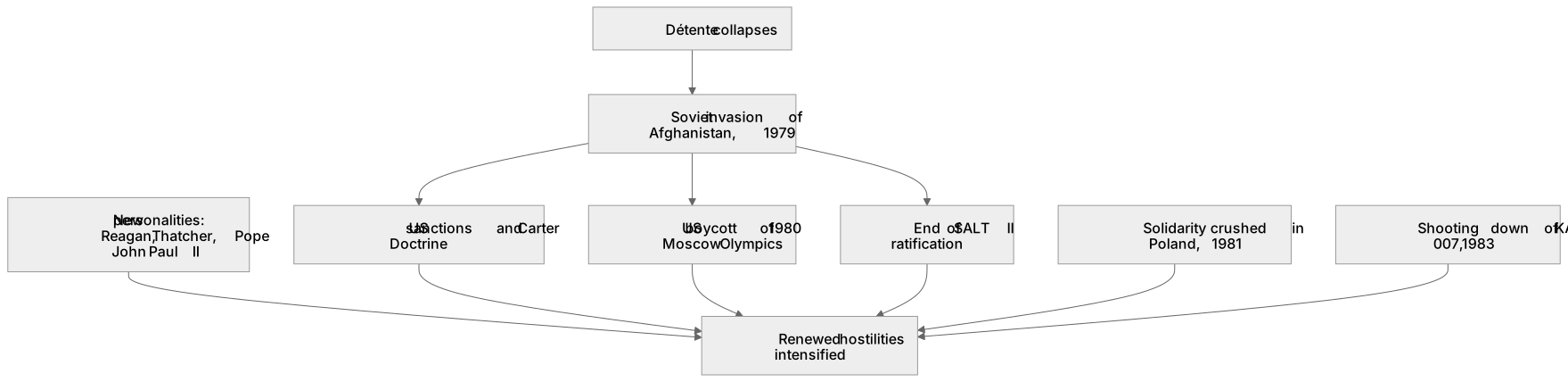
Put the events in order
Put these events in the order they happened, earliest first.
- 1. Soviet invasion of Afghanistan
- 2. Martial law declared in Poland to crush Solidarity
- 3. US boycott of the Moscow Olympics
Label the diagram
Some boxes have lost their names. Pick the right name for each number.
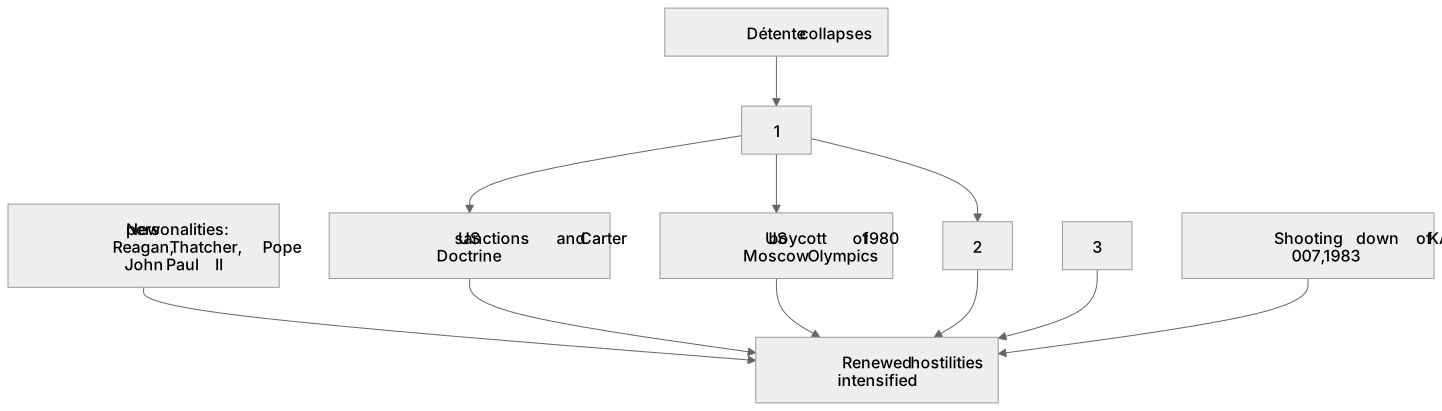
1Box 1
2Box 2
3Box 3
There is more to this lesson
The full lesson goes on to check your understanding and help you earn the marks. Create a free account to carry on, with your progress saved.
A week of Premium from your first lesson · Then the free plan continues · No card, no charge
Test your understanding of 2R The Cold War, c1945–1991 – The Brezhnev era, 1972–1985 (A-level only): The Second Cold War: the reasons for renewed hostilities and developments, including the Soviet invasion of Afghanistan; new personalities, including Reagan, Thatcher and Pope John Paul II; the crushing of Solidarity in Poland; the shooting down of KAL 007
Active recall beats re-reading. Take an instant quiz now to test what you’ve learned and lock it into long-term memory.
A week of Premium from your first lesson · Then the free plan continues · No card, no charge