AQA · A-Level · History
Course version: 7042 · Version from Sept 2017
The extent of Détente up to 1979: the SALT talks; Ostpolitik and Helsinki…
Full specification wording
2R The Cold War, c1945–1991 – The Brezhnev era, 1972–1985 (A-level only): The extent of Détente up to 1979: the SALT talks; Ostpolitik and Helsinki accords; arms race; relations with China
Détente represented a relaxation of Cold War tensions up to 1979, driven by mutual economic and strategic needs.
Checked against the AQA 7042 specification (opens in a new tab) on .
- Point 2 of 4
- 4 key terms
Study notes
From the checked teaching notes for this specification point.
The idea
Détente represented a relaxation of Cold War tensions up to 1979, driven by mutual economic and strategic needs. The Strategic Arms Limitation Talks (SALT I in 1972 and SALT II in 1979) attempted to curb the nuclear arms race, though both superpowers continued developing advanced weaponry like MIRVs. In Europe, Willy Brandt’s Ostpolitik normalised relations between East and West Germany, paving the way for the 1975 Helsinki Accords, which recognised post-war European borders and committed signatories to human rights. Meanwhile, shifting relations with China fundamentally altered the global balance; the Sino-Soviet split allowed the US to pursue triangular diplomacy, culminating in formal US-Chinese diplomatic recognition in 1979.
What earns the marks
- Evaluate the effectiveness of SALT I (1972) in freezing ICBM and SLBM numbers, while noting its failure to restrict MIRV technology, which allowed the arms race to continue qualitatively.
- Analyse the impact of Ostpolitik, specifically the 1972 Basic Treaty, in reducing European tensions by formally recognising the existence of two German states.
- Explain how the Sino-Soviet border conflict of 1969 facilitated US-Chinese rapprochement, allowing Nixon to use 'triangular diplomacy' to pressure Moscow into Détente.
Common mistakes and how to put them right
Confusing SALT I and SALT II.
Put it right: SALT I (1972) was ratified and implemented, whereas SALT II (1979) was never ratified by the US Senate due to the Soviet invasion of Afghanistan.
Assuming Détente ended the arms race.
Put it right by explaining that while quantitative limits were set on certain delivery systems, qualitative improvements like MIRVs meant the nuclear threat actually increased.
Claiming the Helsinki Accords were purely a Soviet victory.
Put it right by highlighting that Basket III's human rights clauses provided a legal framework for Eastern Bloc dissidents to challenge Soviet authority.
Exam tips
- When assessing the 'extent' of Détente, contrast the diplomatic successes in Europe (Ostpolitik, Helsinki) with the ongoing proxy conflicts in the developing world.
- Use the concept of 'triangular diplomacy' to explain why the Soviet Union was motivated to engage in the SALT talks following Nixon's 1972 visit to China.
- Link the human rights agreements in the Helsinki Accords to the later emergence of opposition groups like Charter 77, demonstrating the long-term limitations of Détente for Soviet control.
Try the lesson
The start of the 2R The Cold War, c1945–1991 – The Brezhnev era, 1972–1985 (A-level only): The extent of Détente up to 1979: the SALT talks; Ostpolitik and Helsinki accords; arms race; relations with China lesson, made from checked teaching notes for this specification point.
Have a go first
Which of the following was a primary achievement of the 1975 Helsinki Accords regarding European borders?
Listen
Détente represented a relaxation of Cold War tensions up to 1979, driven by mutual economic and strategic needs. The Strategic Arms Limitation Talks (SALT I in 1972 and SALT II in 1979) attempted to curb the nuclear arms race, though both superpowers continued developing advanced weaponry like MIRVs. In Europe, Willy Brandt’s Ostpolitik normalised relations between East and West Germany, paving the way for the 1975 Helsinki Accords, which recognised post-war European borders and committed signatories to human rights. Meanwhile, shifting relations with China fundamentally altered the global balance; the Sino-Soviet split allowed the US to pursue triangular diplomacy, culminating in formal US-Chinese diplomatic recognition in 1979. A strong answer earns marks for these points. Evaluate the effectiveness of SALT I (1972) in freezing ICBM and SLBM numbers, while noting its failure to restrict MIRV technology, which allowed the arms race to continue qualitatively. Analyse the impact of Ostpolitik, specifically the 1972 Basic Treaty, in reducing European tensions by formally recognising the existence of two German states. Assess the dual nature of the 1975 Helsinki Accords: the Soviet Union gained recognition of Eastern European borders (Basket I), while the West secured human rights commitments (Basket III) that later empowered Soviet dissidents. Explain how the Sino-Soviet border conflict of 1969 facilitated US-Chinese rapprochement, allowing Nixon to use 'triangular diplomacy' to pressure Moscow into Détente. A common slip: Assuming Détente ended the arms race. Instead, explaining that while quantitative limits were set on certain delivery systems, qualitative improvements like MIRVs meant the nuclear threat actually increased. Exam tip: When assessing the 'extent' of Détente, contrast the diplomatic successes in Europe (Ostpolitik, Helsinki) with the ongoing proxy conflicts in the developing world.
See it

Put the events in order
Put these events in the order they happened, earliest first.
- 1. SALT II agreed and formal US-Chinese diplomatic recognition
- 2. Sino-Soviet border conflict facilitated US-Chinese rapprochement
- 3. Helsinki Accords recognised post-war borders and secured human rights commitments
- 4. SALT I signed and Ostpolitik's Basic Treaty recognised two German states
Key words
Say what each word means before you turn the card.
Détente
Try answering aloud or in your head before turning the card.
SALT
Try answering aloud or in your head before turning the card.
Ostpolitik
Try answering aloud or in your head before turning the card.
Triangular diplomacy
Try answering aloud or in your head before turning the card.
See every definition
- Détente
- A relaxation of Cold War tensions up to 1979, driven by mutual economic and strategic needs.
- SALT
- The Strategic Arms Limitation Talks, SALT I in 1972 and SALT II in 1979, which attempted to curb the nuclear arms race.
- Ostpolitik
- Willy Brandt's policy that normalised relations between East and West Germany, paving the way for the 1975 Helsinki Accords.
- Triangular diplomacy
- A strategy pursued by the US after the Sino-Soviet split, culminating in formal US-Chinese diplomatic recognition in 1979.
Label the diagram
Some boxes have lost their names. Pick the right name for each number.
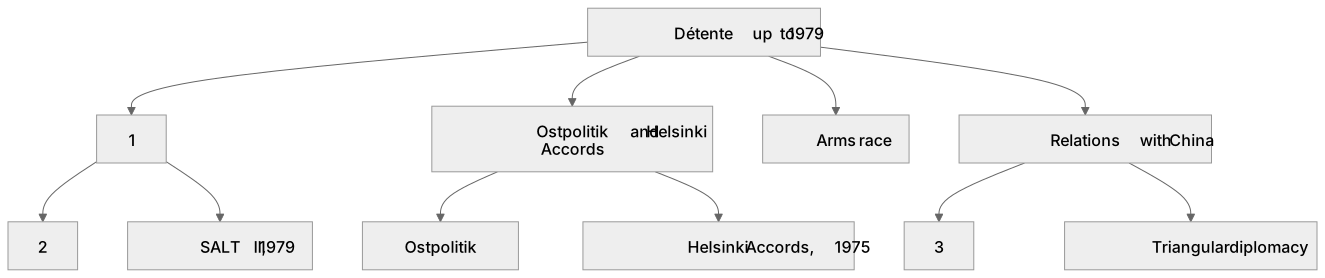
1Box 1
2Box 2
3Box 3
There is more to this lesson
The full lesson goes on to check your understanding and help you earn the marks. Create a free account to carry on, with your progress saved.
A week of Premium from your first lesson · Then the free plan continues · No card, no charge
Test your understanding of 2R The Cold War, c1945–1991 – The Brezhnev era, 1972–1985 (A-level only): The extent of Détente up to 1979: the SALT talks; Ostpolitik and Helsinki accords; arms race; relations with China
Active recall beats re-reading. Take an instant quiz now to test what you’ve learned and lock it into long-term memory.
A week of Premium from your first lesson · Then the free plan continues · No card, no charge