AQA · A-Level · History
Course version: 7042 · Version from Sept 2017
Gorbachev and the ending of the Cold War: pressures on and significance of…
Full specification wording
2R The Cold War, c1945–1991 – The ending of the Cold War, 1985–1991 (A-level only): Gorbachev and the ending of the Cold War: pressures on and significance of Gorbachev as Soviet leader; new thinking and practicalities: the importance of Soviet economic problems;
Mikhail Gorbachev's ascension in 1985 marked a pivotal shift in Soviet policy, driven by immense internal and external pressures.
Checked against the AQA 7042 specification (opens in a new tab) on .
- Point 1 of 4
- 4 key terms
Study notes
From the checked teaching notes for this specification point.
The idea
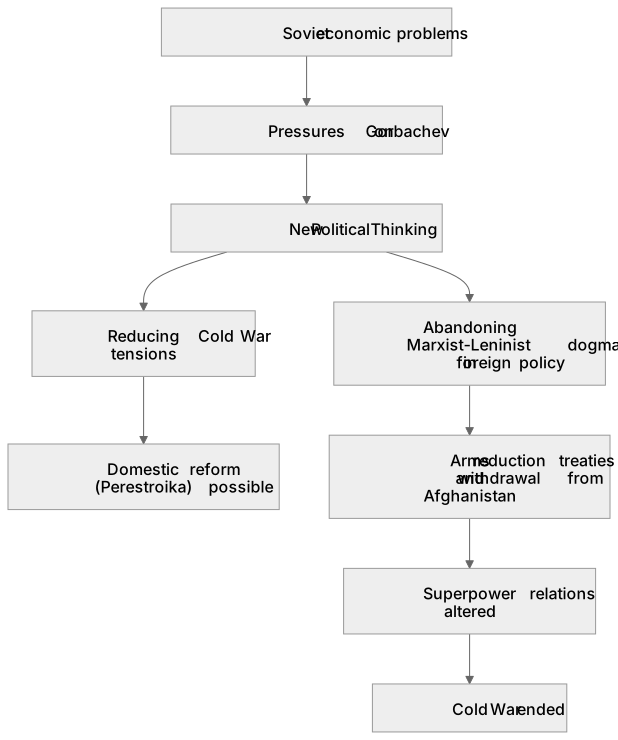
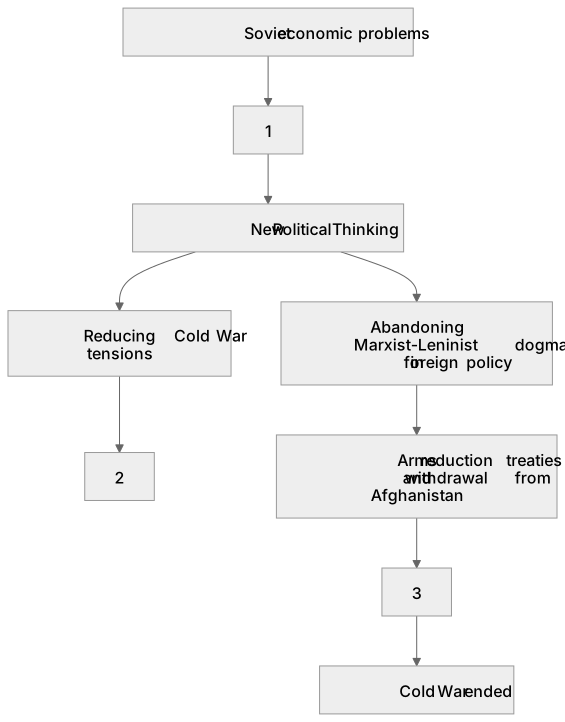
Mikhail Gorbachev's ascension in 1985 marked a pivotal shift in Soviet policy, driven by immense internal and external pressures. The primary catalyst for his 'New Political Thinking' was the stagnant Soviet economy, which could no longer sustain the arms race, the Afghan war, or subsidise the Eastern Bloc. Gorbachev recognised the practicalities of this crisis: without reducing Cold War tensions, domestic reform (Perestroika) was impossible. His significance lies in his willingness to abandon Marxist-Leninist dogma in foreign policy, pursuing arms reduction treaties like the INF Treaty and withdrawing from Afghanistan. By prioritising economic survival over ideological expansion, Gorbachev fundamentally altered superpower relations, inadvertently accelerating the collapse of the Soviet system and ending the Cold War.
What earns the marks
- Identify the specific economic pressures facing the USSR by 1985, including declining growth rates, agricultural failures, and the unsustainable financial burden of the military-industrial complex.
- Explain the concept of 'New Political Thinking', focusing on Gorbachev's shift away from class struggle towards universal human interests and mutual security.
- Evaluate the practicalities that forced Gorbachev's hand, such as the inability to match the US Strategic Defense Initiative (SDI) technologically or financially.
- Assess Gorbachev's significance as a leader, contrasting his reformist approach and willingness to negotiate with the stagnation of his predecessors (Brezhnev, Andropov, Chernenko).
Common mistakes and how to put them right
Arguing that Gorbachev intended to end the Soviet Union.
Put it right: Clarify that his reforms and 'New Thinking' were designed to save and strengthen the socialist system, not dismantle it.
Ignoring the domestic economic drivers of foreign policy.
Put it right: Explicitly link Gorbachev's diplomatic concessions to the urgent need to divert funds from the military to domestic economic restructuring (Perestroika).
Attributing the end of the Cold War solely to US pressure.
Put it right: Balance the narrative by emphasising Gorbachev's agency and the internal systemic failures of the Soviet economy as primary catalysts.
Exam tips
- When evaluating Gorbachev's significance, explicitly connect his foreign policy decisions (like arms control) to his domestic economic imperatives.
- Use the term 'New Political Thinking' accurately, demonstrating an understanding of how it replaced the Brezhnev Doctrine.
- Contrast the economic realities of the USSR in the 1980s with the ideological claims of the Soviet state to highlight the practical necessity of Gorbachev's reforms.
Try the lesson
The start of the 2R The Cold War, c1945–1991 – The ending of the Cold War, 1985–1991 (A-level only): Gorbachev and the ending of the Cold War: pressures on and significance of Gorbachev as Soviet leader; new thinking and practicalities: the importance of Soviet economic problems; lesson, made from checked teaching notes for this specification point.
Have a go first
Which fundamental economic problem placed the greatest pressure on Mikhail Gorbachev when he became Soviet leader in 1985?
Listen
Mikhail Gorbachev's ascension in 1985 marked a pivotal shift in Soviet policy, driven by immense internal and external pressures. The primary catalyst for his 'New Political Thinking' was the stagnant Soviet economy, which could no longer sustain the arms race, the Afghan war, or subsidise the Eastern Bloc. Gorbachev recognised the practicalities of this crisis: without reducing Cold War tensions, domestic reform (Perestroika) was impossible. His significance lies in his willingness to abandon Marxist-Leninist dogma in foreign policy, pursuing arms reduction treaties like the INF Treaty and withdrawing from Afghanistan. By prioritising economic survival over ideological expansion, Gorbachev fundamentally altered superpower relations, inadvertently accelerating the collapse of the Soviet system and ending the Cold War. A strong answer earns marks for these points. Identify the specific economic pressures facing the USSR by 1985, including declining growth rates, agricultural failures, and the unsustainable financial burden of the military-industrial complex. Explain the concept of 'New Political Thinking', focusing on Gorbachev's shift away from class struggle towards universal human interests and mutual security. Evaluate the practicalities that forced Gorbachev's hand, such as the inability to match the US Strategic Defense Initiative (SDI) technologically or financially. Assess Gorbachev's significance as a leader, contrasting his reformist approach and willingness to negotiate with the stagnation of his predecessors (Brezhnev, Andropov, Chernenko). A common slip: Arguing that Gorbachev intended to end the Soviet Union. Instead, clarify that his reforms and 'New Thinking' were designed to save and strengthen the socialist system, not dismantle it. Exam tip: When evaluating Gorbachev's significance, explicitly connect his foreign policy decisions (like arms control) to his domestic economic imperatives.
See it
Key words
Say what each word means before you turn the card.
Economic stagnation
Try answering aloud or in your head before turning the card.
Ideological shift
Try answering aloud or in your head before turning the card.
Leadership and agency
Try answering aloud or in your head before turning the card.
Diplomatic reform
Try answering aloud or in your head before turning the card.
See every definition
- Economic stagnation
- The stagnant Soviet economy was the primary catalyst for Gorbachev's New Political Thinking, as it could no longer sustain the arms race, the Afghan war, or subsidise the Eastern Bloc.
- Ideological shift
- Gorbachev's willingness to abandon Marxist-Leninist dogma in foreign policy, prioritising economic survival over ideological expansion.
- Leadership and agency
- Gorbachev's significance as a leader lay in his reformist approach and willingness to negotiate, prioritising practical economic survival over ideological confrontation.
- Diplomatic reform
- Pursuing arms reduction treaties like the INF Treaty and withdrawing from Afghanistan, reducing Cold War tensions to enable domestic reform.
Label the diagram
Some boxes have lost their names. Pick the right name for each number.
1Box 1
2Box 2
3Box 3
There is more to this lesson
The full lesson goes on to check your understanding and help you earn the marks. Create a free account to carry on, with your progress saved.
A week of Premium from your first lesson · Then the free plan continues · No card, no charge
Test your understanding of 2R The Cold War, c1945–1991 – The ending of the Cold War, 1985–1991 (A-level only): Gorbachev and the ending of the Cold War: pressures on and significance of Gorbachev as Soviet leader; new thinking and practicalities: the importance of Soviet economic problems;
Active recall beats re-reading. Take an instant quiz now to test what you’ve learned and lock it into long-term memory.
A week of Premium from your first lesson · Then the free plan continues · No card, no charge