AQA · A-Level · History
Course version: 7042 · Version from Sept 2017
The summits between the USA and the USSR, including Geneva, Reykjavik,…
Full specification wording
2R The Cold War, c1945–1991 – The ending of the Cold War, 1985–1991 (A-level only): The summits between the USA and the USSR, including Geneva, Reykjavik, Washington and Moscow; Reagan; star wars; Bush and the US response
The late 1980s witnessed a transformation in US-Soviet relations, driven by a series of pivotal summits.
Checked against the AQA 7042 specification (opens in a new tab) on .
- Point 2 of 4
- 4 key terms
Study notes
From the checked teaching notes for this specification point.
The idea
The late 1980s witnessed a transformation in US-Soviet relations, driven by a series of pivotal summits. At Geneva (1985), Reagan and Gorbachev established a crucial personal rapport, though no major agreements were signed. Reykjavik (1986) saw dramatic proposals for nuclear disarmament, ultimately stalling over Reagan's refusal to abandon the Strategic Defense Initiative (SDI, or 'Star Wars'). However, this paved the way for the Washington summit (1987), where the historic Intermediate-Range Nuclear Forces (INF) Treaty was signed. The Moscow summit (1988) further solidified this détente. Following Reagan, President George H.W. Bush initially paused to reassess policy but soon responded positively to Soviet concessions, culminating in the Malta Summit (1989) which effectively declared the Cold War over.
What earns the marks
- Evaluate the significance of the Geneva (1985) and Moscow (1988) summits in building trust between Reagan and Gorbachev.
- Analyse how Reagan's commitment to the Strategic Defense Initiative ('Star Wars') caused the collapse of talks at Reykjavik (1986) but pressured the USSR economically.
- Assess the importance of the Washington summit (1987) and the signing of the INF Treaty in reducing nuclear stockpiles.
- Explain George H.W. Bush's initial 'pause' in 1989 and his subsequent diplomatic response to the changing Soviet landscape.
Common mistakes and how to put them right
Claiming the INF Treaty was signed at Reykjavik.
Put it right: The INF Treaty was signed at the Washington summit in 1987; Reykjavik ended without a formal agreement due to disagreements over SDI.
Assuming George H.W. Bush immediately continued Reagan's rapid pace of diplomacy.
Put it right: Bush initiated a strategic 'pause' upon taking office in 1989 to reassess US-Soviet relations before re-engaging.
Stating that 'Star Wars' was a fully operational defence system.
Put it right: SDI was a proposed, theoretical missile defence system that never became fully operational, though its economic threat was highly significant.
Exam tips
- When evaluating Reagan's role, balance his hardline anti-communist rhetoric and SDI funding with his willingness to negotiate and build a personal relationship with Gorbachev.
- Use the specific outcomes of each summit to trace the chronological development of the end of the Cold War, rather than grouping them as a single event.
- Contrast the diplomatic approaches of Reagan and Bush to demonstrate a nuanced understanding of the US response to Soviet decline.
Try the lesson
The start of the 2R The Cold War, c1945–1991 – The ending of the Cold War, 1985–1991 (A-level only): The summits between the USA and the USSR, including Geneva, Reykjavik, Washington and Moscow; Reagan; star wars; Bush and the US response lesson, made from checked teaching notes for this specification point.
Have a go first
What was the primary obstacle that prevented a comprehensive arms reduction agreement between Ronald Reagan and Mikhail Gorbachev at the 1986 Reykjavik Summit?
Listen
The late 1980s witnessed a transformation in US-Soviet relations, driven by a series of pivotal summits. At Geneva (1985), Reagan and Gorbachev established a crucial personal rapport, though no major agreements were signed. Reykjavik (1986) saw dramatic proposals for nuclear disarmament, ultimately stalling over Reagan's refusal to abandon the Strategic Defense Initiative (SDI, or 'Star Wars'). However, this paved the way for the Washington summit (1987), where the historic Intermediate-Range Nuclear Forces (INF) Treaty was signed. The Moscow summit (1988) further solidified this détente. Following Reagan, President George H.W. Bush initially paused to reassess policy but soon responded positively to Soviet concessions, culminating in the Malta Summit (1989) which effectively declared the Cold War over. A strong answer earns marks for these points. Evaluate the significance of the Geneva (1985) and Moscow (1988) summits in building trust between Reagan and Gorbachev. Analyse how Reagan's commitment to the Strategic Defense Initiative ('Star Wars') caused the collapse of talks at Reykjavik (1986) but pressured the USSR economically. Assess the importance of the Washington summit (1987) and the signing of the INF Treaty in reducing nuclear stockpiles. Explain George H.W. Bush's initial 'pause' in 1989 and his subsequent diplomatic response to the changing Soviet landscape. A common slip: Claiming the INF Treaty was signed at Reykjavik. Instead, The INF Treaty was signed at the Washington summit in 1987; Reykjavik ended without a formal agreement due to disagreements over SDI. Exam tip: When evaluating Reagan's role, balance his hardline anti-communist rhetoric and SDI funding with his willingness to negotiate and build a personal relationship with Gorbachev.
See it
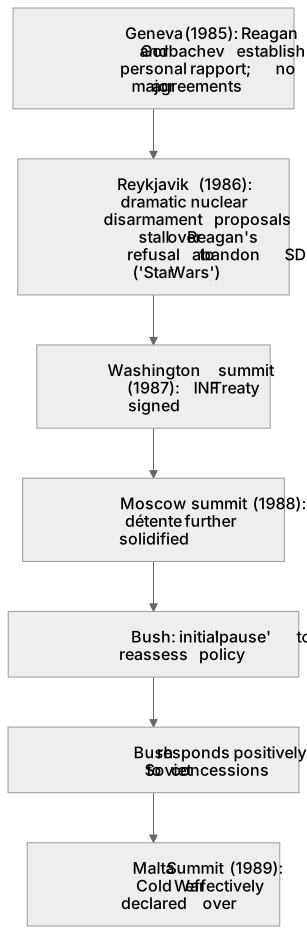
Put it in order
Put these steps in the order they happen.
- 1. Malta Summit (1989): Cold War effectively declared over
- 2. Bush responds positively to Soviet concessions
- 3. Washington summit (1987): INF Treaty signed
- 4. Bush: initial 'pause' to reassess policy
- 5. Geneva (1985): Reagan and Gorbachev establish personal rapport; no major agreements
- 6. Reykjavik (1986): dramatic nuclear disarmament proposals stall over Reagan's refusal to abandon SDI ('Star Wars')
- 7. Moscow summit (1988): détente further solidified
Put the events in order
Put these events in the order they happened, earliest first.
- 1. Reykjavik summit stalled over Reagan's refusal to abandon SDI
- 2. Geneva summit between Reagan and Gorbachev
- 3. Malta Summit effectively declared the Cold War over
- 4. Washington summit where the INF Treaty was signed
- 5. Moscow summit further solidified détente
Key words
Say what each word means before you turn the card.
Nuclear Disarmament
Try answering aloud or in your head before turning the card.
Presidential Leadership
Try answering aloud or in your head before turning the card.
Diplomacy
Try answering aloud or in your head before turning the card.
Technological Competition
Try answering aloud or in your head before turning the card.
See every definition
- Nuclear Disarmament
- Dramatic proposals for this were made at Reykjavik, though the summit stalled over Reagan's refusal to abandon the Strategic Defense Initiative.
- Presidential Leadership
- Reagan built a personal relationship with Gorbachev, while Bush initially paused to reassess policy before responding positively to Soviet concessions.
- Diplomacy
- A series of pivotal summits transformed US-Soviet relations, from Geneva through Reykjavik, Washington and Moscow to Malta.
- Technological Competition
- The Strategic Defense Initiative, or 'Star Wars', was a proposed missile defence system whose economic threat pressured the USSR.
Label the diagram
Some boxes have lost their names. Pick the right name for each number.
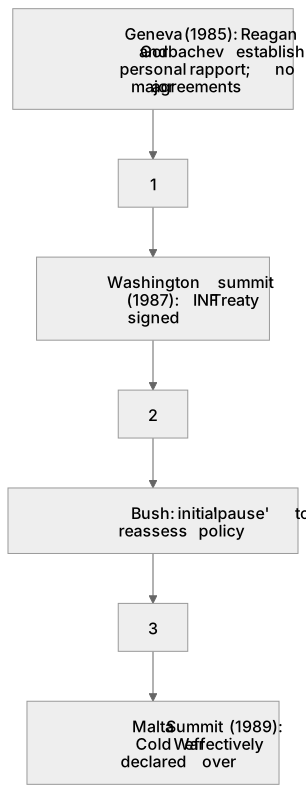
1Box 1
2Box 2
3Box 3
There is more to this lesson
The full lesson goes on to check your understanding and help you earn the marks. Create a free account to carry on, with your progress saved.
A week of Premium from your first lesson · Then the free plan continues · No card, no charge
Test your understanding of 2R The Cold War, c1945–1991 – The ending of the Cold War, 1985–1991 (A-level only): The summits between the USA and the USSR, including Geneva, Reykjavik, Washington and Moscow; Reagan; star wars; Bush and the US response
Active recall beats re-reading. Take an instant quiz now to test what you’ve learned and lock it into long-term memory.
A week of Premium from your first lesson · Then the free plan continues · No card, no charge