AQA · A-Level · History
Course version: 7042 · Version from Sept 2017
Conflict in Asia: Indo-China under Ho Chi-Minh in the North and Diem in…
Full specification wording
2R The Cold War, c1945–1991 – The Global War, 1955–1963: Conflict in Asia: Indo-China under Ho Chi-Minh in the North and Diem in the South; formation of NLF; Kennedy's policies towards Indo-China and Diem's assassination
Following the Geneva Accords, Indo-China was divided into a communist North led by Ho Chi-Minh and a capitalist South governed by Ngo Dinh Diem.
Checked against the AQA 7042 specification (opens in a new tab) on .
- Point 2 of 3
Study notes
From the checked teaching notes for this specification point.
The idea
Following the Geneva Accords, Indo-China was divided into a communist North led by Ho Chi-Minh and a capitalist South governed by Ngo Dinh Diem. Diem’s corrupt, nepotistic regime alienated the Southern population, prompting the formation of the NLF in 1960 to wage a guerrilla insurgency. Viewing Vietnam through the lens of the Domino Theory, Kennedy’s policies towards Indo-China escalated US involvement by increasing financial aid and deploying thousands of military advisors. However, Diem’s continued unpopularity, exacerbated by the 1963 Buddhist Crisis, made him a liability. In 1963, with tacit US approval, a military coup resulted in Diem's assassination, deepening American entanglement in the conflict in Asia.
What earns the marks
- Contrast the political and social structures of Indo-China under Ho Chi-Minh in the North with Ngo Dinh Diem in the South.
- Analyse the domestic factors in South Vietnam that led to the formation of the NLF in 1960.
- Evaluate Kennedy's policies towards Indo-China, including his application of the Domino Theory and strategy of 'Flexible Response'.
- Assess the impact of the 1963 Buddhist Crisis and Diem's authoritarian policies on US-South Vietnamese relations.
- Examine the circumstances surrounding Diem's assassination in 1963 and its consequences for subsequent US policy in Vietnam.
Common mistakes and how to put them right
Claiming Kennedy sent combat troops to Vietnam.
Put it right by specifying he sent military advisors and financial aid, whereas Johnson later deployed ground combat troops.
Equating the NLF entirely with the North Vietnamese Army.
Put it right by defining the NLF (Viet Cong) as a broad-based Southern insurgent coalition, albeit supported and directed by the North.
Stating that the persecution of Buddhists caused the formation of the NLF.
Put it right: The NLF was formed in 1960 due to Diem's broader authoritarianism, while the major Buddhist Crisis occurred later in 1963.
Exam tips
- Analyse Kennedy's policies towards Indo-China as a transitional phase between Eisenhower's initial support and Johnson's full-scale military escalation.
- Use the formation of the NLF to demonstrate how Diem's domestic failures directly fuelled the communist insurgency in the South.
- Evaluate Diem's assassination as a turning point that inadvertently increased US responsibility for the survival of South Vietnam.
Try the lesson
The start of the 2R The Cold War, c1945–1991 – The Global War, 1955–1963: Conflict in Asia: Indo-China under Ho Chi-Minh in the North and Diem in the South; formation of NLF; Kennedy's policies towards Indo-China and Diem's assassination lesson, made from checked teaching notes for this specification point.
Have a go first
Why was the National Liberation Front (NLF) formed in South Vietnam in 1960?
Listen
Following the Geneva Accords, Indo-China was divided into a communist North led by Ho Chi-Minh and a capitalist South governed by Ngo Dinh Diem. Diem’s corrupt, nepotistic regime alienated the Southern population, prompting the formation of the NLF in 1960 to wage a guerrilla insurgency. Viewing Vietnam through the lens of the Domino Theory, Kennedy’s policies towards Indo-China escalated US involvement by increasing financial aid and deploying thousands of military advisors. However, Diem’s continued unpopularity, exacerbated by the 1963 Buddhist Crisis, made him a liability. In 1963, with tacit US approval, a military coup resulted in Diem's assassination, deepening American entanglement in the conflict in Asia. A strong answer earns marks for these points. Contrast the political and social structures of Indo-China under Ho Chi-Minh in the North with Ngo Dinh Diem in the South. Analyse the domestic factors in South Vietnam that led to the formation of the NLF in 1960. Evaluate Kennedy's policies towards Indo-China, including his application of the Domino Theory and strategy of 'Flexible Response'. Assess the impact of the 1963 Buddhist Crisis and Diem's authoritarian policies on US-South Vietnamese relations. A common slip: Claiming Kennedy sent combat troops to Vietnam. Instead, specifying he sent military advisors and financial aid, whereas Johnson later deployed ground combat troops. Exam tip: Analyse Kennedy's policies towards Indo-China as a transitional phase between Eisenhower's initial support and Johnson's full-scale military escalation.
See it
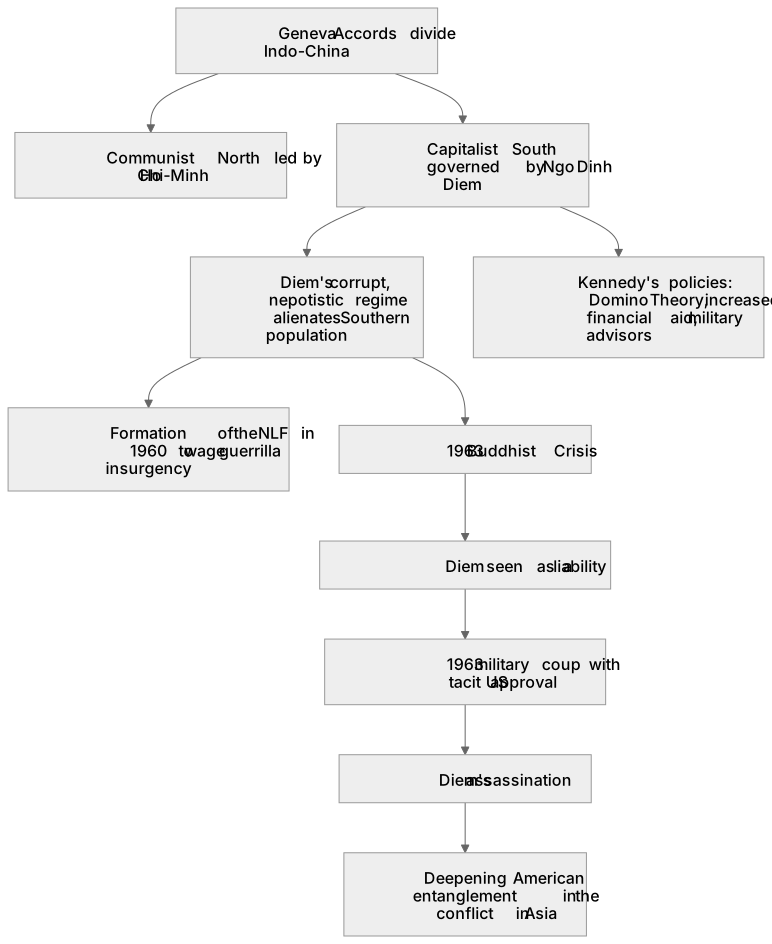
Label the diagram
Some boxes have lost their names. Pick the right name for each number.
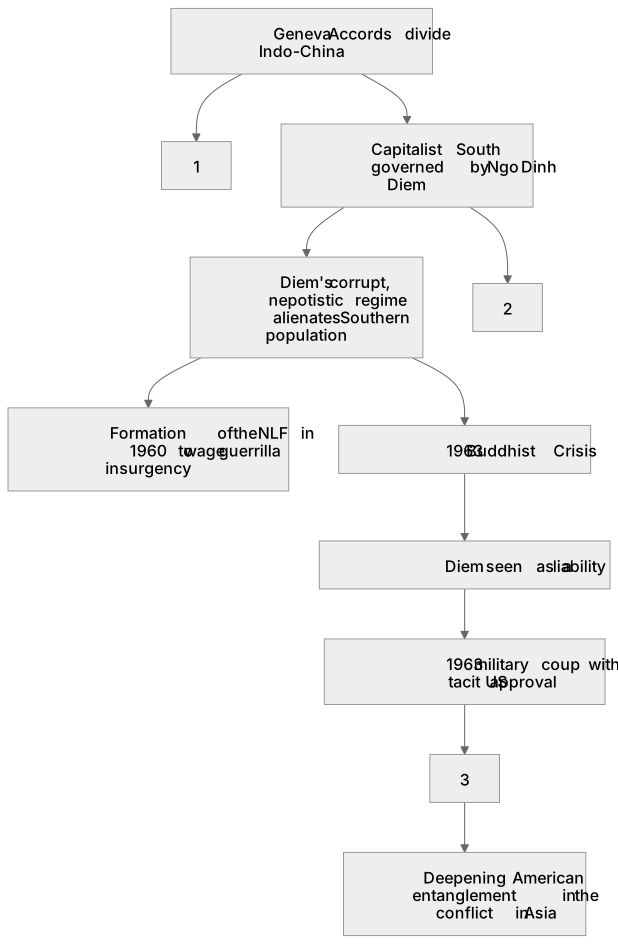
1Box 1
2Box 2
3Box 3
There is more to this lesson
The full lesson goes on to check your understanding and help you earn the marks. Create a free account to carry on, with your progress saved.
A week of Premium from your first lesson · Then the free plan continues · No card, no charge
Test your understanding of 2R The Cold War, c1945–1991 – The Global War, 1955–1963: Conflict in Asia: Indo-China under Ho Chi-Minh in the North and Diem in the South; formation of NLF; Kennedy's policies towards Indo-China and Diem's assassination
Active recall beats re-reading. Take an instant quiz now to test what you’ve learned and lock it into long-term memory.
A week of Premium from your first lesson · Then the free plan continues · No card, no charge