AQA · A-Level · History
Course version: 7042 · Version from Sept 2017
Confrontation between the superpowers: US attitudes to Cuba and…
Full specification wording
2R The Cold War, c1945–1991 – The Global War, 1955–1963: Confrontation between the superpowers: US attitudes to Cuba and developments leading to the missile crisis; the 13 days; the significance of the crisis
The US viewed Cuba as its strategic backyard, reacting to Castro's revolution with embargoes and the disastrous 1961 Bay of Pigs invasion.
Checked against the AQA 7042 specification (opens in a new tab) on .
- Point 3 of 3
- 3 key terms
Study notes
From the checked teaching notes for this specification point.
The idea
The US viewed Cuba as its strategic backyard, reacting to Castro's revolution with embargoes and the disastrous 1961 Bay of Pigs invasion. These developments, alongside US missiles in Turkey, prompted Khrushchev to secretly deploy nuclear missiles to Cuba in 1962. The ensuing '13 days' saw Kennedy reject air strikes for a naval quarantine. The crisis peaked when a US U-2 plane was shot down, but was resolved via a secret deal: the USSR withdrew Cuban missiles for a US pledge not to invade Cuba and the removal of Turkish missiles. The significance was profound, leading to the 1963 Partial Test Ban Treaty, the Washington-Moscow hotline, and a shift towards détente as both superpowers recognised the reality of Mutually Assured Destruction.
What earns the marks
- Explain US attitudes towards Cuba, focusing on economic interests and the fear of a socialist state in the Western Hemisphere.
- Detail the developments leading to the crisis, including the Bay of Pigs, Operation Mongoose, and Soviet strategic aims.
- Analyse the decision-making during the 13 days, contrasting Kennedy's ExComm options like air strikes versus the naval quarantine.
- Evaluate the significance of the crisis, particularly the establishment of the hotline and the 1963 Partial Test Ban Treaty.
Common mistakes and how to put them right
Claiming the US publicly agreed to remove missiles from Turkey.
Put it right: The Turkish missile removal was a secret concession, not part of the public resolution.
Stating that the crisis immediately ended the Cold War.
Put it right: It initiated a period of détente but superpower rivalry continued globally.
Ignoring the role of Castro; students often treat Cuba merely as a passive stage, whereas Castro actively sought Soviet protection after US aggression.
Exam tips
- Use the term 'quarantine' rather than 'blockade', as Kennedy did, to explain how the US avoided an act of war under international law.
- When assessing significance, link the immediate outcomes (like the hotline) to long-term shifts in Cold War diplomacy and Mutually Assured Destruction.
- Contrast the perspectives of Kennedy and Khrushchev to evaluate who 'won' the crisis, noting both domestic and international consequences for each leader.
Try the lesson
The start of the 2R The Cold War, c1945–1991 – The Global War, 1955–1963: Confrontation between the superpowers: US attitudes to Cuba and developments leading to the missile crisis; the 13 days; the significance of the crisis lesson, made from checked teaching notes for this specification point.
Have a go first
Which event directly triggered the beginning of the '13 days' of the Cuban Missile Crisis in October 1962?
Listen
The US viewed Cuba as its strategic backyard, reacting to Castro's revolution with embargoes and the disastrous 1961 Bay of Pigs invasion. These developments, alongside US missiles in Turkey, prompted Khrushchev to secretly deploy nuclear missiles to Cuba in 1962. The ensuing '13 days' saw Kennedy reject air strikes for a naval quarantine. The crisis peaked when a US U-2 plane was shot down, but was resolved via a secret deal: the USSR withdrew Cuban missiles for a US pledge not to invade Cuba and the removal of Turkish missiles. The significance was profound, leading to the 1963 Partial Test Ban Treaty, the Washington-Moscow hotline, and a shift towards détente as both superpowers recognised the reality of Mutually Assured Destruction. A strong answer earns marks for these points. Explain US attitudes towards Cuba, focusing on economic interests and the fear of a socialist state in the Western Hemisphere. Detail the developments leading to the crisis, including the Bay of Pigs, Operation Mongoose, and Soviet strategic aims. Analyse the decision-making during the 13 days, contrasting Kennedy's ExComm options like air strikes versus the naval quarantine. Evaluate the significance of the crisis, particularly the establishment of the hotline and the 1963 Partial Test Ban Treaty. Exam tip: Use the term 'quarantine' rather than 'blockade', as Kennedy did, to explain how the US avoided an act of war under international law.
See it
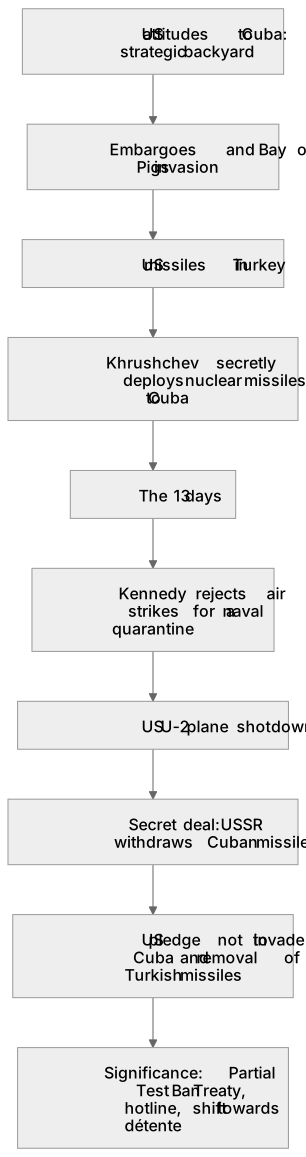
Put the events in order
Put these events in the order they happened, earliest first.
- 1. The disastrous Bay of Pigs invasion
- 2. The Partial Test Ban Treaty was agreed
- 3. Khrushchev secretly deployed nuclear missiles to Cuba
Key words
Say what each word means before you turn the card.
Mutually Assured Destruction
Try answering aloud or in your head before turning the card.
Détente
Try answering aloud or in your head before turning the card.
Quarantine
Try answering aloud or in your head before turning the card.
See every definition
- Mutually Assured Destruction
- The reality recognised by both superpowers after the crisis, which contributed to a shift towards détente.
- Détente
- A shift in relations that the crisis led towards, as both superpowers recognised the reality of Mutually Assured Destruction.
- Quarantine
- The naval measure Kennedy chose during the 13 days instead of air strikes.
Label the diagram
Some boxes have lost their names. Pick the right name for each number.
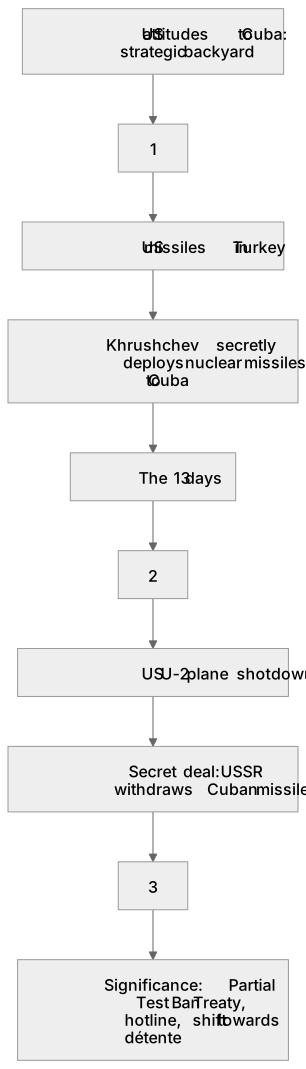
1Box 1
2Box 2
3Box 3
There is more to this lesson
The full lesson goes on to check your understanding and help you earn the marks. Create a free account to carry on, with your progress saved.
A week of Premium from your first lesson · Then the free plan continues · No card, no charge
Test your understanding of 2R The Cold War, c1945–1991 – The Global War, 1955–1963: Confrontation between the superpowers: US attitudes to Cuba and developments leading to the missile crisis; the 13 days; the significance of the crisis
Active recall beats re-reading. Take an instant quiz now to test what you’ve learned and lock it into long-term memory.
A week of Premium from your first lesson · Then the free plan continues · No card, no charge