AQA · A-Level · History
Course version: 7042 · Version from Sept 2017
Alliances and shifts: FRG and NATO; the Warsaw Pact; SEATO; Eisenhower,…
Full specification wording
2R The Cold War, c1945–1991 – The Widening of the Cold War, 1949–1955: Alliances and shifts: FRG and NATO; the Warsaw Pact; SEATO; Eisenhower, Dulles and 'brinkmanship'; the domino theory; attitude to French struggle in Indo-China; the Geneva Conference
The 1950s witnessed a rigid formalisation of Cold War alliances.
Checked against the AQA 7042 specification (opens in a new tab) on .
- Point 4 of 4
- 4 key terms
Study notes
From the checked teaching notes for this specification point.
The idea
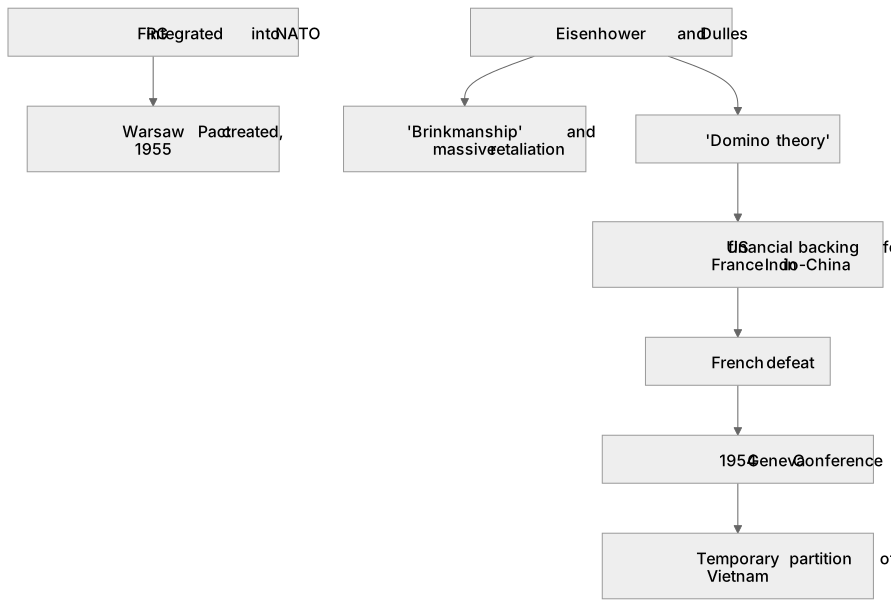
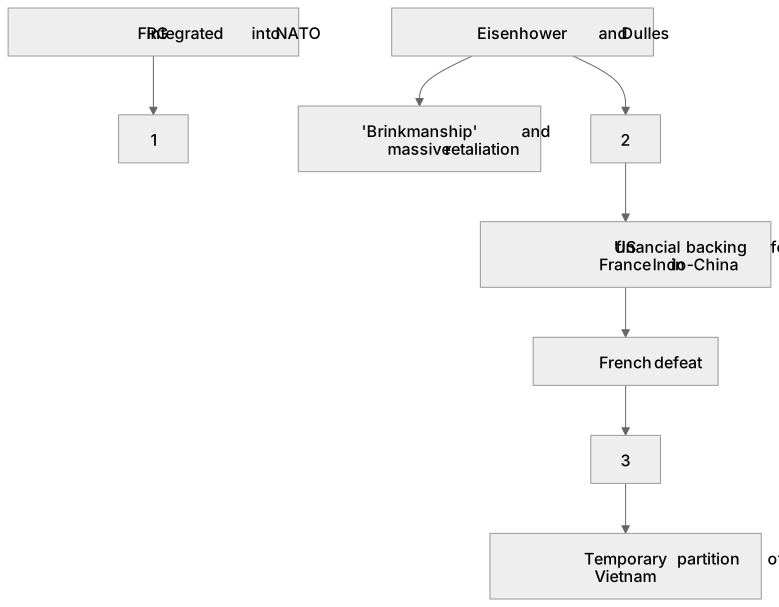
The 1950s witnessed a rigid formalisation of Cold War alliances. The integration of the Federal Republic of Germany (FRG) into NATO in 1955 prompted the immediate creation of the Warsaw Pact, cementing Europe's division. Globally, the US formed SEATO to contain communism in Asia, driven by Eisenhower and Dulles. They championed 'brinkmanship'—threatening massive retaliation to deter Soviet aggression—and the 'domino theory', fearing that if one nation fell, others would follow. This dictated the US attitude to the French struggle in Indo-China, leading to financial backing for France. Following French defeat, the 1954 Geneva Conference temporarily partitioned Vietnam, setting the stage for future conflict.
What earns the marks
- Analyse the causal link between the rearmament of the FRG and its entry into NATO, and the subsequent formation of the Warsaw Pact in 1955.
- Evaluate the effectiveness of SEATO as an Asian equivalent to NATO, noting its lack of a unified military command structure.
- Explain how Eisenhower and Dulles utilised 'brinkmanship' and the threat of massive nuclear retaliation as a diplomatic tool.
- Assess how the 'domino theory' shaped US financial support for the French in Indo-China and influenced the outcomes of the 1954 Geneva Conference.
Common mistakes and how to put them right
Stating the Warsaw Pact was created immediately after NATO.
Put it right: Clarify that the Warsaw Pact was formed in 1955, specifically in response to the FRG (West Germany) joining NATO.
Claiming the US provided direct military troops to aid the French at Dien Bien Phu.
Put it right: Specify that the US provided substantial financial and logistical support, but Eisenhower refused to commit US combat troops.
Confusing the terms of the Geneva Conference with later agreements.
Put it right: Ensure you state that the 1954 Geneva Conference agreed on a temporary partition of Vietnam at the 17th parallel, pending national elections.
Exam tips
- Contrast the rhetoric of 'brinkmanship' and 'massive retaliation' with the actual caution Eisenhower displayed during crises like Indo-China.
- Use the 'domino theory' as a central analytical framework when explaining the shift in US focus from Europe to Asia.
- Compare the structural strengths of NATO with the relative weaknesses of SEATO to evaluate US alliance-building strategies.
Try the lesson
The start of the 2R The Cold War, c1945–1991 – The Widening of the Cold War, 1949–1955: Alliances and shifts: FRG and NATO; the Warsaw Pact; SEATO; Eisenhower, Dulles and 'brinkmanship'; the domino theory; attitude to French struggle in Indo-China; the Geneva Conference lesson, made from checked teaching notes for this specification point.
Have a go first
What was the primary reason for the formation of the Warsaw Pact by the Soviet Union and its Eastern European satellite states in 1955?
Listen
The 1950s witnessed a rigid formalisation of Cold War alliances. The integration of the Federal Republic of Germany (FRG) into NATO in 1955 prompted the immediate creation of the Warsaw Pact, cementing Europe's division. Globally, the US formed SEATO to contain communism in Asia, driven by Eisenhower and Dulles. They championed 'brinkmanship'—threatening massive retaliation to deter Soviet aggression—and the 'domino theory', fearing that if one nation fell, others would follow. This dictated the US attitude to the French struggle in Indo-China, leading to financial backing for France. Following French defeat, the 1954 Geneva Conference temporarily partitioned Vietnam, setting the stage for future conflict. A strong answer earns marks for these points. Analyse the causal link between the rearmament of the FRG and its entry into NATO, and the subsequent formation of the Warsaw Pact in 1955. Evaluate the effectiveness of SEATO as an Asian equivalent to NATO, noting its lack of a unified military command structure. Explain how Eisenhower and Dulles utilised 'brinkmanship' and the threat of massive nuclear retaliation as a diplomatic tool. Assess how the 'domino theory' shaped US financial support for the French in Indo-China and influenced the outcomes of the 1954 Geneva Conference. A common slip: Stating the Warsaw Pact was created immediately after NATO. Instead, Clarify that the Warsaw Pact was formed in 1955, specifically in response to the FRG (West Germany) joining NATO. Exam tip: Contrast the rhetoric of 'brinkmanship' and 'massive retaliation' with the actual caution Eisenhower displayed during crises like Indo-China.
See it
Key words
Say what each word means before you turn the card.
brinkmanship
Try answering aloud or in your head before turning the card.
domino theory
Try answering aloud or in your head before turning the card.
Warsaw Pact
Try answering aloud or in your head before turning the card.
SEATO
Try answering aloud or in your head before turning the card.
See every definition
- brinkmanship
- Threatening massive retaliation to deter Soviet aggression, as championed by Eisenhower and Dulles.
- domino theory
- The fear that if one nation fell, others would follow, which dictated the US attitude to the French struggle in Indo-China.
- Warsaw Pact
- Created immediately in 1955 in response to the integration of the FRG into NATO, cementing Europe's division.
- SEATO
- Formed by the US to contain communism in Asia, driven by Eisenhower and Dulles.
Label the diagram
Some boxes have lost their names. Pick the right name for each number.
1Box 1
2Box 2
3Box 3
There is more to this lesson
The full lesson goes on to check your understanding and help you earn the marks. Create a free account to carry on, with your progress saved.
A week of Premium from your first lesson · Then the free plan continues · No card, no charge
Test your understanding of 2R The Cold War, c1945–1991 – The Widening of the Cold War, 1949–1955: Alliances and shifts: FRG and NATO; the Warsaw Pact; SEATO; Eisenhower, Dulles and 'brinkmanship'; the domino theory; attitude to French struggle in Indo-China; the Geneva Conference
Active recall beats re-reading. Take an instant quiz now to test what you’ve learned and lock it into long-term memory.
A week of Premium from your first lesson · Then the free plan continues · No card, no charge