AQA · A-Level · History
Course version: 7042 · Version from Sept 2017
Increasing Cold War tensions: McCarthyism in the USA and its influence in…
Full specification wording
2R The Cold War, c1945–1991 – The Widening of the Cold War, 1949–1955: Increasing Cold War tensions: McCarthyism in the USA and its influence in Britain and Europe; US dominance in the UN and role as 'world policeman'; the isolation of China
The early 1950s saw escalating Cold War tensions driven by domestic and international factors.
Checked against the AQA 7042 specification (opens in a new tab) on .
- Point 3 of 4
- 2 key terms
Study notes
From the checked teaching notes for this specification point.
The idea
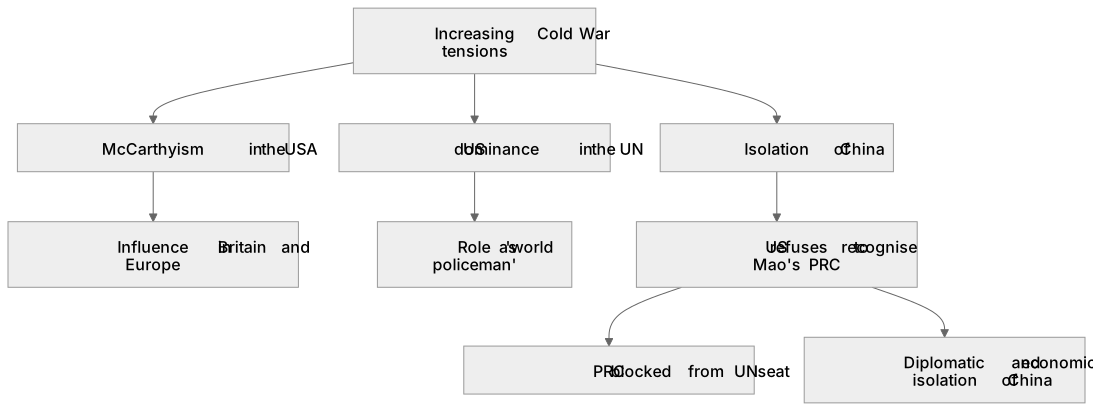
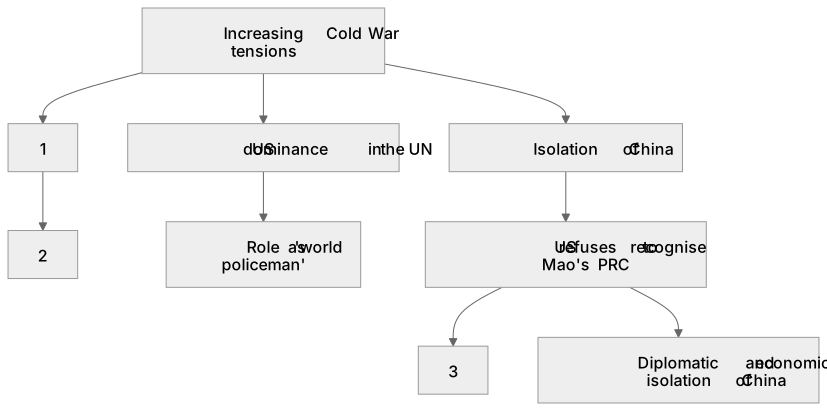
The early 1950s saw escalating Cold War tensions driven by domestic and international factors. In the USA, Senator McCarthy orchestrated a virulent anti-communist witch-hunt (McCarthyism). This domestic paranoia influenced Britain and Europe, straining transatlantic relations as allies viewed US policy as increasingly erratic. Internationally, the US leveraged its power to dominate the United Nations, bypassing Soviet vetoes to act as a 'world policeman' during the Korean War. Concurrently, the US refused to recognise Mao's PRC, blocking its UN seat and enforcing the diplomatic and economic isolation of China, further polarising the global geopolitical landscape.
What earns the marks
- Explain how McCarthyism constrained Truman and Eisenhower's foreign policy options, forcing a harder line against communism.
- Analyse the European reaction to McCarthyism, noting British concerns over US reliability and the fear of being dragged into an unnecessary global conflict.
- Evaluate the mechanisms of US dominance in the UN, such as financial leverage and the 1950 'Uniting for Peace' resolution.
- Assess the impact of the US policy of isolating China, including the refusal to grant the PRC the Chinese UN Security Council seat, which pushed Mao closer to Stalin.
Common mistakes and how to put them right
Claiming McCarthyism only affected domestic US politics.
Put it right: Acknowledge that McCarthyism heavily influenced US foreign policy and caused alarm among British and European allies regarding US stability.
Stating the UN was completely neutral during the early Cold War.
Put it right: Explain that the US dominated the UN in this period, using it to legitimise its 'world policeman' role, particularly in Korea.
Confusing the Republic of China (Taiwan) with the People's Republic of China (PRC) in the UN.
Put it right: Specify that the US ensured Taiwan retained the UN seat to isolate Mao's PRC.
Exam tips
- Link domestic pressures like McCarthyism directly to the hardening of US foreign policy in Asia and Europe.
- Use the Korean War as your primary case study to demonstrate the US acting as a 'world policeman' through the United Nations.
- When discussing the isolation of China, evaluate how this policy inadvertently strengthened the Sino-Soviet alliance in the early 1950s.
Try the lesson
The start of the 2R The Cold War, c1945–1991 – The Widening of the Cold War, 1949–1955: Increasing Cold War tensions: McCarthyism in the USA and its influence in Britain and Europe; US dominance in the UN and role as 'world policeman'; the isolation of China lesson, made from checked teaching notes for this specification point.
Have a go first
Which of the following best describes the specific focus of Senator Joseph McCarthy's anti-communist campaign in the United States during the early 1950s?
Listen
The early 1950s saw escalating Cold War tensions driven by domestic and international factors. In the USA, Senator McCarthy orchestrated a virulent anti-communist witch-hunt (McCarthyism). This domestic paranoia influenced Britain and Europe, straining transatlantic relations as allies viewed US policy as increasingly erratic. Internationally, the US leveraged its power to dominate the United Nations, bypassing Soviet vetoes to act as a 'world policeman' during the Korean War. Concurrently, the US refused to recognise Mao's PRC, blocking its UN seat and enforcing the diplomatic and economic isolation of China, further polarising the global geopolitical landscape. A strong answer earns marks for these points. Explain how McCarthyism constrained Truman and Eisenhower's foreign policy options, forcing a harder line against communism. Analyse the European reaction to McCarthyism, noting British concerns over US reliability and the fear of being dragged into an unnecessary global conflict. Evaluate the mechanisms of US dominance in the UN, such as financial leverage and the 1950 'Uniting for Peace' resolution. Assess the impact of the US policy of isolating China, including the refusal to grant the PRC the Chinese UN Security Council seat, which pushed Mao closer to Stalin. A common slip: Claiming McCarthyism only affected domestic US politics. Instead, Acknowledge that McCarthyism heavily influenced US foreign policy and caused alarm among British and European allies regarding US stability. Exam tip: Link domestic pressures like McCarthyism directly to the hardening of US foreign policy in Asia and Europe.
See it
Key words
Say what each word means before you turn the card.
McCarthyism
Try answering aloud or in your head before turning the card.
Transatlantic relations
Try answering aloud or in your head before turning the card.
See every definition
- McCarthyism
- A virulent anti-communist witch-hunt orchestrated in the USA by Senator McCarthy, which influenced Britain and Europe and strained transatlantic relations.
- Transatlantic relations
- Relations between the USA and its British and European allies, strained as they viewed US policy as increasingly erratic.
Label the diagram
Some boxes have lost their names. Pick the right name for each number.
1Box 1
2Box 2
3Box 3
There is more to this lesson
The full lesson goes on to check your understanding and help you earn the marks. Create a free account to carry on, with your progress saved.
A week of Premium from your first lesson · Then the free plan continues · No card, no charge
Test your understanding of 2R The Cold War, c1945–1991 – The Widening of the Cold War, 1949–1955: Increasing Cold War tensions: McCarthyism in the USA and its influence in Britain and Europe; US dominance in the UN and role as 'world policeman'; the isolation of China
Active recall beats re-reading. Take an instant quiz now to test what you’ve learned and lock it into long-term memory.
A week of Premium from your first lesson · Then the free plan continues · No card, no charge