AQA · A-Level · History
Course version: 7042 · Version from Sept 2017
US containment in action in Asia: the reconstruction of Japan and…
Full specification wording
2R The Cold War, c1945–1991 – The Widening of the Cold War, 1949–1955: US containment in action in Asia: the reconstruction of Japan and US-Japanese relations; support for Jiang Jieshi and policy towards China and Taiwan; the defensive perimeter strategy; support for South Korea; NSC-68
US containment in action in Asia shifted to active intervention following the 1949 'loss' of China.
Checked against the AQA 7042 specification (opens in a new tab) on .
- Point 1 of 4
Study notes
From the checked teaching notes for this specification point.
The idea
US containment in action in Asia shifted to active intervention following the 1949 'loss' of China. The reconstruction of Japan and US-Japanese relations transformed the nation into a capitalist bulwark, culminating in the 1951 San Francisco Peace Treaty. The US continued its support for Jiang Jieshi in Taiwan, refusing to recognise Mao's PRC. Acheson's 1950 defensive perimeter strategy controversially omitted South Korea and Taiwan, arguably encouraging communist aggression. However, the US swiftly provided support for South Korea when invaded. This period was defined by NSC-68 (1950), a pivotal document advocating a massive military build-up and militarised global containment, fundamentally shifting US policy in Asia and beyond.
What earns the marks
- Explain the economic and political reconstruction of Japan and the evolution of US-Japanese relations as a capitalist alliance against communism.
- Analyse the reasons for and consequences of US support for Jiang Jieshi in Taiwan and policy towards China, including non-recognition of the PRC.
- Evaluate the impact of Dean Acheson's defensive perimeter strategy on the outbreak of the Korean War.
- Assess the significance of NSC-68 in shifting US policy from political containment to militarised global confrontation.
- Discuss the rationale behind US support for South Korea following the North Korean invasion.
Common mistakes and how to put them right
Confusing the defensive perimeter strategy with the Truman Doctrine.
Put it right: The former specifically delineated areas in Asia the US would defend, notably excluding South Korea.
Assuming NSC-68 was immediately implemented upon drafting.
Put it right: It was initially considered too expensive, but the outbreak of the Korean War provided the catalyst for its implementation.
Stating NSC-68 advocated the rollback of communism.
Put it right: It advocated militarised containment and global confrontation, whereas rollback is associated with later Eisenhower policies.
Exam tips
- When discussing NSC-68, explicitly link it to the militarisation of the Cold War and the tripling of the US defence budget rather than rollback.
- Use Acheson's defensive perimeter strategy to evaluate whether US policy inadvertently caused the Korean War.
- Contrast the US approach to Japan (economic reconstruction) with its approach to Taiwan and South Korea (military support).
Try the lesson
The start of the 2R The Cold War, c1945–1991 – The Widening of the Cold War, 1949–1955: US containment in action in Asia: the reconstruction of Japan and US-Japanese relations; support for Jiang Jieshi and policy towards China and Taiwan; the defensive perimeter strategy; support for South Korea; NSC-68 lesson, made from checked teaching notes for this specification point.
Have a go first
In January 1950, US Secretary of State Dean Acheson outlined the 'defensive perimeter' strategy in Asia. Which of the following territories was notably excluded from this defensive line?
Listen
US containment in action in Asia shifted to active intervention following the 1949 'loss' of China. The reconstruction of Japan and US-Japanese relations transformed the nation into a capitalist bulwark, culminating in the 1951 San Francisco Peace Treaty. The US continued its support for Jiang Jieshi in Taiwan, refusing to recognise Mao's PRC. Acheson's 1950 defensive perimeter strategy controversially omitted South Korea and Taiwan, arguably encouraging communist aggression. However, the US swiftly provided support for South Korea when invaded. This period was defined by NSC-68 (1950), a pivotal document advocating a massive military build-up and militarised global containment, fundamentally shifting US policy in Asia and beyond. A strong answer earns marks for these points. Explain the economic and political reconstruction of Japan and the evolution of US-Japanese relations as a capitalist alliance against communism. Analyse the reasons for and consequences of US support for Jiang Jieshi in Taiwan and policy towards China, including non-recognition of the PRC. Evaluate the impact of Dean Acheson's defensive perimeter strategy on the outbreak of the Korean War. Assess the significance of NSC-68 in shifting US policy from political containment to militarised global confrontation. Exam tip: When discussing NSC-68, explicitly link it to the militarisation of the Cold War and the tripling of the US defence budget rather than rollback.
See it
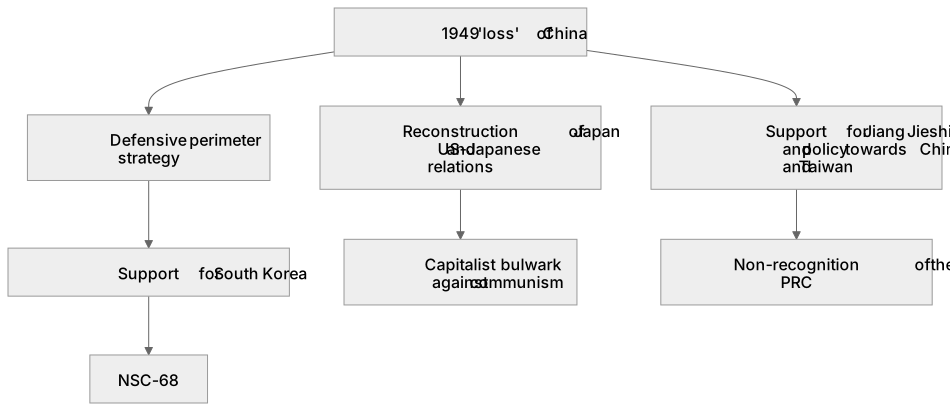
Put the events in order
Put these events in the order they happened, earliest first.
- 1. The 'loss' of China prompted a shift to active intervention
- 2. The San Francisco Peace Treaty concluded Japan's reconstruction
- 3. Acheson's defensive perimeter strategy omitted South Korea and Taiwan
Label the diagram
Some boxes have lost their names. Pick the right name for each number.
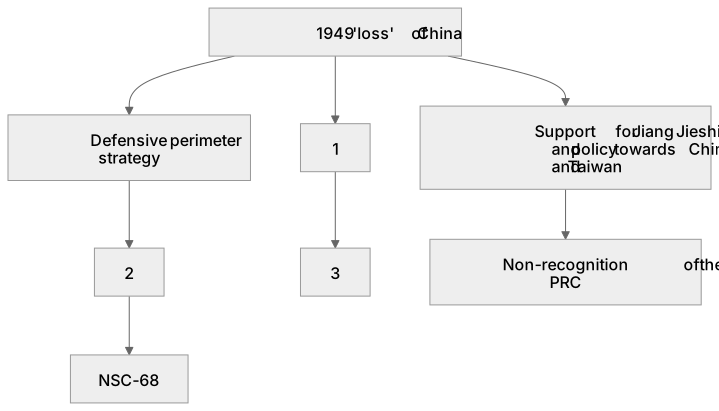
1Box 1
2Box 2
3Box 3
There is more to this lesson
The full lesson goes on to check your understanding and help you earn the marks. Create a free account to carry on, with your progress saved.
A week of Premium from your first lesson · Then the free plan continues · No card, no charge
Test your understanding of 2R The Cold War, c1945–1991 – The Widening of the Cold War, 1949–1955: US containment in action in Asia: the reconstruction of Japan and US-Japanese relations; support for Jiang Jieshi and policy towards China and Taiwan; the defensive perimeter strategy; support for South Korea; NSC-68
Active recall beats re-reading. Take an instant quiz now to test what you’ve learned and lock it into long-term memory.
A week of Premium from your first lesson · Then the free plan continues · No card, no charge