AQA · A-Level · History
Course version: 7042 · Version from Sept 2017
The Korean War: causes, position and aims of Kim ll Sung and Syngman Rhee;…
Full specification wording
2R The Cold War, c1945–1991 – The Widening of the Cold War, 1949–1955: The Korean War: causes, position and aims of Kim ll Sung and Syngman Rhee; attitudes and actions of the UN, USA, USSR and China; military involvement and settlement
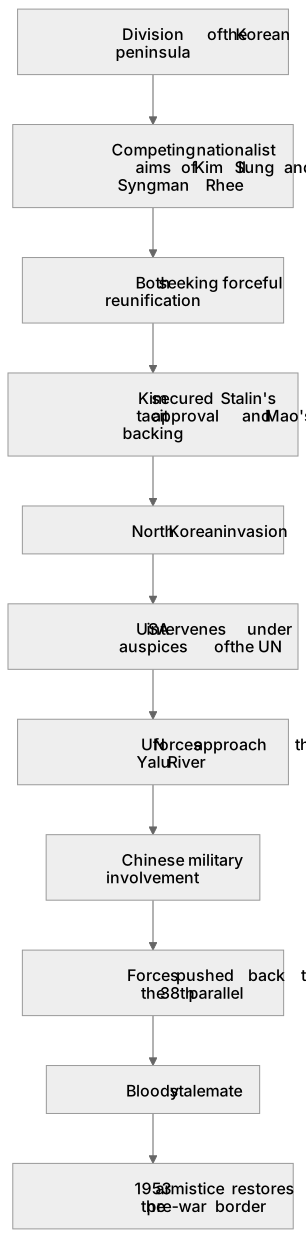
The Korean War (1950-1953) erupted from the division of the peninsula and the competing nationalist aims of Kim Il Sung (North) and Syngman Rhee (South), both seeking forceful reunification.
Checked against the AQA 7042 specification (opens in a new tab) on .
- Point 2 of 4
Study notes
From the checked teaching notes for this specification point.
The idea
The Korean War (1950-1953) erupted from the division of the peninsula and the competing nationalist aims of Kim Il Sung (North) and Syngman Rhee (South), both seeking forceful reunification. Kim secured Stalin's tacit approval and Mao's backing before invading. The USA, perceiving a global communist offensive, intervened under the auspices of the UN, capitalising on the USSR's boycott of the Security Council. Chinese military involvement, triggered by UN forces approaching the Yalu River, dramatically escalated the conflict, pushing forces back to the 38th parallel. The war settled into a bloody stalemate, concluding with the 1953 armistice which restored the pre-war border, cementing the division of Korea and globalising the Cold War.
What earns the marks
- Analyse the domestic causes of the war, focusing on the rival reunification aims of Kim Il Sung and Syngman Rhee.
- Evaluate the role of the USSR and China in enabling and supporting the North Korean invasion.
- Explain the mechanism and significance of UN involvement, driven primarily by US strategic interests and the Soviet boycott.
- Assess the impact of Chinese military intervention on the course and duration of the war.
- Discuss the terms of the 1953 settlement and its consequences for Korea and Cold War international relations.
Common mistakes and how to put them right
Claiming the USSR directly fought in the Korean War.
Put it right: While the USSR provided crucial material support, planning, and covert pilot assistance, it did not officially commit ground troops, avoiding direct conflict with the USA.
Stating the war ended with a peace treaty.
Put it right: The conflict ended with an armistice in 1953, meaning a formal state of war technically continued between North and South Korea.
Ignoring the role of Syngman Rhee in the outbreak of war.
Put it right: Rhee was also highly belligerent and frequently threatened to invade the North, contributing to the volatile atmosphere that precipitated the conflict.
Exam tips
- Differentiate between the initial US aim of containment (saving the South) and the later, temporary aim of rollback (conquering the North).
- Highlight the significance of the Soviet boycott of the UN Security Council in allowing the US to secure a UN mandate for intervention.
- Use the Korean War as a prime example of a 'proxy war' when discussing the wider nature of the Cold War.
Try the lesson
The start of the 2R The Cold War, c1945–1991 – The Widening of the Cold War, 1949–1955: The Korean War: causes, position and aims of Kim ll Sung and Syngman Rhee; attitudes and actions of the UN, USA, USSR and China; military involvement and settlement lesson, made from checked teaching notes for this specification point.
Have a go first
What was the primary shared objective of both Kim Il Sung and Syngman Rhee prior to the outbreak of the Korean War in 1950?
Listen
The Korean War (1950-1953) erupted from the division of the peninsula and the competing nationalist aims of Kim Il Sung (North) and Syngman Rhee (South), both seeking forceful reunification. Kim secured Stalin's tacit approval and Mao's backing before invading. The USA, perceiving a global communist offensive, intervened under the auspices of the UN, capitalising on the USSR's boycott of the Security Council. Chinese military involvement, triggered by UN forces approaching the Yalu River, dramatically escalated the conflict, pushing forces back to the 38th parallel. The war settled into a bloody stalemate, concluding with the 1953 armistice which restored the pre-war border, cementing the division of Korea and globalising the Cold War. A strong answer earns marks for these points. Analyse the domestic causes of the war, focusing on the rival reunification aims of Kim Il Sung and Syngman Rhee. Evaluate the role of the USSR and China in enabling and supporting the North Korean invasion. Explain the mechanism and significance of UN involvement, driven primarily by US strategic interests and the Soviet boycott. Assess the impact of Chinese military intervention on the course and duration of the war. A common slip: Claiming the USSR directly fought in the Korean War. Instead, While the USSR provided crucial material support, planning, and covert pilot assistance, it did not officially commit ground troops, avoiding direct conflict with the USA. Exam tip: Differentiate between the initial US aim of containment (saving the South) and the later, temporary aim of rollback (conquering the North).
See it
Label the diagram
Some boxes have lost their names. Pick the right name for each number.
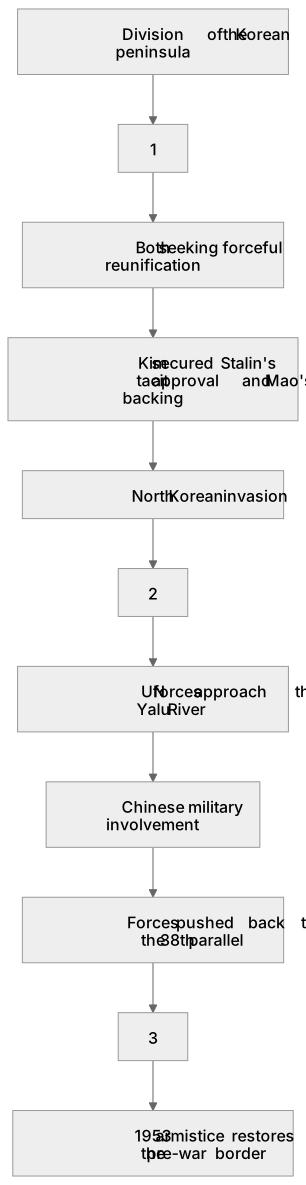
1Box 1
2Box 2
3Box 3
There is more to this lesson
The full lesson goes on to check your understanding and help you earn the marks. Create a free account to carry on, with your progress saved.
A week of Premium from your first lesson · Then the free plan continues · No card, no charge
Test your understanding of 2R The Cold War, c1945–1991 – The Widening of the Cold War, 1949–1955: The Korean War: causes, position and aims of Kim ll Sung and Syngman Rhee; attitudes and actions of the UN, USA, USSR and China; military involvement and settlement
Active recall beats re-reading. Take an instant quiz now to test what you’ve learned and lock it into long-term memory.
A week of Premium from your first lesson · Then the free plan continues · No card, no charge