AQA · A-Level · History
Course version: 7042 · Version from Sept 2017
Foreign Affairs: the Falklands; the 'special relationship' with USA; moves…
Full specification wording
2S The Making of Modern Britain, 1951–2007 – The impact of Thatcherism, 1979–1987 (A-level only): Foreign Affairs: the Falklands; the 'special relationship' with USA; moves to end the Cold War; Thatcher as an international figure; attitudes to Europe, including Thatcher's policies; divisions within the Conservative Party
Margaret Thatcher’s foreign policy transformed her into a formidable international figure.
Checked against the AQA 7042 specification (opens in a new tab) on .
- Point 4 of 4
- 4 key terms
Study notes
From the checked teaching notes for this specification point.
The idea
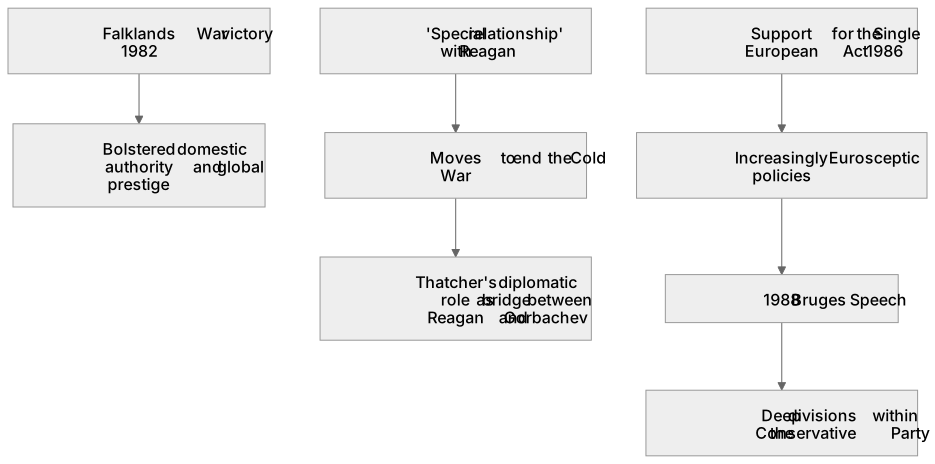
Margaret Thatcher’s foreign policy transformed her into a formidable international figure. The 1982 Falklands War victory bolstered her domestic authority and global prestige. She cultivated a robust 'special relationship' with US President Ronald Reagan, sharing ideological alignment on free markets and anti-communism. Together, they made crucial moves to end the Cold War, with Thatcher famously declaring rising Soviet figure Mikhail Gorbachev a man she could "do business with" in 1984, before he became leader. However, attitudes to Europe proved highly contentious. While initially supporting the Single European Act (1986), Thatcher’s policies became increasingly Eurosceptic, culminating in her 1988 Bruges Speech. This shift exacerbated deep divisions within the Conservative Party.
What earns the marks
- Assess the impact of the 1982 Falklands War on Thatcher's domestic popularity and her emergence as a resolute international figure.
- Evaluate the ideological and strategic dimensions of the 'special relationship' between Thatcher and Reagan, particularly regarding nuclear deterrence.
- Analyse Thatcher's diplomatic role in moves to end the Cold War, acting as a crucial bridge between Reagan and Gorbachev.
- Examine Thatcher's evolving attitudes to Europe, contrasting her support for the Single European Act with her later Eurosceptic Bruges Speech.
- Explain how European integration policies fuelled ideological divisions within the Conservative Party, destabilising her leadership.
Common mistakes and how to put them right
Claiming Thatcher was always entirely anti-Europe.
Put it right: She actively campaigned for the 'Yes' vote in the 1975 referendum and signed the Single European Act in 1986 before her later Euroscepticism.
Stating the Falklands War was the sole reason for the 1983 election victory.
Put it right: While significant, a divided opposition and improving economic indicators also played crucial roles.
Assuming Thatcher and Reagan agreed on everything.
Put it right: They clashed over issues such as the US invasion of Grenada in 1983.
Exam tips
- Link foreign policy successes, such as the Falklands, directly to Thatcher's domestic political dominance and the concept of 'Thatcherism'.
- Use the 1988 Bruges Speech as a turning point when analysing Conservative Party divisions over European integration.
- When evaluating the end of the Cold War, balance Thatcher's influence against the broader economic and political pressures facing the Soviet Union.
Try the lesson
The start of the 2S The Making of Modern Britain, 1951–2007 – The impact of Thatcherism, 1979–1987 (A-level only): Foreign Affairs: the Falklands; the 'special relationship' with USA; moves to end the Cold War; Thatcher as an international figure; attitudes to Europe, including Thatcher's policies; divisions within the Conservative Party lesson, made from checked teaching notes for this specification point.
Have a go first
Which 1982 conflict significantly enhanced Margaret Thatcher's reputation as an international figure and contributed to her domestic electoral success?
Listen
Margaret Thatcher’s foreign policy transformed her into a formidable international figure. The 1982 Falklands War victory bolstered her domestic authority and global prestige. She cultivated a robust 'special relationship' with US President Ronald Reagan, sharing ideological alignment on free markets and anti-communism. Together, they made crucial moves to end the Cold War, with Thatcher famously declaring rising Soviet figure Mikhail Gorbachev a man she could "do business with" in 1984, before he became leader. However, attitudes to Europe proved highly contentious. While initially supporting the Single European Act (1986), Thatcher’s policies became increasingly Eurosceptic, culminating in her 1988 Bruges Speech. This shift exacerbated deep divisions within the Conservative Party. A strong answer earns marks for these points. Assess the impact of the 1982 Falklands War on Thatcher's domestic popularity and her emergence as a resolute international figure. Evaluate the ideological and strategic dimensions of the 'special relationship' between Thatcher and Reagan, particularly regarding nuclear deterrence. Analyse Thatcher's diplomatic role in moves to end the Cold War, acting as a crucial bridge between Reagan and Gorbachev. Examine Thatcher's evolving attitudes to Europe, contrasting her support for the Single European Act with her later Eurosceptic Bruges Speech. Exam tip: Link foreign policy successes, such as the Falklands, directly to Thatcher's domestic political dominance and the concept of 'Thatcherism'.
See it
Put the events in order
Put these events in the order they happened, earliest first.
- 1. Thatcher delivered the Bruges Speech
- 2. The Falklands War victory
- 3. Thatcher supported the Single European Act
- 4. Thatcher called Gorbachev a man she could do business with
Key words
Say what each word means before you turn the card.
International relations and diplomacy
Try answering aloud or in your head before turning the card.
Euroscepticism vs Europhilia
Try answering aloud or in your head before turning the card.
The Cold War and nuclear deterrence
Try answering aloud or in your head before turning the card.
Party unity and ideological division
Try answering aloud or in your head before turning the card.
See every definition
- International relations and diplomacy
- Thatcher's foreign policy, including the Falklands, the 'special relationship' with the USA and moves to end the Cold War, made her a formidable international figure.
- Euroscepticism vs Europhilia
- Attitudes to Europe proved highly contentious: initially supporting the Single European Act, Thatcher's policies became increasingly Eurosceptic, culminating in the 1988 Bruges Speech.
- The Cold War and nuclear deterrence
- Thatcher and Reagan shared ideological alignment on anti-communism and made crucial moves to end the Cold War, with Thatcher calling Gorbachev a man she could "do business with".
- Party unity and ideological division
- Thatcher's shift towards Euroscepticism exacerbated deep divisions within the Conservative Party, fuelling ideological divisions that destabilised her leadership.
Label the diagram
Some boxes have lost their names. Pick the right name for each number.
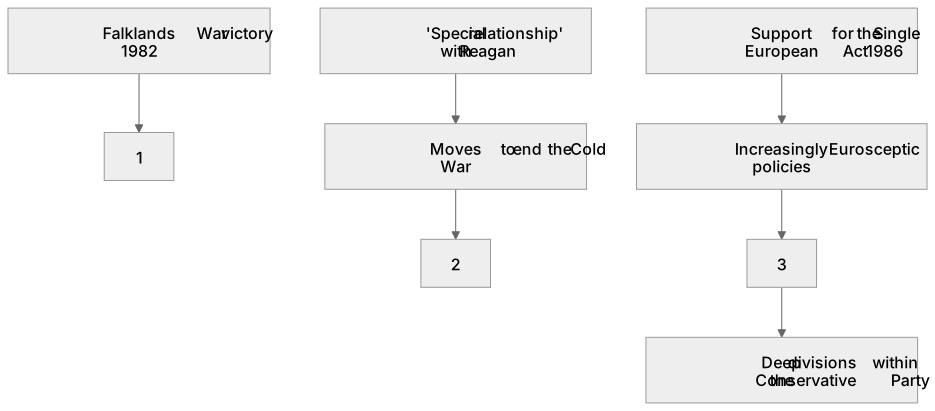
1Box 1
2Box 2
3Box 3
There is more to this lesson
The full lesson goes on to check your understanding and help you earn the marks. Create a free account to carry on, with your progress saved.
A week of Premium from your first lesson · Then the free plan continues · No card, no charge
Test your understanding of 2S The Making of Modern Britain, 1951–2007 – The impact of Thatcherism, 1979–1987 (A-level only): Foreign Affairs: the Falklands; the 'special relationship' with USA; moves to end the Cold War; Thatcher as an international figure; attitudes to Europe, including Thatcher's policies; divisions within the Conservative Party
Active recall beats re-reading. Take an instant quiz now to test what you’ve learned and lock it into long-term memory.
A week of Premium from your first lesson · Then the free plan continues · No card, no charge