AQA · A-Level · History
Course version: 7042 · Version from Sept 2017
Impact of Thatcherism on society: sale of council houses; miners' strike…
Full specification wording
2S The Making of Modern Britain, 1951–2007 – The impact of Thatcherism, 1979–1987 (A-level only): Impact of Thatcherism on society: sale of council houses; miners' strike and other industrial disputes; poll tax; extra-parliamentary opposition
Thatcherism profoundly reshaped British society, championing individualism over collectivism.
Checked against the AQA 7042 specification (opens in a new tab) on .
- Point 3 of 4
- 2 key terms
Study notes
From the checked teaching notes for this specification point.
The idea
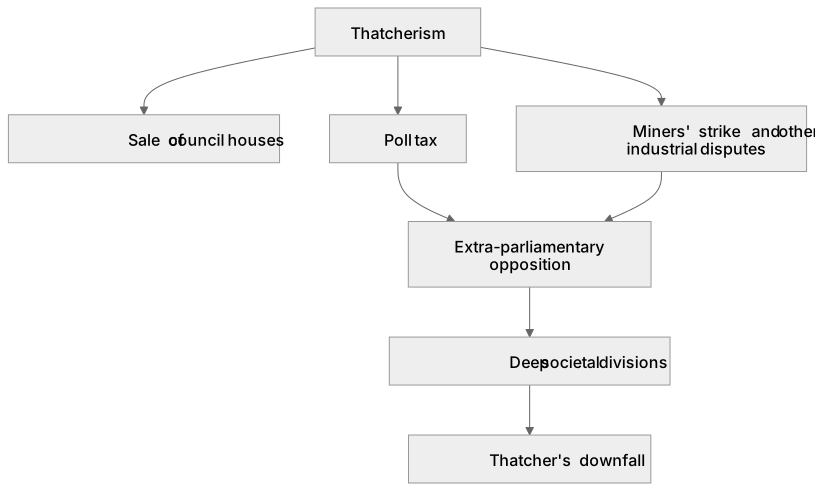
Thatcherism profoundly reshaped British society, championing individualism over collectivism. The 1980 Housing Act introduced the 'Right to Buy', leading to the sale of over a million council houses, fostering a property-owning democracy but depleting social housing stock. Industrial relations were transformed by the defeat of the 1984-1985 miners' strike, alongside other disputes like the Wapping print workers' strike, which severely weakened trade union power. The introduction of the Community Charge, or 'poll tax', in 1989-1990 provoked widespread fury due to its regressive nature. This sparked intense extra-parliamentary opposition, including the 1990 Trafalgar Square riots, and environmental protests, highlighting deep societal divisions and ultimately contributing to Thatcher's downfall.
What earns the marks
- Analyse the social impact of the 'Right to Buy' scheme, noting its success in increasing homeownership alongside the long-term shortage of affordable social housing.
- Evaluate the causes, events, and consequences of the 1984-1985 miners' strike, emphasising the government's preparation and the resulting decline in trade union influence.
- Examine other significant industrial disputes of the era, such as the Wapping dispute, to demonstrate the broader legislative and practical defeat of union power.
- Assess the reasons for the introduction of the poll tax and why its flat-rate nature was perceived as fundamentally unfair by the public.
- Discuss the role and effectiveness of extra-parliamentary opposition, including CND protests, Greenham Common, and the anti-poll tax riots, in challenging government policy.
Common mistakes and how to put them right
Stating the miners' strike was solely about pay.
Put it right by explaining it was primarily about the planned closure of uneconomic pits and the preservation of mining communities.
Assuming the poll tax was a tax on voting.
Put it right: It was actually a flat-rate local government tax (Community Charge) levied on every adult resident regardless of income.
Ignoring extra-parliamentary opposition beyond the poll tax riots.
Put it right: Ensure you include other movements like the Greenham Common Women's Peace Camp or environmental campaigns.
Exam tips
- Contrast the government's successful preparation for the 1984 miners' strike, such as stockpiling coal, with the Heath government's failures in the 1970s.
- Use the 'Right to Buy' policy as a primary example of Thatcher's ideological goal to create a property-owning democracy and reduce state dependency.
- Link the widespread extra-parliamentary opposition to the poll tax directly to the internal Conservative Party pressure that led to Thatcher's resignation in 1990.
Try the lesson
The start of the 2S The Making of Modern Britain, 1951–2007 – The impact of Thatcherism, 1979–1987 (A-level only): Impact of Thatcherism on society: sale of council houses; miners' strike and other industrial disputes; poll tax; extra-parliamentary opposition lesson, made from checked teaching notes for this specification point.
Have a go first
Which piece of legislation introduced the 'Right to Buy' scheme, allowing council tenants to purchase their homes at a significant discount?
Listen
Thatcherism profoundly reshaped British society, championing individualism over collectivism. The 1980 Housing Act introduced the 'Right to Buy', leading to the sale of over a million council houses, fostering a property-owning democracy but depleting social housing stock. Industrial relations were transformed by the defeat of the 1984-1985 miners' strike, alongside other disputes like the Wapping print workers' strike, which severely weakened trade union power. The introduction of the Community Charge, or 'poll tax', in 1989-1990 provoked widespread fury due to its regressive nature. This sparked intense extra-parliamentary opposition, including the 1990 Trafalgar Square riots, and environmental protests, highlighting deep societal divisions and ultimately contributing to Thatcher's downfall. A strong answer earns marks for these points. Analyse the social impact of the 'Right to Buy' scheme, noting its success in increasing homeownership alongside the long-term shortage of affordable social housing. Evaluate the causes, events, and consequences of the 1984-1985 miners' strike, emphasising the government's preparation and the resulting decline in trade union influence. Examine other significant industrial disputes of the era, such as the Wapping dispute, to demonstrate the broader legislative and practical defeat of union power. Assess the reasons for the introduction of the poll tax and why its flat-rate nature was perceived as fundamentally unfair by the public. A common slip: Stating the miners' strike was solely about pay. Instead, explaining it was primarily about the planned closure of uneconomic pits and the preservation of mining communities. Exam tip: Contrast the government's successful preparation for the 1984 miners' strike, such as stockpiling coal, with the Heath government's failures in the 1970s.
See it
Key words
Say what each word means before you turn the card.
Social polarisation
Try answering aloud or in your head before turning the card.
Decline of trade unionism
Try answering aloud or in your head before turning the card.
See every definition
- Social polarisation
- Deep societal divisions highlighted by intense extra-parliamentary opposition, including the 1990 Trafalgar Square riots and environmental protests.
- Decline of trade unionism
- Severely weakened trade union power following the defeat of the 1984-1985 miners' strike and other disputes like the Wapping print workers' strike.
Label the diagram
Some boxes have lost their names. Pick the right name for each number.
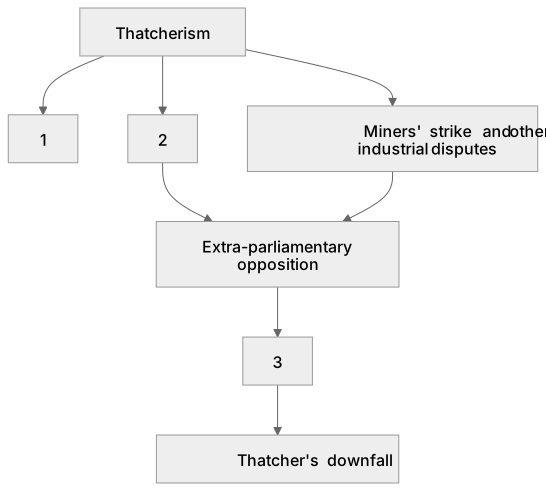
1Box 1
2Box 2
3Box 3
There is more to this lesson
The full lesson goes on to check your understanding and help you earn the marks. Create a free account to carry on, with your progress saved.
A week of Premium from your first lesson · Then the free plan continues · No card, no charge
Test your understanding of 2S The Making of Modern Britain, 1951–2007 – The impact of Thatcherism, 1979–1987 (A-level only): Impact of Thatcherism on society: sale of council houses; miners' strike and other industrial disputes; poll tax; extra-parliamentary opposition
Active recall beats re-reading. Take an instant quiz now to test what you’ve learned and lock it into long-term memory.
A week of Premium from your first lesson · Then the free plan continues · No card, no charge