AQA · A-Level · History
Course version: 7042 · Version from Sept 2017
Thatcher's economic policies and their impact: monetarism; privatisation;…
Full specification wording
2S The Making of Modern Britain, 1951–2007 – The impact of Thatcherism, 1979–1987 (A-level only): Thatcher's economic policies and their impact: monetarism; privatisation; deregulation; issues of inflation, unemployment and economic realignment
Margaret Thatcher’s economic strategy fundamentally shifted Britain away from the post-war consensus.
Checked against the AQA 7042 specification (opens in a new tab) on .
- Point 2 of 4
- 4 key terms
Study notes
From the checked teaching notes for this specification point.
The idea
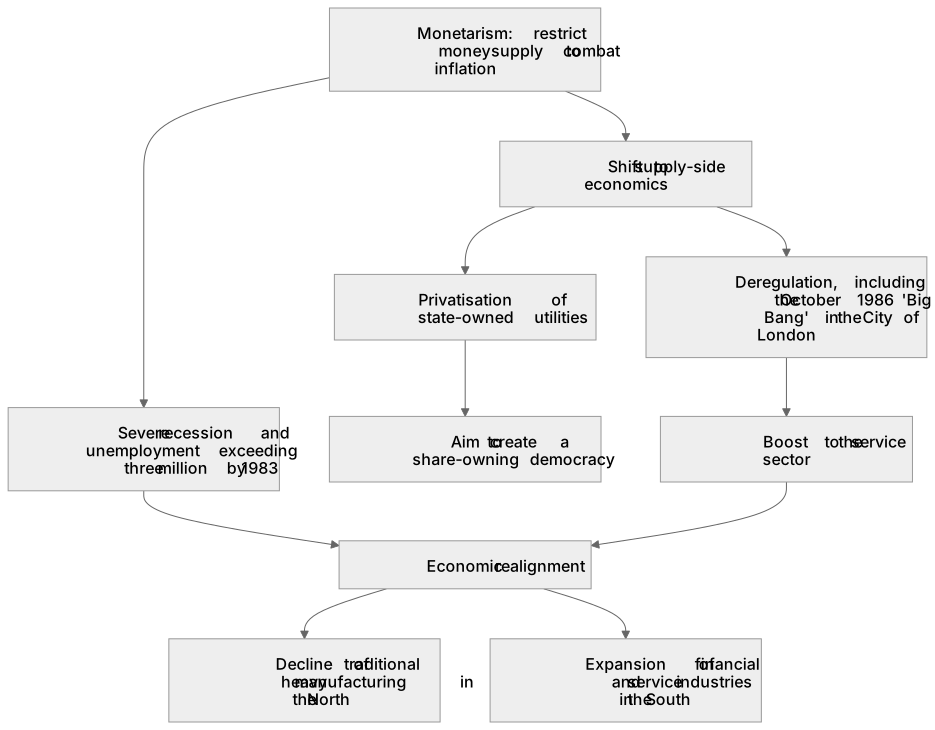
Margaret Thatcher’s economic strategy fundamentally shifted Britain away from the post-war consensus. Initially, she adopted monetarism, restricting the money supply to combat high inflation, though this contributed to a severe recession and unemployment exceeding three million by 1983. The focus later shifted to supply-side economics, notably privatisation of state-owned utilities like British Gas, aiming to create a share-owning democracy. Deregulation, particularly the October 1986 'Big Bang' in the City of London, removed financial restrictions, boosting the service sector. This caused a profound economic realignment, accelerating the decline of traditional heavy manufacturing in the North while expanding the financial and service industries in the South.
What earns the marks
- Explain the principles of monetarism and its primary goal of reducing inflation by controlling the money supply, noting its abandonment by the mid-1980s.
- Assess the impact of privatisation on government revenue, share ownership, and the efficiency of former state monopolies like British Telecom.
- Evaluate the social and regional consequences of economic realignment, contrasting the decline of northern manufacturing with southern service sector growth.
- Discuss the trade-off between reducing inflation and the resulting surge in unemployment during the early 1980s recession.
Common mistakes and how to put them right
Confusing monetarism with supply-side economics.
Put it right: Monetarism specifically targeted inflation via money supply, whereas supply-side policies like deregulation aimed to boost production and market efficiency.
Claiming privatisation was a central policy from 1979.
Put it right: It actually gained significant momentum later, particularly with the British Telecom sale in 1984.
Assuming unemployment remained low.
Put it right: Unemployment actually peaked at over three million in the 1980s as a direct consequence of anti-inflationary measures and industrial decline.
Exam tips
- Use specific examples of privatised industries, such as British Gas or British Airways, to illustrate the shift towards a free-market economy.
- When evaluating economic realignment, explicitly contrast the deindustrialisation of the North and Midlands with the financial boom in London and the South East.
- Link the 'Big Bang' deregulation of 1986 directly to the subsequent rapid expansion of the financial services sector and its contribution to economic growth.
Try the lesson
The start of the 2S The Making of Modern Britain, 1951–2007 – The impact of Thatcherism, 1979–1987 (A-level only): Thatcher's economic policies and their impact: monetarism; privatisation; deregulation; issues of inflation, unemployment and economic realignment lesson, made from checked teaching notes for this specification point.
Have a go first
What was the primary goal of the economic policy of monetarism adopted by Margaret Thatcher's government in the early 1980s?
Listen
Margaret Thatcher’s economic strategy fundamentally shifted Britain away from the post-war consensus. Initially, she adopted monetarism, restricting the money supply to combat high inflation, though this contributed to a severe recession and unemployment exceeding three million by 1983. The focus later shifted to supply-side economics, notably privatisation of state-owned utilities like British Gas, aiming to create a share-owning democracy. Deregulation, particularly the October 1986 'Big Bang' in the City of London, removed financial restrictions, boosting the service sector. This caused a profound economic realignment, accelerating the decline of traditional heavy manufacturing in the North while expanding the financial and service industries in the South. A strong answer earns marks for these points. Explain the principles of monetarism and its primary goal of reducing inflation by controlling the money supply, noting its abandonment by the mid-1980s. Assess the impact of privatisation on government revenue, share ownership, and the efficiency of former state monopolies like British Telecom. Analyse the effects of deregulation, specifically distinguishing the October 1986 'Big Bang' deregulation of the stock exchange from the broader regulatory framework of the Financial Services Act 1986, on the growth of the financial sector. Evaluate the social and regional consequences of economic realignment, contrasting the decline of northern manufacturing with southern service sector growth. Exam tip: Use specific examples of privatised industries, such as British Gas or British Airways, to illustrate the shift towards a free-market economy.
See it
Key words
Say what each word means before you turn the card.
Monetarism
Try answering aloud or in your head before turning the card.
Privatisation
Try answering aloud or in your head before turning the card.
Deregulation
Try answering aloud or in your head before turning the card.
Economic realignment
Try answering aloud or in your head before turning the card.
See every definition
- Monetarism
- Restricting the money supply to combat high inflation, though this contributed to a severe recession and unemployment exceeding three million by 1983.
- Privatisation
- The sale of state-owned utilities such as British Gas, aiming to create a share-owning democracy.
- Deregulation
- The removal of financial restrictions, particularly the October 1986 'Big Bang' in the City of London, boosting the service sector.
- Economic realignment
- A profound shift accelerating the decline of traditional heavy manufacturing in the North while expanding the financial and service industries in the South.
Label the diagram
Some boxes have lost their names. Pick the right name for each number.
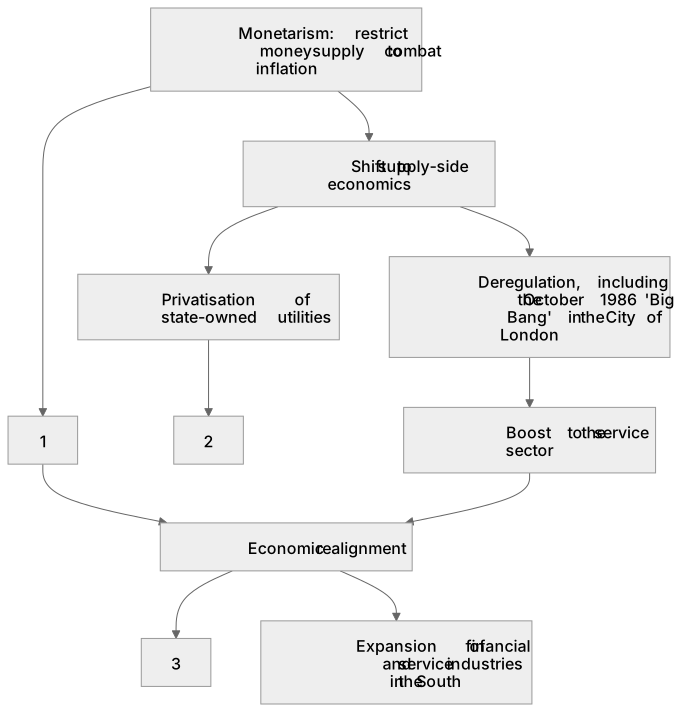
1Box 1
2Box 2
3Box 3
There is more to this lesson
The full lesson goes on to check your understanding and help you earn the marks. Create a free account to carry on, with your progress saved.
A week of Premium from your first lesson · Then the free plan continues · No card, no charge
Test your understanding of 2S The Making of Modern Britain, 1951–2007 – The impact of Thatcherism, 1979–1987 (A-level only): Thatcher's economic policies and their impact: monetarism; privatisation; deregulation; issues of inflation, unemployment and economic realignment
Active recall beats re-reading. Take an instant quiz now to test what you’ve learned and lock it into long-term memory.
A week of Premium from your first lesson · Then the free plan continues · No card, no charge