AQA · A-Level · History
Course version: 7042 · Version from Sept 2017
Wilson and the Labour governments: Wilson's ideology and leadership;…
Full specification wording
2S The Making of Modern Britain, 1951–2007 – The Sixties, 1964–1970: Wilson and the Labour governments: Wilson's ideology and leadership; economic policies and problems; devaluation; industrial relations; the trade unions; other domestic policies; Labour divisions; the beginning of the 'troubles' in Northern Ireland; the end of post-war consensus; loss of 1970 election
Harold Wilson’s 1964-1970 Labour governments aimed to modernise Britain, reflecting his pragmatic ideology and leadership.
Checked against the AQA 7042 specification (opens in a new tab) on .
- Point 1 of 4
Study notes
From the checked teaching notes for this specification point.
The idea
Harold Wilson’s 1964-1970 Labour governments aimed to modernise Britain, reflecting his pragmatic ideology and leadership. However, economic problems dominated, culminating in the 1967 devaluation of the pound. Attempts to reform industrial relations and curb trade union power via 'In Place of Strife' failed due to severe Labour divisions. Other domestic policies included liberal social reforms. Meanwhile, the late 1960s saw the beginning of the 'troubles' in Northern Ireland, requiring troop deployment. These compounding crises, alongside strikes, signalled the end of the post-war consensus and contributed to Labour's loss in the 1970 election.
What earns the marks
- Evaluate the extent to which Wilson's leadership and ideology successfully united the Labour Party.
- Analyse the causes of the 1967 devaluation and its political impact on the Labour government's economic credibility.
- Assess the significance of 'In Place of Strife' in highlighting the deteriorating relationship between the Labour government and trade unions.
- Explain the origins of the 'troubles' in Northern Ireland and the British government's response up to 1970.
- Discuss how economic struggles and industrial unrest contributed to the breakdown of the post-war consensus and the 1970 election defeat.
Common mistakes and how to put them right
Confusing devaluation with inflation or a general economic depression.
Put it right: Define devaluation specifically as the reduction of the pound's exchange rate against the dollar in 1967 to make exports cheaper.
Stating that 'In Place of Strife' became law.
Put it right: Clarify that 'In Place of Strife' was a white paper that was abandoned due to intense opposition from trade unions and Labour MPs.
Attributing the start of the Northern Ireland 'troubles' solely to religious differences.
Put it right: Explain the underlying issues of civil rights, gerrymandering, and housing discrimination against the Catholic minority.
Exam tips
- Contrast Wilson's modernising rhetoric with the reality of his government's economic and industrial struggles.
- Use 'In Place of Strife' as a key example of Labour divisions and the challenge of managing trade union power.
- Connect the domestic policy challenges, such as industrial relations and economic crises, directly to the unexpected loss of the 1970 election.
Try the lesson
The start of the 2S The Making of Modern Britain, 1951–2007 – The Sixties, 1964–1970: Wilson and the Labour governments: Wilson's ideology and leadership; economic policies and problems; devaluation; industrial relations; the trade unions; other domestic policies; Labour divisions; the beginning of the 'troubles' in Northern Ireland; the end of post-war consensus; loss of 1970 election lesson, made from checked teaching notes for this specification point.
Have a go first
In November 1967, Harold Wilson's Labour government announced the devaluation of the pound. What was the primary economic problem this policy was intended to address?
Listen
Harold Wilson’s 1964-1970 Labour governments aimed to modernise Britain, reflecting his pragmatic ideology and leadership. However, economic problems dominated, culminating in the 1967 devaluation of the pound. Attempts to reform industrial relations and curb trade union power via 'In Place of Strife' failed due to severe Labour divisions. Other domestic policies included liberal social reforms. Meanwhile, the late 1960s saw the beginning of the 'troubles' in Northern Ireland, requiring troop deployment. These compounding crises, alongside strikes, signalled the end of the post-war consensus and contributed to Labour's loss in the 1970 election. A strong answer earns marks for these points. Evaluate the extent to which Wilson's leadership and ideology successfully united the Labour Party. Analyse the causes of the 1967 devaluation and its political impact on the Labour government's economic credibility. Assess the significance of 'In Place of Strife' in highlighting the deteriorating relationship between the Labour government and trade unions. Explain the origins of the 'troubles' in Northern Ireland and the British government's response up to 1970. A common slip: Confusing devaluation with inflation or a general economic depression. Instead, Define devaluation specifically as the reduction of the pound's exchange rate against the dollar in 1967 to make exports cheaper. Exam tip: Contrast Wilson's modernising rhetoric with the reality of his government's economic and industrial struggles.
See it
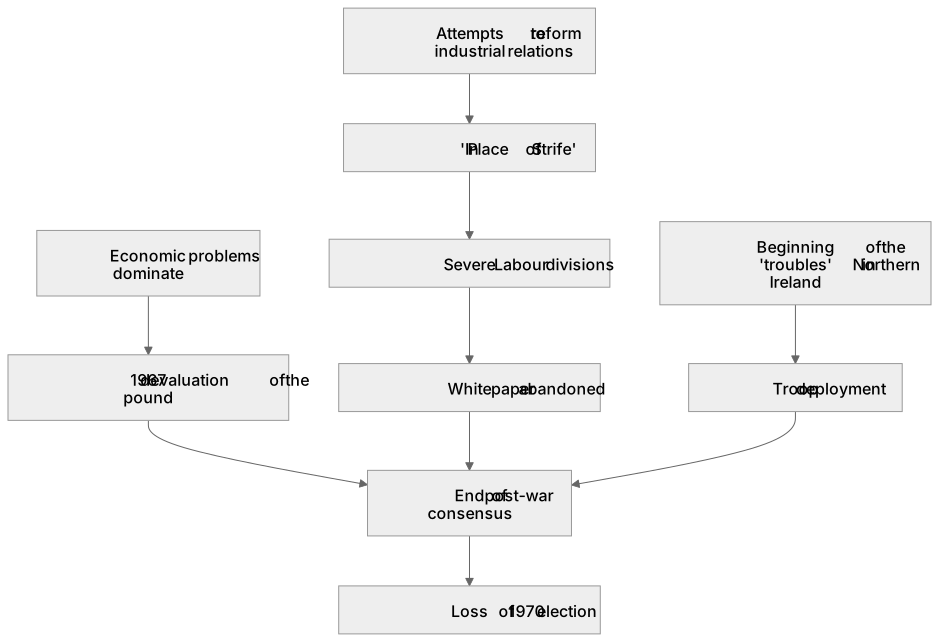
Label the diagram
Some boxes have lost their names. Pick the right name for each number.
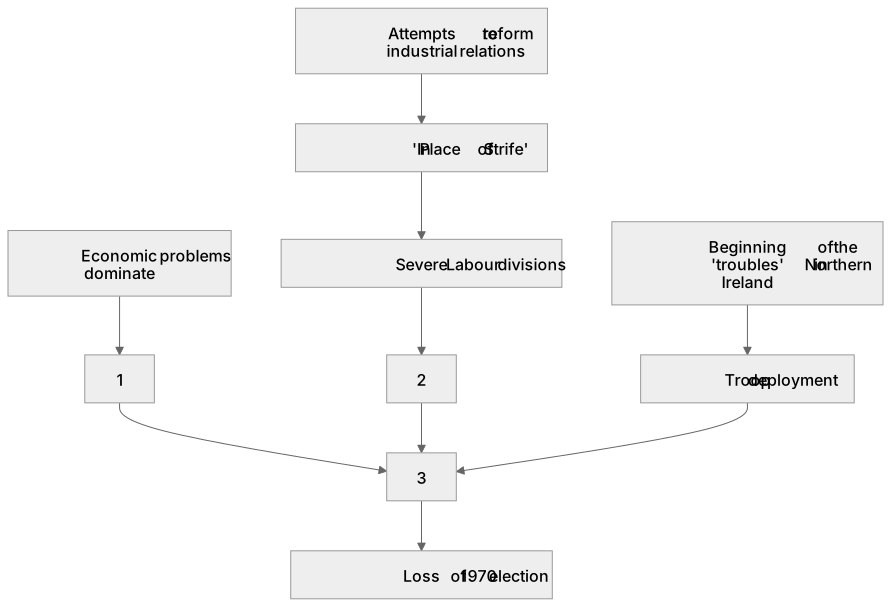
1Box 1
2Box 2
3Box 3
There is more to this lesson
The full lesson goes on to check your understanding and help you earn the marks. Create a free account to carry on, with your progress saved.
A week of Premium from your first lesson · Then the free plan continues · No card, no charge
Test your understanding of 2S The Making of Modern Britain, 1951–2007 – The Sixties, 1964–1970: Wilson and the Labour governments: Wilson's ideology and leadership; economic policies and problems; devaluation; industrial relations; the trade unions; other domestic policies; Labour divisions; the beginning of the 'troubles' in Northern Ireland; the end of post-war consensus; loss of 1970 election
Active recall beats re-reading. Take an instant quiz now to test what you’ve learned and lock it into long-term memory.
A week of Premium from your first lesson · Then the free plan continues · No card, no charge