AQA · A-Level · History
Course version: 7042 · Version from Sept 2017
The USSR and the Soviet Empire, 1953–2000 (A-level only) – The Collapse of…
Full specification wording
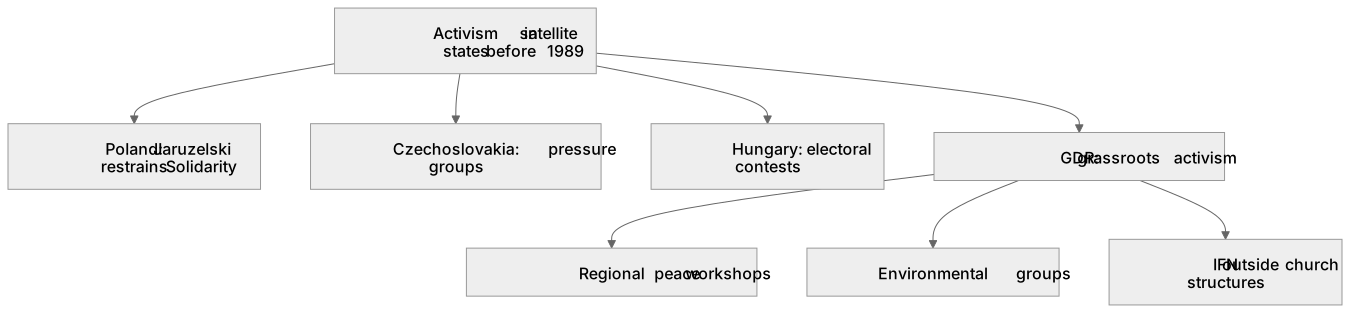
2T The Crisis of Communism: The USSR and the Soviet Empire, 1953–2000 (A-level only) – The Collapse of the Soviet Empire, 1980–2000: Political developments and activism within the satellite states before 1989: Jaruzelski and attempts to restrain Solidarity in Poland; pressure groups in Czechoslovakia and electoral contests in Hungary; regional peace workshops; the IFN and environmental groups in GDR
Before 1989, diverse activism eroded communist authority across the satellite states.
Checked against the AQA 7042 specification (opens in a new tab) on .
- Point 1 of 4
- 4 key terms
Study notes
From the checked teaching notes for this specification point.
The idea
Before 1989, diverse activism eroded communist authority across the satellite states. In Poland, General Jaruzelski attempted to crush Solidarity by declaring Martial Law in 1981, driving the movement underground where it survived through clandestine networks. In Czechoslovakia, pressure groups like Charter 77 and VONS highlighted human rights abuses, maintaining moral opposition despite severe state repression. Hungary experienced gradual political reform, introducing multi-candidate electoral contests in 1985 that allowed limited independent voices into parliament. Meanwhile, the GDR saw the rise of grassroots activism shielded by the Protestant Church. This included regional peace workshops, environmental groups protesting severe industrial pollution, and the Initiative for Peace and Human Rights (IFN), which uniquely operated outside church structures to demand democratic freedoms.
What earns the marks
- Assess General Jaruzelski's imposition of Martial Law in December 1981 and its effectiveness in temporarily suppressing Solidarity.
- Analyse the role of Czechoslovakian pressure groups, such as Charter 77, in utilising the Helsinki Accords to demand civil liberties.
- Evaluate the significance of Hungary's 1985 electoral reforms, which mandated multiple candidates and subtly undermined one-party dominance.
- Examine the function of the Protestant Church in the GDR as a sanctuary for environmental groups and regional peace workshops.
- Identify the Initiative for Peace and Human Rights (IFN) as a critical development in the GDR for operating independently of both state and church.
Common mistakes and how to put them right
Stating that Jaruzelski destroyed Solidarity completely in 1981.
Put it right: Martial law only drove Solidarity underground; it continued to operate illegally and retained massive popular support.
Confusing the IFN with church-led groups in East Germany.
Put it right: The Initiative for Peace and Human Rights (IFN) was distinct precisely because it was the first major opposition group in the GDR to operate outside the protective umbrella of the Church.
Assuming Hungarian electoral contests before 1989 were fully democratic.
Put it right: The 1985 elections required multiple candidates but all had to accept the Patriotic People's Front programme, making it a limited, rather than absolute, democratic reform.
Exam tips
- Compare the different methods of state control and opposition across the satellite states, such as Poland's military crackdown versus Hungary's gradual legislative concessions.
- Highlight the intersection of environmentalism and political dissent in the GDR, noting how ecological disasters mobilised citizens against the state.
- Use specific examples of Czechoslovakian pressure groups, like VONS (Committee for the Defence of the Unjustly Prosecuted), to demonstrate the focus on legal and human rights.
Try the lesson
The start of the 2T The Crisis of Communism: The USSR and the Soviet Empire, 1953–2000 (A-level only) – The Collapse of the Soviet Empire, 1980–2000: Political developments and activism within the satellite states before 1989: Jaruzelski and attempts to restrain Solidarity in Poland; pressure groups in Czechoslovakia and electoral contests in Hungary; regional peace workshops; the IFN and environmental groups in GDR lesson, made from checked teaching notes for this specification point.
Have a go first
What decisive action did General Wojciech Jaruzelski take in December 1981 in an attempt to crush the Solidarity movement in Poland?
Listen
Before 1989, diverse activism eroded communist authority across the satellite states. In Poland, General Jaruzelski attempted to crush Solidarity by declaring Martial Law in 1981, driving the movement underground where it survived through clandestine networks. In Czechoslovakia, pressure groups like Charter 77 and VONS highlighted human rights abuses, maintaining moral opposition despite severe state repression. Hungary experienced gradual political reform, introducing multi-candidate electoral contests in 1985 that allowed limited independent voices into parliament. Meanwhile, the GDR saw the rise of grassroots activism shielded by the Protestant Church. This included regional peace workshops, environmental groups protesting severe industrial pollution, and the Initiative for Peace and Human Rights (IFN), which uniquely operated outside church structures to demand democratic freedoms. A strong answer earns marks for these points. Assess General Jaruzelski's imposition of Martial Law in December 1981 and its effectiveness in temporarily suppressing Solidarity. Analyse the role of Czechoslovakian pressure groups, such as Charter 77, in utilising the Helsinki Accords to demand civil liberties. Evaluate the significance of Hungary's 1985 electoral reforms, which mandated multiple candidates and subtly undermined one-party dominance. Examine the function of the Protestant Church in the GDR as a sanctuary for environmental groups and regional peace workshops. A common slip: Stating that Jaruzelski destroyed Solidarity completely in 1981. Instead, Martial law only drove Solidarity underground; it continued to operate illegally and retained massive popular support. Exam tip: Compare the different methods of state control and opposition across the satellite states, such as Poland's military crackdown versus Hungary's gradual legislative concessions.
See it
Key words
Say what each word means before you turn the card.
State repression and martial law
Try answering aloud or in your head before turning the card.
The evolution of civil society and human rights
Try answering aloud or in your head before turning the card.
Environmentalism as a vehicle for political dissent
Try answering aloud or in your head before turning the card.
Gradualism and reform within communist structures
Try answering aloud or in your head before turning the card.
See every definition
- State repression and martial law
- General Jaruzelski attempted to crush Solidarity by declaring Martial Law in 1981, driving the movement underground where it survived through clandestine networks.
- The evolution of civil society and human rights
- Pressure groups like Charter 77 and VONS highlighted human rights abuses, maintaining moral opposition despite severe state repression.
- Environmentalism as a vehicle for political dissent
- Environmental groups protested severe industrial pollution, with grassroots activism shielded by the Protestant Church in the GDR.
- Gradualism and reform within communist structures
- Hungary experienced gradual political reform, introducing multi-candidate electoral contests in 1985 that allowed limited independent voices into parliament.
Label the diagram
Some boxes have lost their names. Pick the right name for each number.
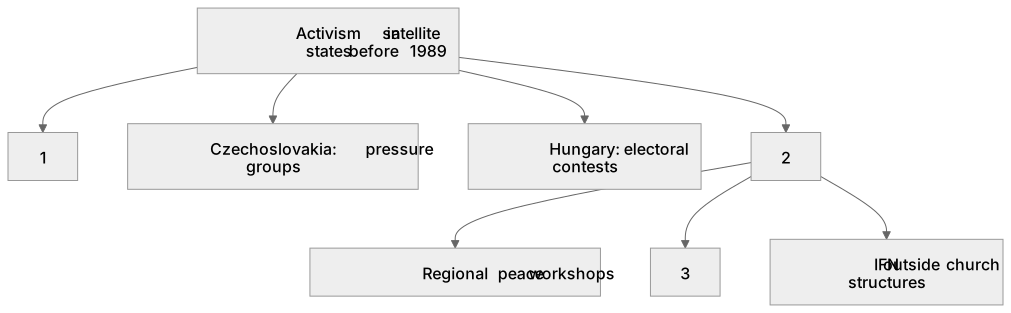
1Box 1
2Box 2
3Box 3
There is more to this lesson
The full lesson goes on to check your understanding and help you earn the marks. Create a free account to carry on, with your progress saved.
A week of Premium from your first lesson · Then the free plan continues · No card, no charge
Test your understanding of 2T The Crisis of Communism: The USSR and the Soviet Empire, 1953–2000 (A-level only) – The Collapse of the Soviet Empire, 1980–2000: Political developments and activism within the satellite states before 1989: Jaruzelski and attempts to restrain Solidarity in Poland; pressure groups in Czechoslovakia and electoral contests in Hungary; regional peace workshops; the IFN and environmental groups in GDR
Active recall beats re-reading. Take an instant quiz now to test what you’ve learned and lock it into long-term memory.
A week of Premium from your first lesson · Then the free plan continues · No card, no charge