AQA · A-Level · History
Course version: 7042 · Version from Sept 2017
The USSR and the Soviet Empire, 1953–2000 (A-level only) – The Collapse of…
Full specification wording
2T The Crisis of Communism: The USSR and the Soviet Empire, 1953–2000 (A-level only) – The Collapse of the Soviet Empire, 1980–2000: The state of Communism in the satellite states of Romania and Bulgaria by 1989: leadership of Ceausescu in Romania and Zhivkov in Bulgaria; political and economic problems
By 1989, Communism in Romania and Bulgaria faced severe crises under entrenched dictatorships.
Checked against the AQA 7042 specification (opens in a new tab) on .
- Point 2 of 4
Study notes
From the checked teaching notes for this specification point.
The idea
By 1989, Communism in Romania and Bulgaria faced severe crises under entrenched dictatorships. In Romania, Nicolae Ceaușescu’s megalomaniacal leadership created extreme economic hardship. His drive to eliminate foreign debt led to draconian rationing of food and heating, while his 'Systematisation' programme destroyed rural villages. Politically, his regime relied on the brutal Securitate to crush dissent. In Bulgaria, Todor Zhivkov’s long-standing rule was similarly stagnant. Economically, Bulgaria suffered from declining Soviet subsidies and failed modernisation, causing severe shortages. Politically, Zhivkov tried to deflect unrest through a forced assimilation campaign against the ethnic Turkish minority, which isolated his regime and exacerbated domestic opposition, leaving both states vulnerable.
What earns the marks
- Assess the impact of Ceaușescu's austerity measures, specifically the export of agricultural goods to pay off Western debt, on the living standards of Romanian citizens.
- Evaluate the role of the Securitate in maintaining Ceaușescu's political control through pervasive surveillance and state terror.
- Analyse the economic stagnation in Bulgaria under Zhivkov, focusing on the reliance on Soviet economic support and the failure of domestic economic reforms.
- Examine the political fallout of Zhivkov's 'Revival Process', noting how the forced assimilation and subsequent exodus of ethnic Turks damaged the Bulgarian economy and international standing.
Common mistakes and how to put them right
Assuming both regimes faced identical political opposition.
Put it right: Recognise that Romania's opposition was heavily suppressed by the Securitate until the very end, whereas Bulgaria saw internal party manoeuvring against Zhivkov.
Confusing the economic policies of the two leaders.
Put it right: Attribute the extreme austerity and debt-repayment drive specifically to Ceaușescu in Romania, not Zhivkov in Bulgaria.
Overlooking the ethnic dimension in Bulgaria.
Put it right: Explicitly include Zhivkov's persecution of the Turkish minority as a key political and economic catalyst for his downfall.
Exam tips
- Compare the different methods used by Ceaușescu and Zhivkov to maintain power when evaluating the political problems of the satellite states.
- Use specific examples of economic hardship, such as Romanian energy rationing or the impact of the Turkish exodus on Bulgarian agriculture, to substantiate arguments about economic failure.
- Link the domestic crises in these countries to the broader context of Gorbachev's withdrawal of Soviet support, showing how this exacerbated their vulnerabilities.
Try the lesson
The start of the 2T The Crisis of Communism: The USSR and the Soviet Empire, 1953–2000 (A-level only) – The Collapse of the Soviet Empire, 1980–2000: The state of Communism in the satellite states of Romania and Bulgaria by 1989: leadership of Ceausescu in Romania and Zhivkov in Bulgaria; political and economic problems lesson, made from checked teaching notes for this specification point.
Have a go first
Which economic policy pursued by Nicolae Ceaușescu in the 1980s caused severe hardship and rationing for the Romanian population by 1989?
Listen
By 1989, Communism in Romania and Bulgaria faced severe crises under entrenched dictatorships. In Romania, Nicolae Ceaușescu’s megalomaniacal leadership created extreme economic hardship. His drive to eliminate foreign debt led to draconian rationing of food and heating, while his 'Systematisation' programme destroyed rural villages. Politically, his regime relied on the brutal Securitate to crush dissent. In Bulgaria, Todor Zhivkov’s long-standing rule was similarly stagnant. Economically, Bulgaria suffered from declining Soviet subsidies and failed modernisation, causing severe shortages. Politically, Zhivkov tried to deflect unrest through a forced assimilation campaign against the ethnic Turkish minority, which isolated his regime and exacerbated domestic opposition, leaving both states vulnerable. A strong answer earns marks for these points. Assess the impact of Ceaușescu's austerity measures, specifically the export of agricultural goods to pay off Western debt, on the living standards of Romanian citizens. Evaluate the role of the Securitate in maintaining Ceaușescu's political control through pervasive surveillance and state terror. Analyse the economic stagnation in Bulgaria under Zhivkov, focusing on the reliance on Soviet economic support and the failure of domestic economic reforms. Examine the political fallout of Zhivkov's 'Revival Process', noting how the forced assimilation and subsequent exodus of ethnic Turks damaged the Bulgarian economy and international standing. A common slip: Assuming both regimes faced identical political opposition. Instead, recognise that Romania's opposition was heavily suppressed by the Securitate until the very end, whereas Bulgaria saw internal party manoeuvring against Zhivkov. Exam tip: Compare the different methods used by Ceaușescu and Zhivkov to maintain power when evaluating the political problems of the satellite states.
See it
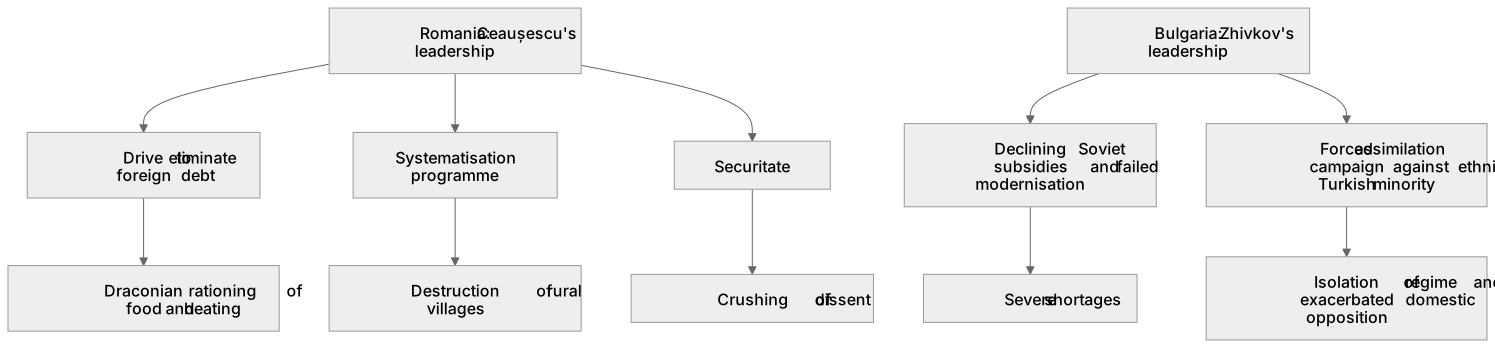
Label the diagram
Some boxes have lost their names. Pick the right name for each number.
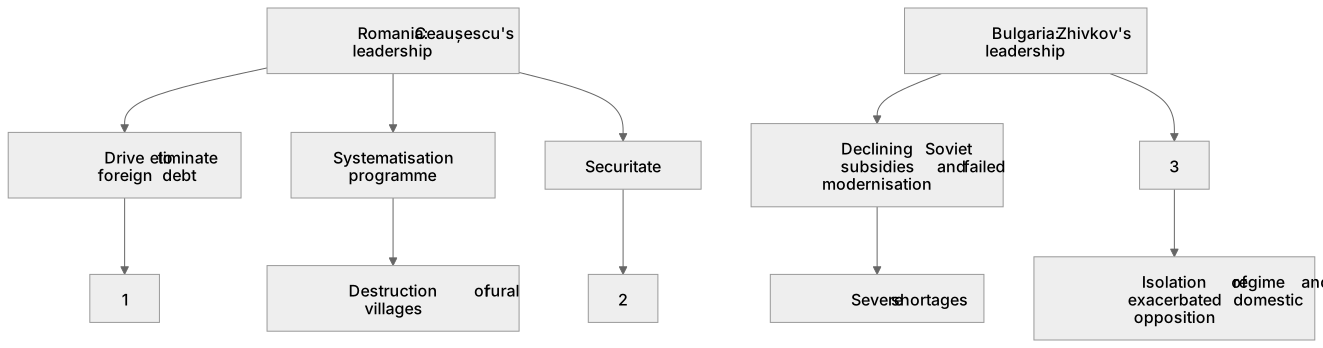
1Box 1
2Box 2
3Box 3
There is more to this lesson
The full lesson goes on to check your understanding and help you earn the marks. Create a free account to carry on, with your progress saved.
A week of Premium from your first lesson · Then the free plan continues · No card, no charge
Test your understanding of 2T The Crisis of Communism: The USSR and the Soviet Empire, 1953–2000 (A-level only) – The Collapse of the Soviet Empire, 1980–2000: The state of Communism in the satellite states of Romania and Bulgaria by 1989: leadership of Ceausescu in Romania and Zhivkov in Bulgaria; political and economic problems
Active recall beats re-reading. Take an instant quiz now to test what you’ve learned and lock it into long-term memory.
A week of Premium from your first lesson · Then the free plan continues · No card, no charge