AQA · A-Level · History
Course version: 7042 · Version from Sept 2017
The USSR and the Soviet Empire, 1953–2000 (A-level only) – The Collapse of…
Full specification wording
2T The Crisis of Communism: The USSR and the Soviet Empire, 1953–2000 (A-level only) – The Collapse of the Soviet Empire, 1980–2000: The collapse of Communism within the satellite states in 1989: reasons for and results of demonstrations and peaceful revolution in East Germany, Poland, Hungary, Czechoslovakia, Bulgaria and violent change in Romania
The 1989 collapse of Communism was driven by economic stagnation, political repression, and Gorbachev’s refusal to use Soviet force.
Checked against the AQA 7042 specification (opens in a new tab) on .
- Point 3 of 4
Study notes
From the checked teaching notes for this specification point.
The idea
The 1989 collapse of Communism was driven by economic stagnation, political repression, and Gorbachev’s refusal to use Soviet force. Peaceful revolutions transformed most satellite states. In Poland, strikes led to the Round Table Agreements and Solidarity's victory. Hungary dismantled its border fence and transitioned to a multi-party system. In East Germany, mass demonstrations and the opening of the Berlin Wall caused the regime's collapse. Czechoslovakia’s Velvet Revolution saw peaceful protests elevate Václav Havel to the presidency, while in Bulgaria, internal party pressure forced Zhivkov’s resignation. Conversely, Romania experienced violent change; Ceaușescu ordered troops to fire on demonstrators, sparking a bloody uprising that culminated in his execution.
What earns the marks
- Identify Gorbachev's abandonment of the Brezhnev Doctrine as a primary enabling factor for the 1989 revolutions across the satellite states.
- Analyse the role of popular demonstrations and civil society, such as Solidarity in Poland and Civic Forum in Czechoslovakia, in forcing peaceful political transitions.
- Evaluate the specific triggers for the collapse in East Germany, particularly the mass exodus through Hungary and the mismanaged opening of the Berlin Wall.
- Contrast the peaceful transitions in Poland, Hungary, East Germany, Czechoslovakia, and Bulgaria with the violent overthrow and execution of Ceaușescu in Romania.
Common mistakes and how to put them right
Treating the collapse in all satellite states as identical.
Put it right: Distinguish between the negotiated transitions (Poland, Hungary), popular peaceful uprisings (East Germany, Czechoslovakia), internal party coups (Bulgaria), and violent revolution (Romania).
Stating that the Soviet Union intervened militarily in 1989.
Put it right: Emphasise that Gorbachev explicitly refused to use the Red Army to prop up satellite regimes, unlike previous crises in 1956 or 1968.
Assuming the Berlin Wall's fall was a planned policy.
Put it right: Explain that the opening of the border was the result of a botched press conference by Günter Schabowski amidst mounting public pressure.
Exam tips
- Structure comparative essays by contrasting the methods of transition, particularly highlighting why Romania's experience was uniquely violent compared to the Velvet Revolution.
- Ensure you can provide at least one specific catalyst for the revolution in each named country, such as the reburial of Imre Nagy in Hungary or the Leipzig protests in East Germany.
- Connect the internal economic and political grievances of the satellite states to the external catalyst of changing Soviet foreign policy under Gorbachev.
Try the lesson
The start of the 2T The Crisis of Communism: The USSR and the Soviet Empire, 1953–2000 (A-level only) – The Collapse of the Soviet Empire, 1980–2000: The collapse of Communism within the satellite states in 1989: reasons for and results of demonstrations and peaceful revolution in East Germany, Poland, Hungary, Czechoslovakia, Bulgaria and violent change in Romania lesson, made from checked teaching notes for this specification point.
Have a go first
In contrast to the peaceful revolutions in East Germany, Poland, Hungary, Czechoslovakia, and Bulgaria, how did the collapse of Communism occur in Romania in 1989?
Listen
The 1989 collapse of Communism was driven by economic stagnation, political repression, and Gorbachev’s refusal to use Soviet force. Peaceful revolutions transformed most satellite states. In Poland, strikes led to the Round Table Agreements and Solidarity's victory. Hungary dismantled its border fence and transitioned to a multi-party system. In East Germany, mass demonstrations and the opening of the Berlin Wall caused the regime's collapse. Czechoslovakia’s Velvet Revolution saw peaceful protests elevate Václav Havel to the presidency, while in Bulgaria, internal party pressure forced Zhivkov’s resignation. Conversely, Romania experienced violent change; Ceaușescu ordered troops to fire on demonstrators, sparking a bloody uprising that culminated in his execution. A strong answer earns marks for these points. Identify Gorbachev's abandonment of the Brezhnev Doctrine as a primary enabling factor for the 1989 revolutions across the satellite states. Analyse the role of popular demonstrations and civil society, such as Solidarity in Poland and Civic Forum in Czechoslovakia, in forcing peaceful political transitions. Evaluate the specific triggers for the collapse in East Germany, particularly the mass exodus through Hungary and the mismanaged opening of the Berlin Wall. Contrast the peaceful transitions in Poland, Hungary, East Germany, Czechoslovakia, and Bulgaria with the violent overthrow and execution of Ceaușescu in Romania. A common slip: Treating the collapse in all satellite states as identical. Instead, distinguish between the negotiated transitions (Poland, Hungary), popular peaceful uprisings (East Germany, Czechoslovakia), internal party coups (Bulgaria), and violent revolution (Romania). Exam tip: Structure comparative essays by contrasting the methods of transition, particularly highlighting why Romania's experience was uniquely violent compared to the Velvet Revolution.
See it
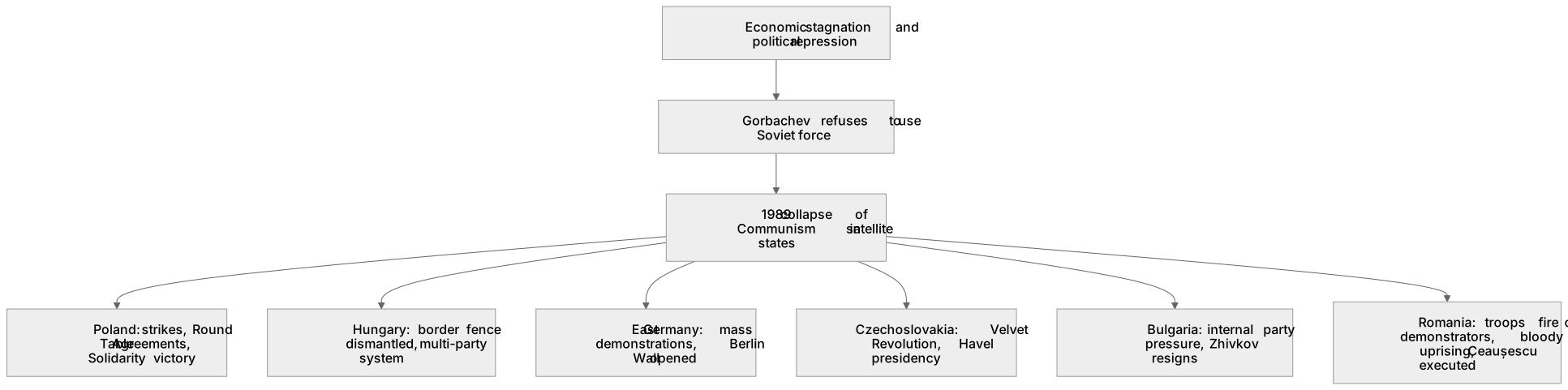
Label the diagram
Some boxes have lost their names. Pick the right name for each number.
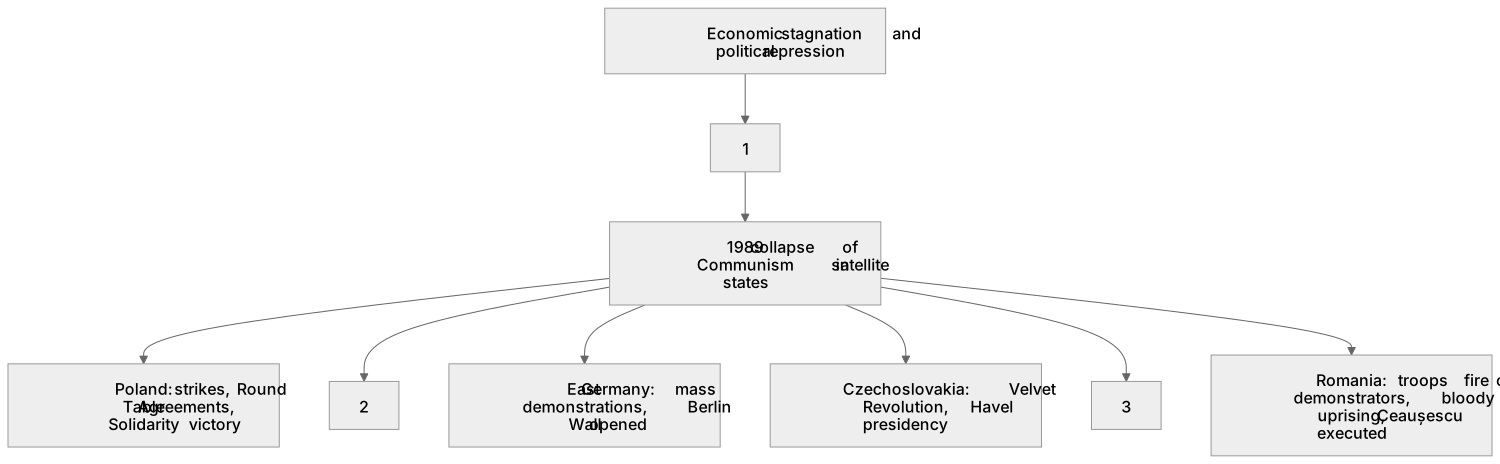
1Box 1
2Box 2
3Box 3
There is more to this lesson
The full lesson goes on to check your understanding and help you earn the marks. Create a free account to carry on, with your progress saved.
A week of Premium from your first lesson · Then the free plan continues · No card, no charge
Test your understanding of 2T The Crisis of Communism: The USSR and the Soviet Empire, 1953–2000 (A-level only) – The Collapse of the Soviet Empire, 1980–2000: The collapse of Communism within the satellite states in 1989: reasons for and results of demonstrations and peaceful revolution in East Germany, Poland, Hungary, Czechoslovakia, Bulgaria and violent change in Romania
Active recall beats re-reading. Take an instant quiz now to test what you’ve learned and lock it into long-term memory.
A week of Premium from your first lesson · Then the free plan continues · No card, no charge