AQA · A-Level · History
Course version: 7042 · Version from Sept 2017
The USSR and the Soviet Empire, 1953–2000 (A-level only) – Years of…
Full specification wording
2T The Crisis of Communism: The USSR and the Soviet Empire, 1953–2000 (A-level only) – Years of Stagnation, 1964–1985: Brezhnev as leader: reasons for Khrushchev's removal from power and Brezhnev's ascendancy; character, views and aims of Brezhnev and his associates in government; the nomenklatura system and corruption
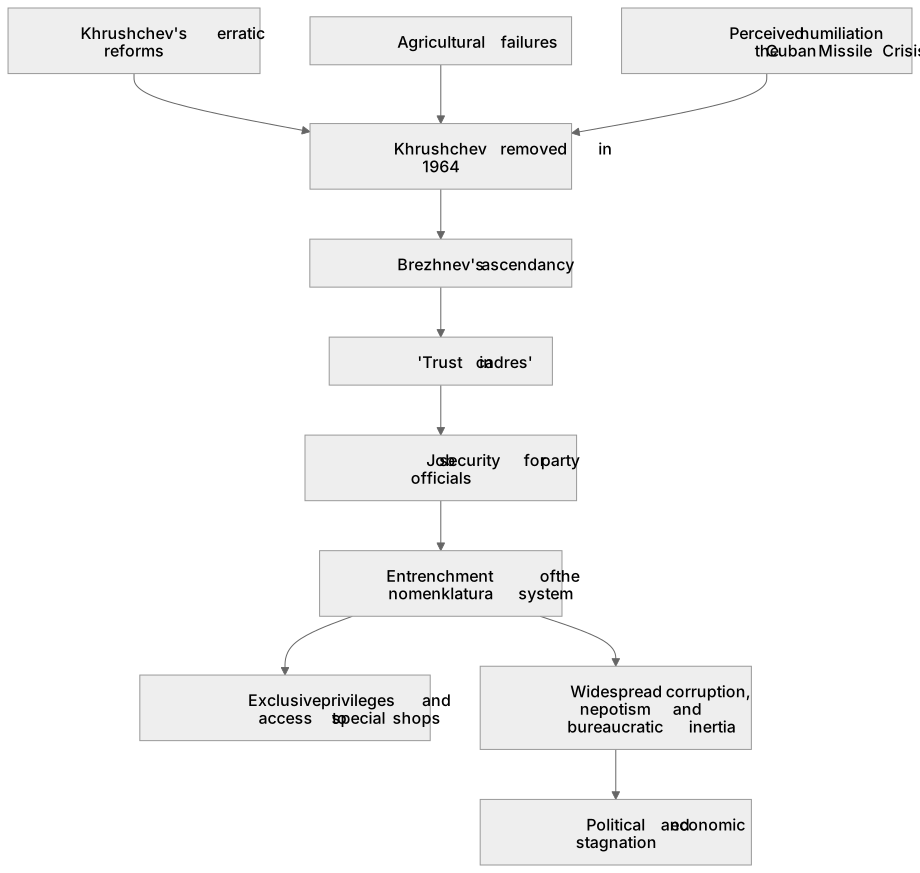
Khrushchev’s erratic reforms, agricultural failures, and the perceived humiliation of the Cuban Missile Crisis led to his removal in 1964.
Checked against the AQA 7042 specification (opens in a new tab) on .
- Point 1 of 4
- 4 key terms
Study notes
From the checked teaching notes for this specification point.
The idea
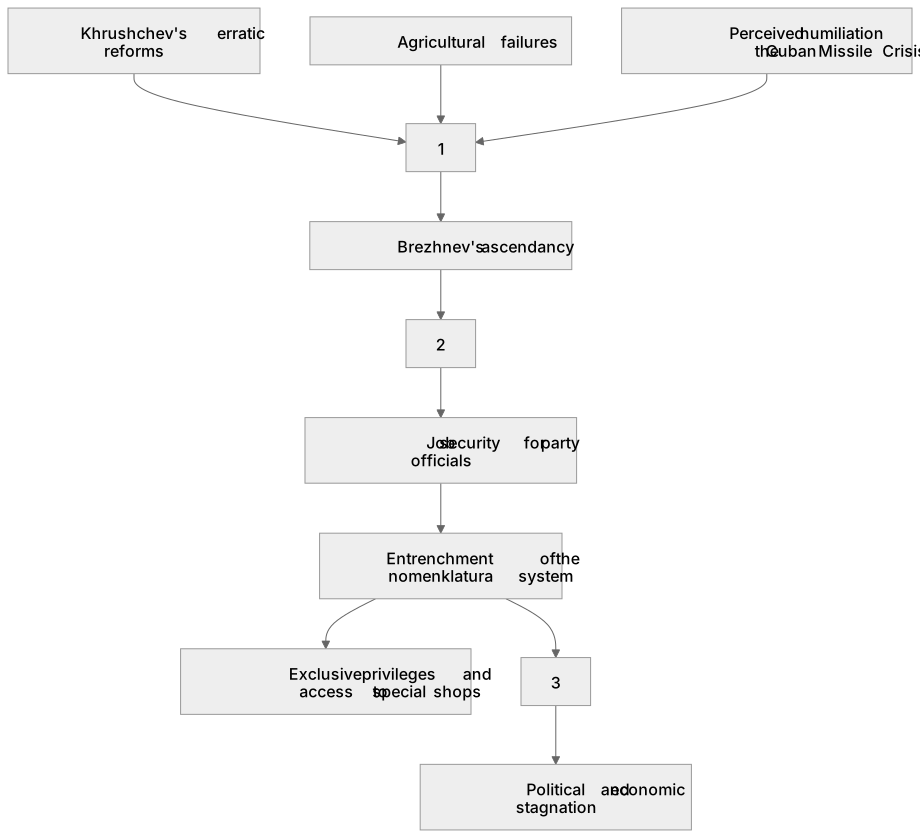
Khrushchev’s erratic reforms, agricultural failures, and the perceived humiliation of the Cuban Missile Crisis led to his removal in 1964. Leonid Brezhnev ascended to power promising 'trust in cadres' and stability. Brezhnev and his conservative associates, such as Kosygin and Podgorny, aimed to reverse Khrushchev's decentralisation and restore central party control. This era became characterised by the entrenchment of the nomenklatura system, where party elites enjoyed exclusive privileges, job security, and access to special shops. Without the threat of purges or rotation, this system fostered widespread corruption, nepotism, and bureaucratic inertia, ultimately leading to the political and economic stagnation of the Soviet Union.
What earns the marks
- Identify the domestic and foreign policy failures that alienated the Presidium and led to Khrushchev's ousting in October 1964.
- Analyse Brezhnev's character and his initial collective leadership with Kosygin, focusing on their shared aim of restoring stability and reversing Khrushchev's reorganisations.
- Evaluate the impact of the 'trust in cadres' policy on the Soviet bureaucracy, noting how it provided job security for party officials.
- Examine the mechanics of the nomenklatura system and how it created an entrenched, privileged elite disconnected from the general population.
- Assess the extent to which the lack of accountability within the nomenklatura fostered systemic corruption and contributed to the 'Era of Stagnation'.
Common mistakes and how to put them right
Claiming Brezhnev ruled as an absolute dictator from 1964.
Put it right: He initially operated within a collective leadership alongside Kosygin and Podgorny before gradually consolidating power.
Confusing the nomenklatura with the general Communist Party membership.
Put it right: The nomenklatura were a specific elite group of appointed officials holding key administrative positions.
Assuming Khrushchev's removal was a violent coup.
Put it right: It was a bloodless, orchestrated vote by the Central Committee, demonstrating a shift away from Stalinist methods of succession.
Exam tips
- Use the phrase 'trust in cadres' to explain how Brezhnev secured the loyalty of the party apparatus by guaranteeing their positions and privileges.
- Connect the systemic corruption of the Brezhnev era directly to the lack of political turnover and the rigid nature of the nomenklatura system.
- Contrast Brezhnev's conservative, consensus-driven leadership style with Khrushchev's erratic and disruptive approach to governance.
Try the lesson
The start of the 2T The Crisis of Communism: The USSR and the Soviet Empire, 1953–2000 (A-level only) – Years of Stagnation, 1964–1985: Brezhnev as leader: reasons for Khrushchev's removal from power and Brezhnev's ascendancy; character, views and aims of Brezhnev and his associates in government; the nomenklatura system and corruption lesson, made from checked teaching notes for this specification point.
Have a go first
Which of the following was a significant domestic factor contributing to Nikita Khrushchev's removal from power in October 1964?
Listen
Khrushchev’s erratic reforms, agricultural failures, and the perceived humiliation of the Cuban Missile Crisis led to his removal in 1964. Leonid Brezhnev ascended to power promising 'trust in cadres' and stability. Brezhnev and his conservative associates, such as Kosygin and Podgorny, aimed to reverse Khrushchev's decentralisation and restore central party control. This era became characterised by the entrenchment of the nomenklatura system, where party elites enjoyed exclusive privileges, job security, and access to special shops. Without the threat of purges or rotation, this system fostered widespread corruption, nepotism, and bureaucratic inertia, ultimately leading to the political and economic stagnation of the Soviet Union. A strong answer earns marks for these points. Identify the domestic and foreign policy failures that alienated the Presidium and led to Khrushchev's ousting in October 1964. Analyse Brezhnev's character and his initial collective leadership with Kosygin, focusing on their shared aim of restoring stability and reversing Khrushchev's reorganisations. Evaluate the impact of the 'trust in cadres' policy on the Soviet bureaucracy, noting how it provided job security for party officials. Examine the mechanics of the nomenklatura system and how it created an entrenched, privileged elite disconnected from the general population. Exam tip: Use the phrase 'trust in cadres' to explain how Brezhnev secured the loyalty of the party apparatus by guaranteeing their positions and privileges.
See it
Key words
Say what each word means before you turn the card.
Political stagnation
Try answering aloud or in your head before turning the card.
Bureaucratic conservatism
Try answering aloud or in your head before turning the card.
Elite privilege
Try answering aloud or in your head before turning the card.
Leadership transition
Try answering aloud or in your head before turning the card.
See every definition
- Political stagnation
- A condition in which the Soviet Union experienced political and economic stagnation, fostered by widespread corruption, nepotism and bureaucratic inertia.
- Bureaucratic conservatism
- The outlook of Brezhnev and his conservative associates, who aimed to reverse Khrushchev's decentralisation and restore central party control.
- Elite privilege
- The exclusive privileges, job security and access to special shops enjoyed by party elites under the entrenched nomenklatura system.
- Leadership transition
- Khrushchev's removal in 1964, after which Leonid Brezhnev ascended to power promising 'trust in cadres' and stability.
Label the diagram
Some boxes have lost their names. Pick the right name for each number.
1Box 1
2Box 2
3Box 3
There is more to this lesson
The full lesson goes on to check your understanding and help you earn the marks. Create a free account to carry on, with your progress saved.
A week of Premium from your first lesson · Then the free plan continues · No card, no charge
Test your understanding of 2T The Crisis of Communism: The USSR and the Soviet Empire, 1953–2000 (A-level only) – Years of Stagnation, 1964–1985: Brezhnev as leader: reasons for Khrushchev's removal from power and Brezhnev's ascendancy; character, views and aims of Brezhnev and his associates in government; the nomenklatura system and corruption
Active recall beats re-reading. Take an instant quiz now to test what you’ve learned and lock it into long-term memory.
A week of Premium from your first lesson · Then the free plan continues · No card, no charge